Portage County Historical Society
Railroading in Stevens Point
The Many Faces of Stevens Point. From Wisconsin Central to Soo Line and back again
By Andrew Roth
PART I, Section 2: Competition
Improvements to the WC facilities were not the only railroad activities around Stevens Point in 1881 and 1882. The Green Bay, Stevens Point & Northern began construction of a branch line from the main line at Plover, Wis., to Stevens Point in 1881, and the first freight cars on the GBSP&N were hauled out of Point in December of that year. The railroad built a nice depot at the foot of Main Street for $2,000 and remodeled a nearby building into a freight warehouse for $500. The first passenger train on the GBSP&N arrived in Point in late January 1882.
The actions of this Green Bay & Western predecessor caused a reaction by the WC officials, thus it came as no surprise when, in 1882, the WC decided to replace its worn-out depot at Stevens Point; local newspapers had been calling for its replacement for at least a year. WC acted quickly to its new competitive challenge, and the new, two-story, Queen Anne-style depot opened in August 1882 at a cost $5,000. The 24 x 85-foot building featured a baggage room, ticket office, men’s waiting room, women’s waiting room, and a store room (for conductor’s boxes, lamps, and other items) on the first floor. The second floor contained the railroad’s division headquarters and dispatcher’s offices, and an attic was used to store company records.
AT THE SHOPS
The activities at the Shops interacted with almost every major activity in WC’s early years. To meet WC’s need of additional equipment to handle the growing volume of freight, Point Shops built over 170 freight cars, three cabooses, and one baggage-mail-express car (car No. 6) between 1876 and 1887 including 73 flatcars, 34 boxcars, 25 stockcars, one charcoal car, and some work equipment. Shops even built ten freight cars and four cabooses and rebuilt ten freight cars for other railroads.
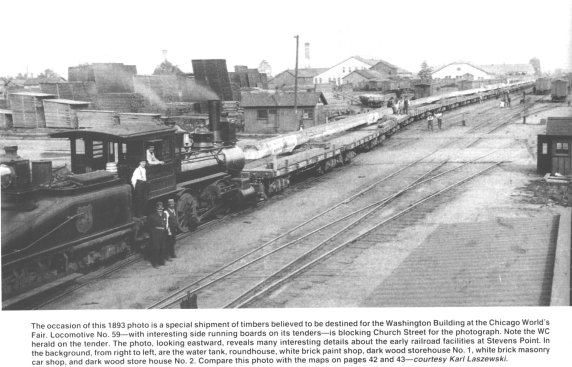
The need to build new equipment declined after the railroad’s early years, mainly because WC management decided to upgrade equipment it already owned as of 1881. At that time, most of the freight cars had a capacity of 12 tons, so from 1881 through 1885, Shops upgraded 660 cars to 20-ton capacity.
The Shops also handled a lot of locomotive work. Between 1876 and 1885 more than 94 locomotive overhauls, 24 major rebuildings, and many other tasks such as tire changes and conversions from wood-burning to coal-burning were accomplished at Point.
The first Westinghouse air brake equipment was installed on WC equipment at Point in late 1878. The first test train with air brakes - consisting of engine 18, a baggage car, and two coaches - operated successfully between Point and Custer in mid-November of that year. Initially, the WC bought enough air brake equipment to upgrade six locomotives and 26 passenger and head-end cars.
The paint shop began painting passenger cars into a new paint scheme in October 1878. The Journal reported, "The railroad turned out three very handsome cars from the paint shops in this town. The color of the cars is changing from a dark to a light yellow." However, the repainting project had some delays of over a year. On Jan. 10, 1880, the newspaper reported, "The coaches are now painted a bright yellow which looks much handsomer than the old brown color. By the 20th, the WC will have a train out with all the same color."
The Shops also handled small and unique projects for the WC. When the railroad needed a pile driver in 1879, one was built at Point. A work train was needed for the 1880 construction season, and therefore the machine shop was asked to build it. Shops built a 60-foot 36-passenger sleeper, a 60-foot 60-seat dining car, and a cook car and a supply car, both 34 feet long. Shops also built many M.O.W. (maintenance-of-way) cars. In 1882, employees built 74 switch frogs. After experiencing some horrible snow storms, the railroad in 1885 built four steel snow plows and 17 locomotive pilot plows at Point.
LOCAL BUSINESS
An 1880 article indicates that Stevens Point was a very important station on the railroad. Passenger tickets sold out of the Point depot averaged $2,600 and freight revenue varied between $4,000 and $5,000 each month. The amount of freight volume each month was 12.5 million pounds forwarded and 2.25 million pounds received, and about 2,500 cars a month were weighed at the yard scale house. Lumber shipments out of town varied from 300-500 cars a month. There were four major and five smaller sawmills in Point in the 1880s, and the combined annual output from just the four major companies was more than 47 million board feet of lumber, 27.5 million shingles, and five million laths. Not included in these numbers was output from other industries including two planing mills, two door, window frame, and sash companies and two grist mills for rye and flour.
In March 1880 it was reported that the WC was operating "four freight trains hauling lumber, logs, etc. between Point and Menasha. The railroad also operates two freight trains north from Point." In the same newspaper, WC also advertised one passenger train and one mixed train operating each way on the main line through Point as well as a daily passenger train and a mixed train running round trip between Point and Portage.
All of this activity kept Shops quite busy. Employment at the Shops, which had risen to about 200 in 1880, continued to climb to 450 workers in 1887. However, these numbers were about to change.
FACILITY CHANGES AT POINT
It was in 1886 that the people of Stevens Point realized that the written agreement with the WC lacked the clause that would permanently keep the Shops in town. The WC had completed its track to Chicago as well as into the Gogebic Iron Range that year, and WC officials realized infrastructure improvements were necessary to handle the new traffic and operations.
Talk surfaced in early 1886 about the removal of the Shops from Stevens Point and how other towns along the line were offering valuable sites and large sums of money to the WC to secure the additional shop facilities necessitated by the expansion of the railroad. Representatives of Stevens Point’s Business Men’s Association went to Milwaukee to meet with WC General Manager Mr. Finney in regard to securing the additional Shops facilities for Point in late March 1886. It was at this meeting that Stevens Point was informed that the new machine shops would most likely be built at a more southern location so as to save the railroad the considerable expense in freighting heavy material to Point, most of which came in from or through Chicago. However, Mr. Finney also informed the businessmen that the total number of WC employees in Point would increase due to the conversion of the Point Shops to rolling-stock repair and construction, locating the new Dining Service headquarters there, and the possibility of building stockyards at either Point or Neenah.
HERDING CATTLE
The Stevens Point Business Men’s Association quickly set about securing ten acres of land east of Minnesota Avenue on the north side of the tracks to entice the WC to locate the stockyards in town (imagine this happening now). The Association bought the land in late April 1886 and transferred it to the WC with the stipulation that it be used for stockyards. Construction began at once, with the WC building 12 holding pens, three hay barns, three shelter sheds, ten unloading, and eleven loading chutes at a cost of about $10,000. The stock pens could hold about 100 carloads of cattle. The water tank next to the roundhouse was replaced with a new larger tank, and the new tank was sized to supply water for locomotives and to the stock pens via piping.
WC entered into a contract that year with the Northern Pacific to move livestock from NP stations to Chicago, and the first stock train of 18 cars carrying 312 head of Montana cattle arrived on Monday, July 31. "The arrival and unloading of the stock were something entirely new to the people of this city, and proved more attractive than an incoming circus. A large crowd assembled to see them unloaded. The cattle were unloaded about 8 p.m., watered and fed. Around 4 am., the livestock were loaded and the train pulled out for Chicago," reported the Journal. A trainload of sheep arrived in town the next day on its way to Chicago. The newspaper also reported in August that, "The Central is doing a rushing business. Several stock passed through the city the first of this week from Montana en route to Chicago. A special stock train left here Tuesday at 5:30 p.m. and arrived in Chicago Wednesday at 6:40 a.m."
The WC added 300 stock cars to its fleet between March and September of 1886 for this new traffic. The most common shipments were cattle, sheep and horses.
WC’S CULINARY DEPARTMENT
WC established the headquarters for its dining-car service at Stevens Point in 1886 with the opening of the line to Chicago. Dining cars in both directions on the St. Paul - Chicago trains stopped at Point to replenish supplies.
WC built a 20 x 70-foot, two-story commissary building in the yard west of the supply building, and the commissary began operations on Aug. 1, 1886. The first story was divided into a kitchen, office, preparation room, wine room, and storage room. On the north side of the building was a 16 x 20-foot addition with two refrigerators, one for meat and another for produce. Over each department was a large space for storing ice, which held 22 1/2 cords. A bakery and a range were located at the west end of the building. The second story was divided into six sleeping rooms and an accommodation room for commissary employees. The building had a basement with a concrete floor for storing vegetables and other items.
A Journal reporter commented, "A carload of dishes arrived on July 24th and its contents were unloaded and stocked. All of the dishes and glassware were marked ‘Wisconsin Central Lines,’ and the fine tableware might make any lady [and many current SLHTS members] jealous." The dining cars were run alongside the building on a side track and the edibles along with other supplies were transferred from the building directly onto the car.
WC officials soon realized that the building should have been built next to the main line, and WC relocated the building to the west side of the depot in late September 1886. The refrigerator room was removed from the side of the building due to clearances when the structure was moved, and the building was slightly remodeled to include a lunch counter. The lunch counter was in operation by late November and was well patronized.
RAILROAD SUPPLIES
The 1886 extensions of the railroad to Chicago and into the Gogebic Range along with the aging of the car fleet, increased the demand for supplies. All supplies, such as castings, wheels, axles, and lamps were shipped to Stevens Point and distributed from there. An addition on the north side to the 1881 built supply house was completed in 1886, exclusively for brass and iron castings. Six men were employed at that time in receiving and shipping supplies. The WC expanded the company supply store again in 1887 with a 35 x 110-foot addition which also contained an office for the superintendent of the Bridges & Buildings Department, also based at Point.
On to section 3 or back to Part 1 Section 1