Groups wishing to visit the RSM can contact: Jim Walker at 715-213-7578 or by email: jimtrojan@aol.com.
September 12, 2021 Sunday, "Celebrate Nelsonville" a public fundraising event of the Nelsonville Lutheran Church.
Includes a Pig roast, brunch and local entertainment.
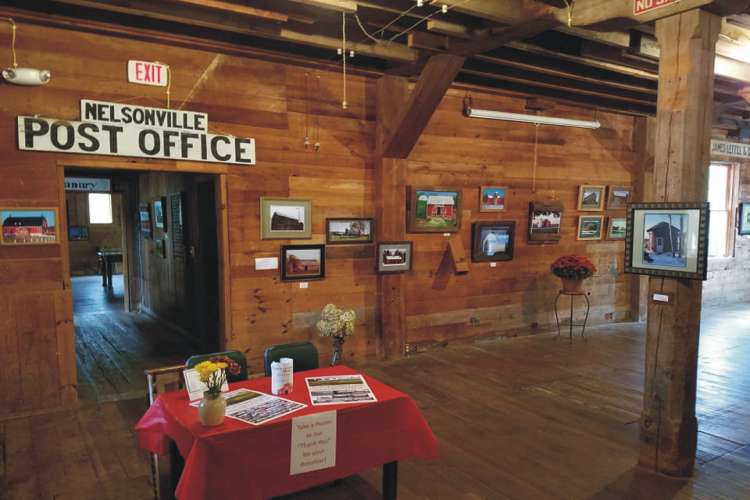
September 18 - 19, 2021 Saturday and Sunday, "Inside the Rising Star Mill - Through the Lens".
A public art sale. Open 11:00 am to 5:00 pm, both days, September 18 - 19, 2021 Saturday and Sunday.
Oct 1-2 and 3, 2021, Friday, Saturday and Sunday, The Annual Rising Star Mill Open House and Barns of Portage County
Exhibit. 11:00 am to 4:00 pm.
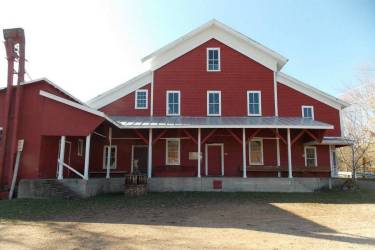
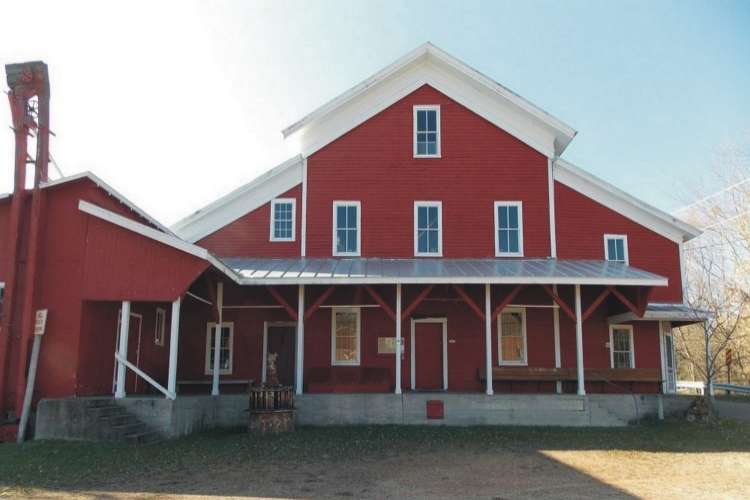
August 18, 2017 the Rising Star Mill was listed on the Wisconsin State Registry of Historic Places
On September 10, 1855,
Jerome Nelson purchased land and water rights from Anna and Charles
Stoltenberg on which to "construct and maintain a mill dam." Nelson, for whom
Nelsonville is named, built the dam and sawmill in 1855. The Mill was built in
1868 upon his return from serving in the Civil War. The Mill was operated as a
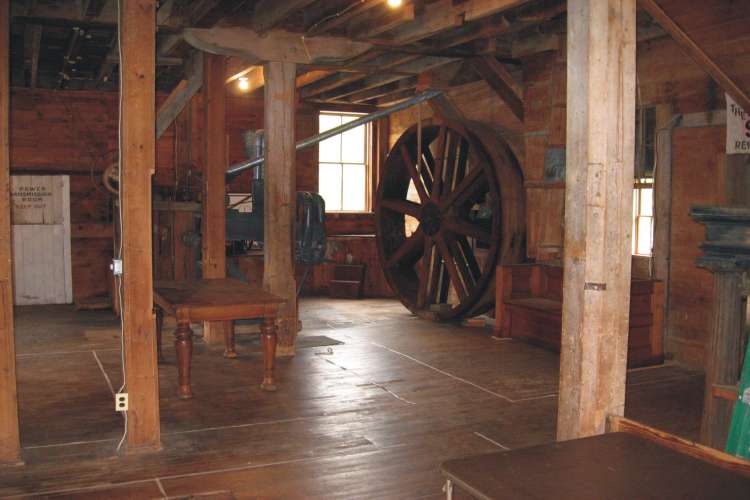
business until 1984. Of particular interest is the Woodward Governor turbine,
which was ordered in 1917 for the Jackson Milling Company.
An advertisement in the
Pinery of 1870 refers to the “Rising Star Flouring Mill, Jerome Nelson,
proprietor.., all work done. ..warranted to give satisfaction.” The
advertisement also indicated that he was prepared to do custom grinding or
‘exchange with farmer.” Most common was the barter agreement, whereby a farmer
with wheat or rye gave a percentage of grain to be ground to the miller in
exchange for grinding the balance. Nelson produced various kinds of flour (rye,
whole wheat, cracked wheat and white) under the brand names of Gold Coin, Legal
Tender, and Climax.
In 1883 Jerome went to Milwaukee to purchase metal rollers to replace the
original millstones. It was during this time period that Nelson purchased
another flour mill, four miles down the Tomorrow River. This mill was named the
Eclipse Mill and was run by John Loberg, Jerome and Marilla’s only son-in-law.
It was abandoned in 1942 and razed in 1954.
In 1886 the May Stevens Point Journal reported that “Jerome was overhauling
the Mill, putting in new centrifugal reels, dust collectors, aspirators and
other machines of the most approved design.” In 1893 Nelson arranged to have the
dam on the pond raised another three feet, i.e., to nine feet, which suggests
that he needed more power either for the saw mill or flour mill or both. It was
during these years that the north and south wing additions were built. After
Jerome s death in 1897, his son-in-law, John Loberg, leased the Rising Star Mill
to Matthias Wick of Stevens Point, and then in 1898, B.E. Dwinell of Amherst
leased the building.
Two years later Dwinell and Loberg changed mills. The March 14, 1890, the
Portage County Gazette reported that Dwinell had decided to buy the lower mill,
41 acres of land, and two houses for $8,000. Loberg then ran the Rising Star
Mill until the spring of 1916, when he sold the business to the Jackson Milling
Company of Stevens Point for $6,000.
Jackson improved the machinery and confined its operation to grinding
only feed, not flour. Amherst Electric Company took over the mill in 1924,
and a generating plant was started to provide electricity to the village.
Many homes were soon wired and had their first lights. The power was not
always consistent. When lights would flicker, a common saying was “a carp
must be going over the dam.”
Wisconsin Power and Light took over the mill in 1929. In 1936 they closed
down the Nelsonville Mill because it was unable to produce enough electricity
and was too costly. A federal tax was being levied and small power plants were
unable to function profitably.
The Mill was sold to Ben Cycosh, who operated the mill for only 6 months
until 1946 when John Koziczkowski purchased it.
The Department of Natural Resources purchased the land and the mill in 1984
in order to gain control of the dam. The building was sold to the Portage County
Historical Society in January of 1985. The Dept. of Natural Resources removed
the spillway in 1988 to restore almost a mile of the Tomorrow River to a Class A
trout stream.
The Mill hosts an annual art show & sale as well as several concerts and an
open house each year. All profits generated are applied to the restoration and maintenance of the
Rising Star Mill. The Mill is also available to rent for meetings and other
activities.