Portage County Historical Society
Railroading in Stevens Point
The Many Faces of Stevens Point. From Wisconsin Central to Soo Line and back again
By Andrew Roth
PART I, Section 3: CAR SHOP ACTIVITIES
The WC began constructing new shop facilities and a new yard in Waukesha, Wis., in 1886. Large shop facilities, a twelve-stall roundhouse, and five miles of switching and storage tracks were built on the site. As stated by Mr. Finney, WC did not close the shops at Point and instead converted the main machine shop building into a car shop. A new replacement transfer table was installed in April 1886 for the main shop building, and a new turntable was installed in December 1886 50 that the roundhouse could handle the road’s new, heavier locomotives.
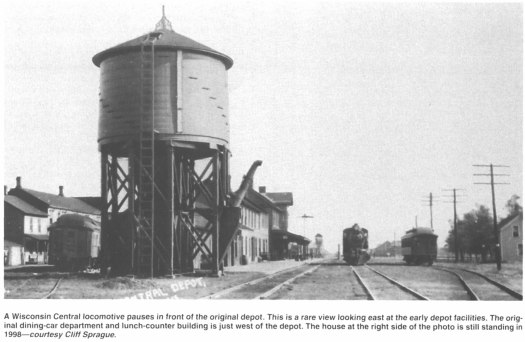
The demand on the WC for locomotives, rolling stock, and other equipment to be built for the Chicago and Gogebic extensions was very great. All new locomotives were sent to Point to be inspected, checked, and tested before entering service. In September 1886, the woodworking department at Point was busy making water tanks, three new turntables, new locomotive cabs, pilots, snowplows, and various other items for the extensions. The car department converted coaches 22 and 23 into combination baggage-smokers that same month. Shop workers also made a lot of coal buckets and cranes for the new lines. Point Shops had to handle all of the increased workload until Waukesha Shops opened. Two additional side tracks were built west of the Point shop building for car repairs in 1886. After hiring more workers in November 1886, the Mechanical Department had 352 workers consisting of 85 machinists, 30 boiler makers, 58 blacksmiths, 42 carpenters, 25 painters, 62 car smiths, and 50 general laborers. The Shops ran day and night with an extra large force of men, and the building’s engine stopped only one hour in 24 hours. The WC met its increased demand for coal cars by adding sides to 50 flat cars in December 1886. As soon as these cars were built and other work was out of the way, Point Shops built 30 Tiffany refrigerator cars.
The workload did not let up that winter. On Jan. 8, 1887, the Journal reported, "The Central Company needs double the room to do the work they are now doing. It is safe to say that at least 100 men were working out of doors on box cars, flats, and all kinds of repairing. With the mercury below zero through the entire day, it is impossible to work to advantage."
CAR REPAIR WORK, 1887-1900
Some of the machinists and others moved to Waukesha when the Shops opened in that city in mid-September 1887, and WC employment at Point Shops dropped to 160. Waukesha Shops employed some 150 people including those who had relocated from Point. Local employment at Point partially rebounded when WC expanded car repair work.
WC began modifying Point’s main shop building within two weeks of the opening of Waukesha Shops. In 1887, WC bought land to accommodate three new tracks built westward from the stockyards, through the yard north of the round house, and through the main shop. The main shop was modified to accommodate the three run-through tracks in place of what had been stub tracks; as remodeled, the building could hold 12 passenger cars under repair. The transfer table was no longer needed after these modifications were made and was removed.
Since the Point facilities were still being used to rebuild and build new rolling stock, Mr. A. Redfield, general foreman of the WC shops, proclaimed in September 1887, "We have 120 men at work in the shops and outside in the yard performing carpenter work, and still we are unable to keep up with demand. We are rebuilding on average one car per day." Shop workers were also building six new cabooses at the same time. On Oct. 1, 1887, the Stevens Point Journal claimed that the WC shops was the busiest place in town.
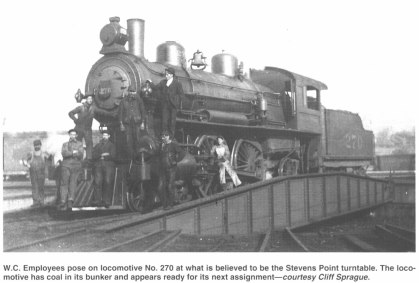
The remodeled car shop and paint shop at Point continued to play a major role for the WC. Over the next six years, the WC began a new car-building program at Point in addition to repairs and rebuild work. More than 385 new cars were constructed, including boxcars, flatcars, gondolas, refrigerator cars, passenger cars, and cabooses. Shop workers also performed passenger-car conversions such as rebuilding second-class coaches to combines (baggage-coach). Freight-car conversions consisted mainly of modifying flatcars to other uses.
The paint shop was involved in another passenger paint scheme change in 1889. The Journal reported on February 23, "All of the passenger coaches that come out of the shop now are painted a wine color, which gives a more tasty appearance than does the yellow ones so long used on the Central." Thus the Stevens Point paint shop was involved with all three WC passenger paint schemes.
In the early 1890s, railroads only had a portion of their rolling stock equipped with air brakes, and air-brake-equipped cars could be found mixed with non-air-brake equipment on trains. To enhance the safety concerns wrought by this temporary situation, WC shop employees installed an alarm gong system in all cabooses in late 1891. The Journal reported on Nov. 29, 1891, "In making up freight trains, cars supplied with air brakes are placed in front. If these cars break in two, the air brakes will stop them. Not so with the cars behind, not supplied with air brakes. A long bell cord is run from the last air brake car to the caboose. The alarm gong in the caboose is rung as the bell cord is pulled if cars without air brake cars break in two. The ringing gong alerts the conductor and rear brakeman to rush out and set hand brakes before any damage is done. The new invention has already prevented several accidents."
The sound of the caboose alarm gong must have sent a chill down the men’s spine, for it meant climbing up and over freight cars rushing toward a derailment or other mishap. It was not a job for the squeamish; it was a requirement if the men wanted to live! The centuries old phrase, ". . . never send to know for whom the bell tolls, it tolls for thee," truly applied to these men.
Point car shops were extremely busy in late 1892 and early 1893. In addition to R.I.P. track repairs totaling 100 - 150 cars each week, in late 1892 and early 1893 more than 265 cars - including 50 passenger cars for the Chicago World’s Fair - were built in a short time period. The Fair cars, built early in 1893, were"., much like those used on streetcar lines in the summer, open on both sides," and they were delivered at Chicago just days before the World’s Fair opened on May 1, 1893. The paint shop was also busy painting new and old passenger cars so that they would be in top shape for World’s Fair traffic. WC’s new roundhouse at Chicago was initially used as an additional paint shop to get all of the passenger rolling stock painted.
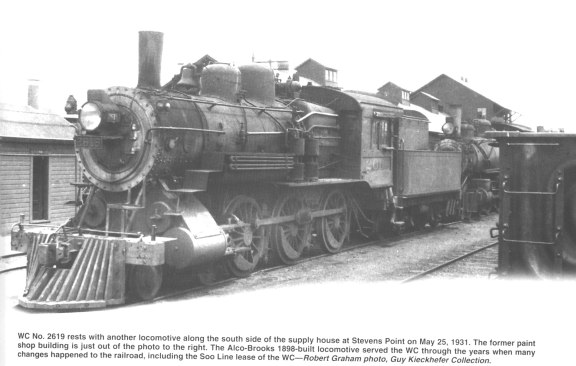
The country’s economic downturn that began in late 1893 continued for a number of years, and WC business diminished accordingly along with that of many other railroads. The WC tried to reduce the impact to its employees as much as possible. At Stevens Point Shops, the employees’ work days were reduced from ten-hour days to eight hours in an effort to keep as many employees as possible working.
THE LEAN EMPLOYEE YEARS
The WC was reorganized in July 1899, and once out of bankruptcy, money was allocated for major improvements. A massive mainline grade and curve reduction project between Stevens Point and Neenah was implemented, and in 1900 WC President Whitcomb instituted longer divisions as a part of the major changes being made on the railroad. Waukesha and Stevens Point would no longer be division points; in their place were Fond du Lac, Abbotsford, and St. Paul. Abbotsford replaced the Stevens Point division-office duties in mid-September 1900. After employees transferred to their new terminals, the WC further reduced Stevens Point employment in December 1900 when three freight department employees and an entire switch crew were let go. After this employee reduction, only one day crew - switching local customers - and one night switch crew remained at Point. Any road train crews, such as the Plover branch freight crew, had to make up their own trains.
The only bright spot for train crews was the start of a paper mill passenger train in early December 1900 to bring Stevens Point people to the paper mills near Whiting. The train left Point at 6:30 a.m. on a round trip to take workers to the mills and return with workers going off duty. The train made a round trip to the Whiting mills again at 6 p.m. This "commuter train" was probably one of the shortest passenger runs on the WC!
Waukesha Shops met a fate similar to that of Point Shops when the WC built yet newer and larger facilities in North Fond du Lac, Wis. In fact, car-shop work at Stevens Point was at this time relocated to North Fond du Lac. The WC operated two special trains on Sept. 29, 1900, to bring Waukesha and Stevens Point shop employees to North Fond du Lac to inspect the construction of the new facilities and give people an opportunity to look for new housing. A total of 415 Stevens Point and 339 Waukesha employees and family members took advantage of the free train rides.
The North Fond du Lac Shops were opened in mid-August 1901. The Journal reported on July 31 of that year, "Only ten WC employees stated that they would relocate to the new shops when surveyed by WC officials. The men employed upon the car tracks, as well as the majority of those in the shops, cannot afford to remove from this city, where most of them own comfortable homes, and go elsewhere and pay rents such as they will be obliged to do. The work force has been materially decreased here within the past few weeks. Many employees have resigned to find employment in other factories, while several have gone to the wheat fields of Minnesota and the Dakotas."
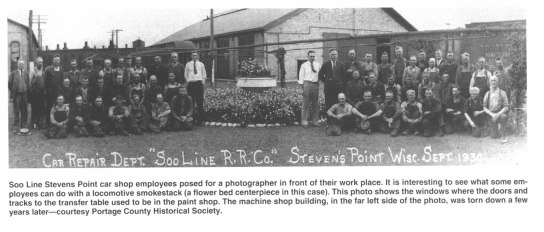
Stevens Point had a healthy economy at the time. Many businesses were doing well, including a furniture company and a paper mill which were doubling their capacities. Yet, the City of Stevens Point was quite upset with the closing of the car shops and took legal action to attempt to reclaim the land it had given the railroad for the shop facilities; however the City dropped its legal action when it realized that it could not win. Nonetheless, it took some time for ill feelings to subside.
The railroad shop facilities at Stevens Point played an important role in the first 30 years of the WC. From late 1871 through September 1887 Point was the only place on the railroad to repair and rebuild locomotives, and from 1871 through August 1901 the car shop was also the main facility for repairing, rebuilding, painting and building new rolling stock. The car shop built over 560 freight and passenger cars and work equipment, and the number of cars rebuilt and repaired at the early facilities are far to high to count. The railroad’s policy of building its own equipment - a policy dating from 1876 - continued for just over a century, ending in November 1976 with the completion of 100 refrigerator cars at the North Fond du Lac shops.
Back to Part 1 Section 2 or Back to Portage County RR History.