Portage County Historical Society
Railroading in Stevens Point
The Many Faces of Stevens Point. From Wisconsin Central to Soo Line and back again
By Andrew Roth
PART I: THE WISCONSIN CENTRAL COMES TO TOWN
The City of Stevens Point was associated with the original Wisconsin Central from the start of that railroad’s existence. In fact, Stevens Point contributed toward the construction of the railroad. One of the original WC directors and a Stevens Point resident, Matthew Wadleigh, was a main driving force in the city and for the railroad.
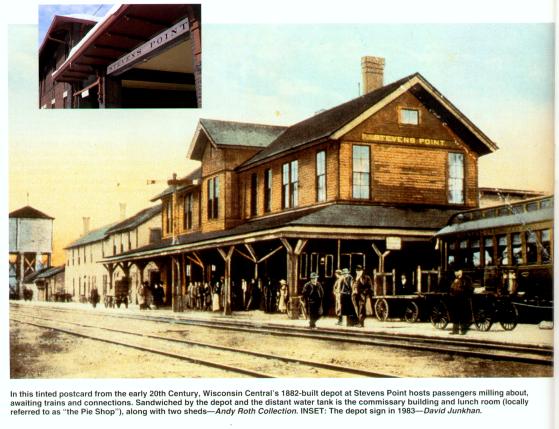
With a population of 1,800, Stevens Point was already a developed city when talk began of building a railroad in the area around the late 1860s. The creation of Stevens Point and its economic livelihood was, and still is, connected to the lumber industry. The City subscribed $30,000 to help finance the railroad’s construction starting about 1870 and also bought and donated land in town to the railroad. When city leaders drafted the contract to contribute funds and donate land to the railroad, they included a clause that specified that the railroad’s shop complex would forever remain in Stevens Point. However, some of the railroad financiers deleted this condition without the City realizing it when the final contract was executed. The City did not discover this contract change until 1886.
Construction of the railroad facilities at Stevens Point began in 1871; construction of the original ten-stall roundhouse began in the fall of that year and was completed in May 1872. Six of its stalls still serve the railroad today, which translates to 126 years of continuous service-and counting! As built, the roundhouse had an iron truss roof with slate shingles, iron service doors, stone walls and a pit and stack hood for each 67-foot-long engine stall. A 60-foot-long turntable was built to serve the roundhouse.
The first train rolled into Stevens Point on Nov. 15, 1871. "The whole city was out in great numbers to welcome the first locomotive ever seen here," wrote Caleb Swayze, the editor of a local newspaper. The residents of Stevens Point had good reason to celebrate. The railroad’s rates were half of what the drayage companies had been charging. Further, passenger trains cut the travel time between Stevens Point and Menasha from an 18-hour stagecoach ride to only four hours.
Construction of the railroad west of Stevens Point began on March 18, 1872, and the railroad was completed to Ashland on June 2, 1877. During the same five-year period, the railroad also expanded southward. Construction began in town for a line to Portage, in central Wisconsin, on Oct. 15, 1875, and was completed by October 1876. With the completion of these projects, Stevens Point became an important junction point on the WC. Initially, one passenger train and one freight train operated each way on the main line through "Point." Two mixed trains ran each way on the Portage line, connecting with mainline trains at Point. From 1872 until 1887, Stevens Point had the only shops and one of the few yards on the entire railroad.
THE FIRST "SHOPS"
The main locomotive machine and car shop building at Stevens Point was completed in 1876. Work had begun in 1873 but the building’s construction was halted later that same year account of a financial downturn that was affecting businesses throughout the country. During the slack, WC set up a temporary machine and blacksmith shop in a wood building just north of the unfinished masonry shop building. The local newspaper reported on Oct. 20, 1873, that the WC employed 20 mechanics at the shops.
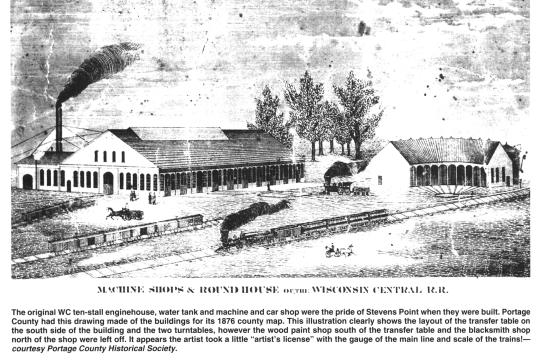
In June 1875, the railroad awarded the first of many construction contracts to complete the machine shop building, eliminating local fears that the railroad’s shops would be built elsewhere. "The Shops comprise three separate buildings: the main building, which is the machine and car shops; the roundhouse; and the paint shop," as described by WC Master Mechanic Mr. Campbell. This was the first mention of the paint shop building in town, and it was to be a 200 x 25-foot wood-frame building with an office in the rear.
The machine shop was an impressive structure measuring 198 x 122 feet and featuring three-inch thick wood flooring. The south half of the shop had ten stalls aligned north and south which extended 60 feet into the building for car or locomotive work. These stalls were reached by a 54-foot long transfer table which ran along the south wall of the building. The transfer table connected the stalls to a turntable that could direct the cars or locomotives to either the roundhouse turntable or the yard tracks. There was also one east-west track which ran through the building near its center.
The north half of the building housed lathes, planers, and other milling apparatus. The building featured a skylight along the slate roof peak to provide natural interior light. An engine and boiler room was attached to the northwest corner, and an impressive, tall smoke stack reached for the sky from the boiler room. The boiler was of steam-locomotive design and could keep the entire building heated to 60 degrees when the outside temperature was 30 degrees below zero. A spur track off of a shop lead track allowed the railroad to deliver coal to the boiler room. A 60-horsepower stationary steam engine furnished power for the long shaft line which powered various machines through belt arrangements.
The building had a partial second floor along the east and west sides. The east side contained the offices of the master mechanic and his clerk and afforded a fine view over the interior of the whole shop. The west side contained the pattern room for making and storing patterns used to manufacture engine and car parts.
As the story goes, the three-foot-high, 15-inch diameter whistle on the shop roof was the pride of the railroad and could be heard on a clear day in Waupaca 25 miles away. Signaling shift changes, the thunderous blasts from the whistle became the despair of neighbors, interrupting the peace and composure of the residents. It rattled windows and even shook plates off of cupboard shelves. Thus, Stevens Point became one of the first Wisconsin communities to field complaints about railroad whistles.
The first two freight cars built in the new machine shop were boxcars. These cars were long enough to carry two 16-foot boards, side-by-side. The demand for additional freight cars was great, and car construction began in mid-March 1876 while the building’s last equipment was being installed.
WC FIRES
Fire played a significant role over the years in WC railroad buildings in Stevens Point. In early March 1876, lightning struck a messenger line which carried the bolt into the WC freight depot. At the time, building personnel were off duty, and it burned to the ground despite the townspeople’s best firefighting efforts. Temporary telegraph and freight offices were set up in passenger cars.
A few days later, lightning struck the passenger cars-turned-offices. "The WC employees must think the elements are against them," proclaimed the Stevens Point Journal on March 18, 1876. Fortunately, an operator was on duty and the small fire was extinguished in a short time. On June 27, 1876, a fire started in the temporary, wooden machine and blacksmith shop building just north of the new machine shop. A lack of water in that portion of the city hampered firefighting, so a steam locomotive had to be moved near the fire to supply the town’s only fire engine with water. Firefighters - who included all WC employees and many townspeople - were successful in stopping the fire from destroying the new machine shop, which escaped with only $200 in damages. Alas, the wood blacksmith shop was a complete loss. The WC built a 40 x 60-foot masonry blacksmith shop later that year to replace the burned building and, at the same time, took a preventive step by also building a 20 x 30 masonry oil house.
A fire alarm was sounded on two separate occasions for fires in the wood paint-shop building on Jan. 4, 1880. Both fires were quickly put out by workers on duty at the time, however another paint-shop fire in early February 1881 could not be stopped and the building was destroyed. WC carpenters partitioned off a 24 x 70-foot room in the machine shop to use as a temporary paint shop until a new one could be constructed.
SHOP IMPROVEMENTS
The Stevens Point facilities received a number of improvements in 1880 and 1881 due to WC’s growing business and the paint shop fire. Six additional stalls, each 67 feet long, were added to the east end of the roundhouse. The masonry blacksmith shop was doubled in size to 40 x 120 feet. WC added four more forges, a steam hammer, two lathes, a frame welding fire, and other tools totaling $13,815. The blacksmith shop was a busy place and had a total of 20 fires of blast and 30 men working as of March 1882 after the improvements were completed. Foreman Otto Horn stated "There is no end to the number of irons in the fire and more irons ready." The blacksmith shop building is still being used by the WCL in 1998, though no longer in its original capacity.
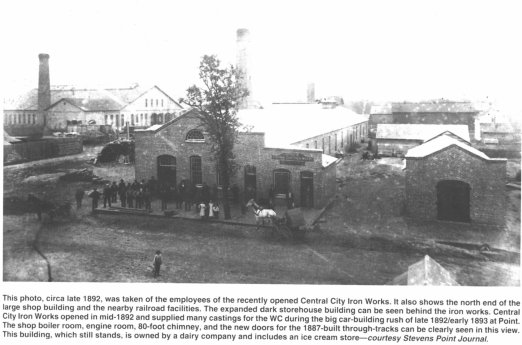
Between the main and blacksmith shops, a small room housed the punch and shears, the axle lathe and car-wheel boring mill, and a hydraulic press for pressing freight-car wheels on and off axles. A coal shed with hand-powered bucket hoists, a water tank, and sand house, were built east of the roundhouse along a roundhouse lead track. Behind the main shop building were eight R. I. P. (repair-in-progress) tracks for bad-order cars and "flat wheelers." Electric lights - a relatively new innovation in 1881 - were added to the interior of the shop building. A new 85-foot-tall brick chimney replaced the old chimney for the boiler room of the car shop building. A new oil house and store room for engine supplies, built of native stone with steel plate floors, was built a few yards north of the roundhouse.
A new paint-shop building, 146 x 40 feet, was built west of the roundhouse. As with the main shop building, a skylight ran longitudinally along the peak of the roof to provide interior light. This new building was positioned such that it could also be served by the existing transfer table, enabling rebuilt or new cars to ride the transfer table from the machine shop to the paint shop. Some car repair work was performed in the paint shop if the space was needed. Completed in early 1882, the paint-shop building still stands today and is used by today’s WC for car repairs. The Stevens Point Shops were an impressive sight and attracted a lot of attention.
On to section 2 of Part 1.