Portage County Historical Society
History of Sacred Heart - Polonia Pt. 3
100th
Anniversary
Fire!
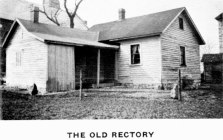
Early on March 16, 1875, a devastating fire destroyed the "rectory"-convent and practically all its contents. The blaze, supposed to have been caused by a defective flue, spread between the walls of the frame building and burst into the open with a sudden fury. It took a few minutes to convince the sisters that the building was doomed, so the little time remaining was devoted to removing whatever could be reached. Father Dabrowski, battling with desperate energy against the flames, was able to rescue the Blessed Sacrament from the chapel. Two hours after the fire had begun, the ‘first convent" and school of the Felician Sisters in America was reduced to a smoldering heap. More than two hundred carefully-chosen books which had been brought by the sisters from Europe, irreplaceable cloth for habits, records and precious keepsakes were destroyed by fire.
Stripped utterly of all possessions, the pioneer band stood on the threshold of their future faced with a long period of bitter disappointment, utter want and physical and moral suffering which would try their faith and endurance to the breaking point. The only recorded comment we have from the distraught sisters was Mother Monica’s act of resignation, "Love seeks sacrifice."
It was necessary to close the school and disband the children. Those boarding in nearby farmhouses were sent home. The only shelter left on the parish premises was the hut in which Father Dabrowski had established his living quarters during the sisters’ occupancy of the rectory. Now this, too, he offered to them as a temporary refuge. Convinced from the first moment of their arrival that he was the heaven-appointed guide of the sisters, he decided to stand by them no matter how great a sacrifice this would entail.
The townspeople manifested their generosity and a true Christian charity to the homeless sisters. A number of farmers volunteered their assistance and offered their homes as a shelter. The McGreer estate, with all its accommodations, was immediately turned over by the owner to the sisters for an indefinite period. The sisters accepted the offer of a residence closest to the parish church, that of Andrew Sikorski, the organist in the parish and the postmaster of the town of Sharon. Here they arranged sleeping quarters for the night, while the cabin on the parish premises served as a "convent" during the day. Father Dabrowski accepted the hospitality of Martin Kiedrowicz, a kindly old man who lived with his elderly sister in a nearby farmhouse.
New Convent
Father Dabrowski vigorously pushed the completion of the new convent, the building of which he had been forced to forego during the severe cold of the winter months. Accounts lead us to believe that the priest and the sisters themselves did all the interior work and helped considerably with the heavier construction. Using donated materials; they provided the convent with crude furniture and other necessities.
In the midst of these trials, the first postulant was admitted, April 16, 1875. She was Valeria Reczek from Winona, Minnesota. Her appearance was entirely unexpected, and although she had come a long way, the sisters urged her to return and enter after the completion of the new convent, but she insisted on remaining with them and sharing their privations.
On May 4, 1875, the new convent was blessed by Father Dabrowski and placed under the patronage of Saint Francis. This building became the Congregation’s first novitiate in America.
With renewed vigor, the little Community began to reshape its affairs after the devastation and chaos of the fire. Its members struggled against great odds to assemble equipment and to procure the necessary books for the reopening of school in the fall. The convent was divided and organized to provide accommodations for boarders and an academy where young girls, seeking admission to the Sisterhood, would be trained. First steps in that direction had already been taken, and eight girls had been enrolled. By this time, another aspirant had been added to the Congregation’s religious family, one Xaviera Wroblewski from Cincinnati, Ohio, who had met the sisters during their fund-raising mission a few weeks before.
It was too late in the year to reopen the parish school. However, the sisters assembled the children for catechism instructions and prepared them for their first Holy Communion. In short, the infant Community was beginning to emerge from the dark hours they had known since their entry into the new land six months before. But their joy was short-lived. Two weeks after the dedication of the new convent, the blow fell.
Tragedy Strikes Again
On the evening of May 18, during Benediction services in the church, the sisters and the congregation were aroused by one of the parishioners who had seen flames and smoke, bursting forth from the roof and windows of the recently-built convent. In the frantic excitement that followed, desperate efforts were made by the worshippers to salvage a few precious items, but the fire blazed so furiously that entry into the building would have been suicidal.
There was no fire apparatus within ten miles of the building, so the farmers drove in from all quarters to form a bucket and pitcher brigade to protect the church in the event that the convent blaze spread. But a wind arose and caught up showers of charcoal sparks and burning shingles, carrying them to the roof of the church with a terrible effect. In a short time it, too, was a flaming mass. The townspeople worked desperately to quench the flames that were destroying the church they had transplanted and rebuilt with their own hands three years before, but the water could not be hoisted to the roof fast enough to check the flames and within a half-hour the situation was hopeless.
All expectations and hopes were brought to naught by this wholly unforeseen deviation of fortune. It was heart-rending to see the panic-stricken and confused pastor, moving from place to place clutching the Sacred Species which he had rescued from the church before the interior burst into flame. Parishioners finally led the distraught priest to the home of Mr. Martin Kiedrowicz, where a repository was prepared for the Blessed Sacrament.
In community chronicles particular attention was called to the bells in the steeple of the church. The roof around the belfry was set on fire by a burning fragment of wood. The flames, being carried up through the open space to the eaves, set the bells whirling and ringing out on their frame with a weirdness that remained in memory for many years.
The little band of religious and the intrepid pastor watched in helpless silence as the flames devoured the buildings erected within the last three years with superhuman patience and toil. They were utterly crushed. The stamina and courage that marked the character of the thirty-four year old priest in war and exile now gave way, and he fell unconscious to the ground. He was carried to the home of Mr. Kiedrowicz by compassionate town folk where he remained during a long convalescence.
The convent and church were but a mass of burning embers scarcely two hours after the fire had begun. The sisters were left without a home for the second time in two months, and stripped of everything they had accumulated after the first fire, including the cash donations they had received from benefactors during their fund-raising tour.
All source materials agree that the fire was the work of incendiaries. The old feud which existed between the parish priest and the hostile element of "Poland Corner," had not entirely died out. A local newspaper reported the incident and a previous attempt on the life of Father Dabrowski in a rather caustic article:
The sisters had left the house, however, not more than ten minutes before it was discovered to be wrapped in flames, and when they left it, there were but a few coals in the kitchen stove. Immediately after the fire had been discovered, a boy or a young man was seen running across the field from the direction of the house, which gives the incendiary theory a bright tinge of probability. But this is not the first attempt (if attempt it was) that has been made to pull Mr. Dabrowski down. The first one was made two or three years ago, and was a most diabolical one. Some devil in human form bored a large hole in a stick of stove wood, filled the cavity with powder, and placed the stick on the priest’s pile. This in due course of time was carried into his house and put into the stove. Fortunately, however, when the terrific explosion which followed occurred, shattering the stove into pieces, he happened to be in another room, and therefore escaped the hellish plot that had been laid against him. Such plots as these would intimidate a more irresolute man than Mr. Dombrowski, but the words "give up" do not appear in his vocabulary.
New Construction
Feeling that they could not abandon a mission on which Providence had sent them to the new world, the five valiant nuns decided to start again. And just as Father Dabrowski had been a tower of strength to the sisters in the previous disaster, so again the young priest rose to new heights of self-sacrifice unapproached by any other figure in the Congregation’s history.
The weeks following the fire, he worked from eight to twelve hours each day on the construction of parish buildings - a frame house to serve as a temporary convent which later was to be converted into a rectory, and a church and convent, both to be built of stone.
Meanwhile, supplies of food, household articles and offers of lodging poured in from kindly farmers in the vicinity. Public school officials, moved by the plight of the homeless sisters, placed a one-room rural school at their disposal after the children had been disbanded for the vacation months. Loath to impose on the generosity of local farmers who themselves struggled to eke out an existence; the sisters established their "convent" in the public schoolhouse during the summer. From this time on the schoolroom was used as a "multiple-purpose" room. It served as a church in which the Holy Sacrifice of the Mass was offered on a portable altar in the early hours of the morning; then was converted into a community room, dining room and chapel later in the day. Sleeping quarters were again established in the homes of the sisters’ loyal standbys, the McGreer and the Sikorski families.
First Church
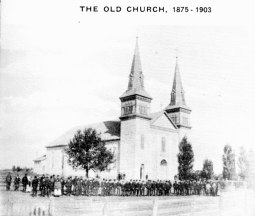
In a desperate effort to supply a convent for the sisters and a place of worship for his parishioners, Father Dabrowski continued to push construction of both buildings. On September 29, 1875, the Most Rev. F. X. Krautbauer, Bishop of Green Bay, placed the cornerstone for this new church being built under the title of the "Most Sacred Heart of Jesus." On this same day the cornerstone was laid for the convent for the sisters. News reports pertinent to the parish building program which appeared in the winter issues of the Stevens Point Journal are an evidence of this
While the buildings were being erected, the lives of the sisters were an epic of incredible hardships and of heart-rending struggle as they moved from one shelter to another - the rural public school to the basement of the unfinished convent and finally to a temporary shelter in the newly-completed rectory. By the third of October 1876, the sisters were finally able to move into the new convent - a combination convent-school building made entirely of stone.
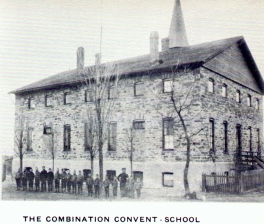
On the feast of Saint Francis, October 4, 1876, the convent was dedicated by Father Dabrowski and placed under the patronage of Saint Claire. A gift of altar linens, vestments and sacred vessels, valued at more than one thousand dollars, was received from the Generalate in Cracow, and reached the convent on the eve of the dedication.
In September, 1876, Mother Mary Monica received an official authorization from the Generalate at Cracow to open a novitiate. The first investiture took place in the convent chapel on November 21, the feast of the Presentation, the date associated with the important milestones of the Congregation’s history.
Three sisters received the habit: Frances Wroblewski was given the name of Sister Mary Felix; Rosalie Teclaw, Sister Mary Clara; and Athanasia Czajkowski, Sister Mary Francis. Father Dabrowski was delegated by Bishop Krautbauer to perform the ceremony. Five clergymen from Milwaukee, Chicago and Stevens Point participated in this first religious ceremony in the new convent. Crudely plastered, unpainted, and furnished with roughly-hewn pews, the chapel was a silent testimony of the stark poverty of the infant Foundation. Most appropriately, Father Dabrowski used poverty as the theme for his investiture sermon. "How singularly Almighty God has favored you, my beloved sisters," he said, "that He has allowed you to experience, in this land of plenty, the joy of supreme poverty which your holy Father Saint Francis so loved."
Education MissionaryWork
During these first eighteen tragic months, the field in which the Felician Sisters had come to labor was by no means allowed to lie fallow. Although they were stranded without permanent housing, the children continued to attend the school. Whenever it was possible, accommodations were made - in the rectory, unfinished convent, and in the open fields during fair weather.
In spite of the material adversities, the sisters prospered in other ways. The hostile element in "Poland Corner" was becoming less troublesome, and the ruthless conspiracy to ruin the foundation began to wane. The patient endurance of the religious, after the destruction of the convents, awakened the consciences of the stray flock and slowly they trickled back into the true fold.
In various ways the sisters also helped their Founder in his work among the Indians, who reverently called Mother Monica the "Black Robe’s Squaw," and loved her for the small gifts she generously gave them.
Father Dabrowski’s activities among the local tribes is a fine example of Catholic missionary effort. A blind Christian Indian who spoke English acted as interpreter, and with his help the versatile clergyman learned the Winnebago dialect and wrote and edited a small Indian dictionary for the use of the sisters.
On one occasion, the sisters prepared baskets of food which friends of the Congregation had donated and with these gifts, they paid a "good will visit" to the Indians. They surprised and delighted the Winnebagoes by using a bit of their dialect which they learned from the dictionary and Father Dabrowski’s interpreter. The venture was a "diplomatic success," and their friends of the forest exhibited their art work and prepared a feast for general good cheer - a canine favorite, slaughtered and roasted over an open fire for the occasion. "Love is an eloquent language that speaks without words to the hearts of even the most untamed," Mother Monica told the sisters upon the termination of that visit. The sisters so won the good will of the Indians with their friendly interest, that a number of them volunteered their aid in the construction of the convent.
The harvest was great indeed in the year of greatest trials. Baptismal records, still extant, reveal that thirty Indians of the Winnebago and the Menomonee tribes were baptized by Father Dabrowski in November, 1876 and sixty-seven, ranging in age from fifteen to seventy-five years, received the sacrament in December of the same year. Mother Mary Monica, according to these records, became the godmother of more than one-third of the Indians listed. When the academy in the new convent was opened in December of 1876, two fifteen-year old Winnebago girls began attending the school. Special attention was lavished upon them by the sisters with a hope that someday they would keep the spark of Christianity alive in the hearts of their own people. They were beginning to make excellent adjustments, but when their people were forced to migrate, the girls left the academy.