Portage County Historical Society
History of Sacred Heart - Polonia Pt. 2
100th
Anniversary
New Site
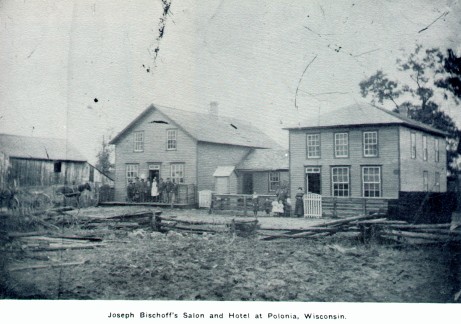
Farmers from all parts of Portage County rode into the parish square equipped with axes, picks, hammers, team horses, wagons and carts. Plank after plank, as well as complete sections of the building, were carefully loosened and hoisted downward. Muscular arms stacked the materials on readied wagons and the cavalcade rolled away to a hill-top two miles east of the old site. After one week of exhausting labor, no trace of Saint Joseph Church remained in "Poland Corner."
The land to which the church was transplanted had been sold by Hannah McGreer, a wealthy farmer of Portage County, for a sum of $50.
Immigrants, whose experiences in the wilderness of Wisconsin would overshadow the imagination of famous authors, did not shrink from the task of rebuilding their shattered temple. With the spirit with which the great cathedrals of medieval Europe were built, they set to work reconstructing the church. Within a few weeks the building, resembling the original in every detail, was completed. In the spring, a small rectory was constructed alongside the church. On September 12; 1872, the church was solemnly blessed by Bishop Melcher and placed under the patronage of the Annunciation of the Blessed Virgin Mary. The site on which the church had been reassembled was named by Father Dabrowski, "Polonia."
Anti-clerical Persecution
The joy of having escaped the persecution of the malcontents in "Poland Corner" was short-lived. Not long after the removal of the church, the liquor business succumbed to the young priest’s strategy. The Sunday patronage dropped off sharply, regular customers gradually dwindled away and public sympathy, awakened by the heroic efforts of the long-suffering pastor, began to manifest itself. Enraged at this unexpected turn of events, the owners of the taverns filed a lawsuit against Father Dabrowski, charging him with conspiracy to ruin their establishments, and against Bishop Melcher for sanctioning the move. The prosecutors, after having lost in the local court, appealed the case to the Supreme Court in Madison where the decision of the local court was upheld.
For a number of years the hostility of this evil element continued and was a source of suffering and hardship to the pastor and his faithful parishioners. The old anti-Catholic sentiments of the 1840’s which had given birth to Know-Nothingism and all its violent outbursts, were not dead but showed up again and again. The spirit had found an echo here in the deeds of the alien community.
Father Dabrowski believed that it was not viciousness and malice so much as ignorance that accounted for the discord and dissension of the alien society. Its ideals had become perverted because it had lost the guiding star of truth. For the young pastor, it was a heart-breaking experience to see falsehood and vituperation used so effectively as to make weak Catholics ashamed of their faith, cause them to abandon its sacraments and cast aside respect for its ministry.
Keen, zealous, intelligent, he penetrated the network of the circumstances surrounding him and determined upon a course of action. He would reclaim these people through the education of their children. It was at this time that Father Dabrowski made plans to find workers who would aid him in the accomplishment of his purpose.
Appeal to Felician Sisters
From his knowledge of the racial characteristics of the Polish people, and his wide grasp of their religious and social needs, the young pastor was convinced that their future welfare lay in their education and training by a religious community of their own nationality. He appealed, therefore, to the Congregation of the Sisters of Saint Felix, resident in Cracow, Poland, for aid in his educational and missionary work.
Thus, destiny shaped the circumstances which inscribed in the annals of the Congregation the name of an intrepid pastor in a Wisconsin wilderness parish, who was destined by the Providence of God to establish the Sisters of Saint Felix on American soil, and who is reverently referred to in the chronicles of the Community as "the Founder."
Like other frontier towns, the area around Sharon, where the Congregation of the Sisters of Saint Felix established their first American foundation, was off to a slow start in its organization of a public school system. The problems related to the language and religion of the German and Polish immigrants in this area caused any satisfactory solution to be postponed for some time.
Many schools at this time were conducted by various denominations. In Catholic, as well as Protestant settlements, the minister or the priest was the teacher. So it was with Father Dabrowski. He had not been long in the United States when he began to realize the needs of his scattered, isolated and religion-famished brethren. Consequently, soon after becoming pastor of Annunciation of the Blessed Virgin Mary Church, he set aside the largest room in the rectory for a school in an attempt to meet the educational needs of the children until he could secure the services of a religious community. It was here that the Catholic children of the vicinity first plodded through the three R’s under the direction of Miss Mary McGreer, the scholarly daughter of a neighboring farmer.
In the summer of 1874, Father Dabrowski received permission from Rt. Rev. Joseph Melcher, Bishop of Milwaukee, to send an appeal for sisters to the Generalate of the Felician Congregation in Cracow, Poland. In a letter to Mother Mary Magdalene, Superior General of the Congregation, he presented the lamentable plight of his tiny settlement. By his stress on the necessity for Catholic teachers for the spiritual needs of the children, he so appealed to the zealous minds of Mother Mary Magdalene and her council that they were prompted to accept his invitation to labor in the vineyard of the Lord in the new world.
Foolhardy as the enterprise seemed, the sisters were convinced that Providence was directing the movement. On August 15, 1874, Mother Magdalene presented the matter to the fifth General Chapter of the Congregation where the momentous decision was made - five sisters were to be sent on the Community’s first missionary venture to America.
Sisters Sail for America
The year that the Congregation received its first Papal decree of approbation, June 1,1874, five sisters sailed for America to begin a new milestone in their work of Christian mercy. The following comprised the pioneer band: Sister Mary Monica Sibilska who was later to become the first provincial superior of the American foundation, Sister Mary Cajetan Jankiewicz, Sister Mary Wenceslaus Zubrzycka, Sister Mary Vincentine Kalwa and Sister Mary Raphael Sworzeniowska.
In a letter to Mother Mary Magdalene, dated August 27, 1874, Father Dabrowski gave minute instructions for the journey to America. Enclosed was a donation of two hundred dollars which Rev. Edward Dems, Administrator of the Green Bay Diocese, made to defray part of the expense of the journey.
Notes and diaries of the founding sisters, from which particulars concerning the voyage to America might have been gleaned, have not been preserved. However, community chronicles, written by the earliest members, portray poignant scenes of the last tender farewells at the time of the departure, as well as hardships en route to America.
The sisters left no record of their first impressions on landing, nor details of the journey to Wisconsin. Stranded in a strange land with no knowledge of the English language and only very meager means, it might be assumed that they would have trustfully followed the instructions sent to them by Father Dabrowski. That he took every precaution to preclude any confusion or hardship on the last stretch of the sisters’ journey is evident from the following extract:
In New York notify Mr. Zolkowski (Chatham Street No. 43) ... From here please send a telegram addressed to me (Jos. Dabrowski - Stevens Point Wisconsin.) After you arrive in Milwaukee, contact Mr. Rudzinski (Reed Street No. 100) I shall meet you here personally.
...The above mentioned persons had been notified about the arrival of the sisters and given the necessary directives.
Erection of the sisters’ convent had already begun. When completed, it will be a large two-story building made of materials about which I had written in my previous letter.
Arrival of Sisters
After a seven-day journey from New York, the sisters reached their destination - Sharon, Wisconsin. The first building that they entered was the Church of the Annunciation of the Blessed Virgin Mary. Here, in a wilderness church, began the saga of courage and consecration. From here they were to go forth in God’s name until the entire land became the scene of their exploits - praying, teaching, dispensing mercy. Referring in her diary to this memorable moment, Mother Mary Monica stated:
...We arrived in Polonia Friday evening November 20, on the very day of the founding of the Congregation nineteen years before.
We have re-dedicated our lives on this memorable day to our Beloved Spouse and His Mother, beseeching them to nurture and cultivate the seedling sown in this distant land.
In spite of Father Dabrowski’s desperate efforts to complete the erection of the convent, it was still under construction at the time the sisters arrived. Built by Father Dabrowski, with the assistance of neighboring farmers and their sons, the structure rose slowly, for the necessary finances and equipment were lacking. The immigrant farmers came with strong arms and a willingness to work, but as a general rule there was little money. Before the work was completed, winter with sub-zero temperatures set in and work on the building had to be discontinued. The convent was ready for occupancy six months after the sisters’ arrival, April, 1875.
Meanwhile, the young priest converted his rectory into a temporary convent which the sisters occupied on the evening of their arrival. His own living quarters, according to Community chronicles, he transferred to a small cabin on the premises in which he had stored a small printing press and other equipment.
The day following the arrival - the feast of the Presentation and the anniversary of the founding of the Congregation - Father Dabrowski celebrated a High Mass of thanksgiving in the tiny rectory chapel, and interred the Blessed Sacrament there. That, he told the sisters, "will serve as a Reservoir from which you must draw solace and fortitude in the trying days ahead."
"At their first opportunity" Mother Mary Monica and Sister Mary Cajetan called on the Administrator of the Diocese, Rev. Edward Dems, to ask his blessing for the work they had already begun in Polonia, and to offer their services for the Catholic Church in America.
First School
The arrival of the sisters caused quite a stir among the Polish Catholics in Portage County and its environs. When parishioners of the Annunciation of the Blessed Virgin Mary Church were told after the next Sunday services that a school would be established, the board of trustees at once set about furnishing "temporary facilities" and organizing committees. During the next two weeks parents from Sharon, Plover, Milwaukee, Stevens Point and outlying areas, some from distances of fifteen to twenty miles, came to enroll their children.
Crowded as they were, the sisters converted two small rooms of their living quarters in the rectory into schoolrooms, retaining only as much of the house as was absolutely indispensable for their needs. This was their first school on American soil; this too, was their first home. Here, they moored their anchor to a bedrock of poverty and suffering. Hardship, inconvenience, want, seem to have roused rather than dampened the apostolic urge of the founding sisters, and two weeks after their arrival, plans for the opening of their school were complete.
On December 3, the sisters began their teaching apostolate in America with an initial enrollment of thirty children. In this makeshift foundation, laid in the rectory of the Annunciation of the Blessed Virgin Mary Church, the sisters conducted their school and attempted to lead a convent life until their living quarters were completed four months later.
At the outset, the sisters realized that a boarding school was indispensable in a wilderness where children traveled long distances in bitter cold of a Wisconsin winter. Shortly after the school opened, accommodations for a number of children were found in private homes of nearby farmers until winter’s end, when the building, which was to serve as convent and school, was completed." Occasionally, too, the hardy "little pioneers" enjoyed the experience of a night spent on pallets by blazing fires in the classrooms when blizzards cut off all possibility of reaching their homes.
Records of the beginnings at the Annunciation of the Blessed Virgin Mary School at Polonia are a bit blurred. From fragments of data found in community chronicles, it can be gathered that the school was upgraded, and that "girls were taught the usual subjects of reading, writing, grammar, arithmetic, geography and the study of the Bible. Besides this, they were tutored in ornamental needlework and embroidery." Mary McGreer continued to teach English, not only to the children, but to the sisters as well.
The administration of the first school was assigned to Sister Mary Cajetan, who continued to hold the responsibility of superintending educational establishments of the Congregation during its formative years in America.
Sister Mary Cajetan soon became keenly aware of the evils rampant among immigrant Catholics attending public schools. Totally ignorant of the English language, the children found adjustment difficult. Truancy was the order of the day. Moreover, "control of the public schools had been taken over in many instances by Protestants who looked upon these schools as seed-beds for their own convictions. This drove the Catholic children out of public schools, sometimes by their own conscientious objections to the method of instruction, sometimes through the machinations of bigoted superintendents."
Sister Mary Cajetan was convinced that the parish school must join the front ranks in the conquest of these problems. Despite the fact that facilities were hopelessly inadequate, she sought out the children of Polish Catholics and urged their attendance at the Annunciation of the Blessed Virgin Mary School.
From the very inception of the American foundation, Father Dabrowski’s idea was to have the Felician Sisters establish an American province with a teacher-training school.
Mother Mary Monica, too, saw the necessity of opening a novitiate, for the field of labor was extensive and already a number of candidates sought admission. However, a blow was to fall which shattered not only her plans for the immediate future, but also every achievement and adjustment the sisters had made in a four-month effort.