Portage County Historical Society
History of Sacred Heart - Polonia Pt. 1
100th Anniversary
Sacred Heart Congregation
Today a twenty-four foot crucifix, rising above the crossroads which lead into the tiny hamlet of Polonia in Portage County, Wisconsin, marks the site on which stands the Sacred Heart Catholic Church. The scene around this landmark is that which a fertile and prosperous farming country presents - comfortable homes, long stretches of pasture lands and richly cultivated fields of grain. It shows a marvelous change from the day in 1864, when an immigrant population had settled here.
First Pioneers
The first Poles who came to the northeastern part of Portage County, Wisconsin, were Michael von Koziczkowski and family, consisting of his wife and nine children; they were followed, a year later, by the three families of John Zynda, Adam Klesmit and Joseph Platta. As to the dates of their arrivals, these facts are sufficiently settled by the papers on file in the office of the clerk of the Circuit Court in Stevens Point, where the declaration of intention to become a citizen made by Koziczkowski states that he arrived in 1857. The papers of the others named give the date of their coming as 1858, and confirming this evidence are the baptismal records of the Zynda family with the same year thereupon, furnished by the priest upon their departure for America. The following year saw the arrival in Portage County of Jacob Werachowski, Joseph Schulfer, Christian Dzwankowski, Joseph Jazdewski. Peter Konopacki came this year from Winona, Minnesota.
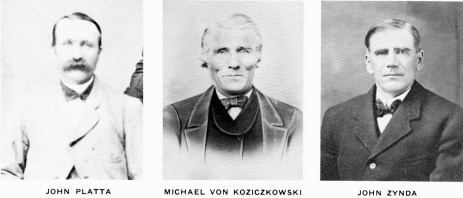
The pioneer of the early group of immigrants, Koziczkowski, had been the owner of a small farm in the region of Dantzic, West Prussia. He realized that the future for his nine children was dark, having read of America, sold his farm and started for the New World without knowing his destination. Arrived in Chicago, he heard of cheap lands to be had on the upper Wisconsin River. In Milwaukee he learned more, for there was at that time a movement among the Germans to take up lands in Marathon County. Proceeding in this direction, Koziczkowski arrived in Stevens Point in September 1857, with fifty dollars in money. He left his family in Stevens Point while he went to Wausau to look at land which proved unsatisfactory because too heavily wooded. Returning, he spent the winter of (1857-1858) in Stevens Point, and in the following summer worked for farmers a few miles east of the city. In the meantime he had written to friends at home, and the three families of Zynda, Klesmit and Platta had found their way to Portage County and were employed in the same neighborhood. Later they bought land from the Fox River Company, and settled here. The land purchased was dotted with hundreds of tree stumps, huge boulders and rocks of every size. It was only after many months of patient and backbreaking labor that clearings, upon which crops could be planted, were made by the settlers.
Early Hardships
These first Polish settlers endured great hardships. There was little demand for labor on the farms, the men were paid fifty cents a day for cradling grain, and twenty-five cents a day for digging potatoes, or they were paid at the rate of one bushel of potatoes a day. The wife of one of these comers worked for a loaf of bread a day, and a sixteen year old girl hired out for fifteen dollars and board for a year. Under these circumstances only the bare necessities of life could be secured. Often their bread contained more of middlings than of flour, and was more often made of rye than of wheat. Generally their meal consisted of a soup of milk and potatoes.
Most of these early Polish settlers had been farmers or laborers in the mother country. In numerous instances the men were foremen on estates; they had had comfortable incomes and their labor had not been as hard as the tilling of their lands in this country proved. But they were ambitious and looked forward to better things. Among the early immigrants were numerous artisans, but practically no tradesmen or professional men.
The only other reason besides their desire for economic betterment, was the desire to escape army service. Some of them had seen army service in the Austro-Prussian war and others expected a draft for the Franco-Prussian war. The majority of them came here directly from the old country; many came in sailing vessels, by way of Quebec, the voyage taking three months or more.
These hardy, rugged, determined people came with the purpose to force this timbered land to yield and at once set out to clear and break this rich soil of decayed vegetation to develop farms.
While the wages of the farm hands were very low during the decades of 1860-1870, better wages were paid in the woods, on the river, and in the saw mills. During the winter months the farmers entered the logging camps to secure financial needs. Many of them earned enough in a year to buy one or more forties of land.
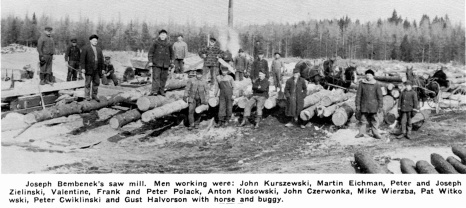
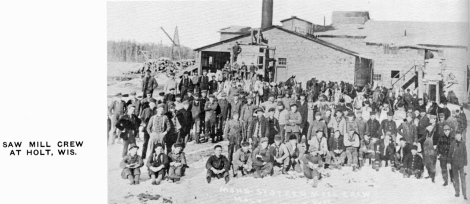
These three sawmills provided winter employment for the Polish farmers, Boyington’s Sawmill between Polonia and Rosholt, Klondike Sawmill at Holt; Wisconsin, and the Shantytown Sawmill north of Polonia at Shantytown.
Harvest Time and Hop Picking
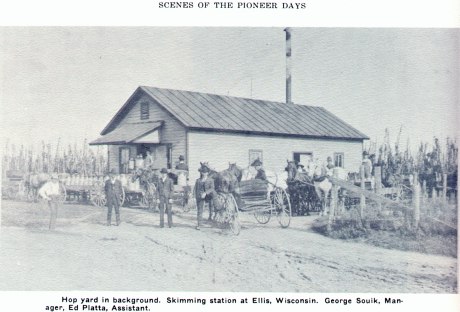
Perhaps the most interesting episode in the agricultural history is the period of the "Hop" craze which swept over our township between the years of 1880-1900. The hop vine originally had been brought to Wisconsin by pioneers from the great hop districts of New York. In the spring, roots were planted 8 feet apart in hills and 8 feet apart in rows. The first variety planted was a cream colored vine called the "Cluster" type, a few years later the Red vine was imported which proved to be more productive.
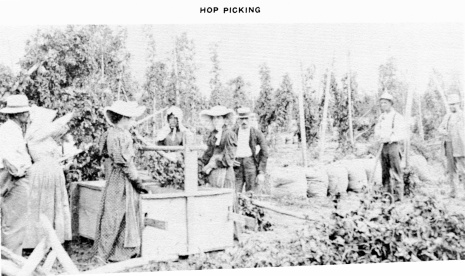
Harvest time in the hop district was a season of unusual and picturesque life. From far and near country girls and women of every class and condition, in response to the call for pickers, streamed into hop gardens. The picking season was a time of feasting and merrymaking. Each night when darkness put an end to labor, the well-used fiddle was fetched from its case, and to its merry strains, under the mellow autumn moon the unwearied tripped the jovial steps of the hop dance.
Rev. John Polak
Was it chance, or was it that their fates drove them here? The Providence of God led them with the help of a priest, the natural leader of the people by God’s will. This priest was Rev. John Polak. He was placed by Providence as a signpost for the Polish pioneers of Wisconsin. Father John Polak, an emigrant priest of Polish nationality, was at that time rector of the combined Irish, French, and German parish at Stevens Point.
Soon after the arrival of the Polish group, families of German nationality came, and together they established a settlement at a place known as "Poland Corner" in the town of Sharon. Here they built a small church which they dedicated to Saint Martin. For the next eight years, 1857-1865, Father Polak paid occasional visits to these people and ministered to their spiritual needs. Throughout these years, the parish was never thoroughly unified and harmonious. Differences in language and custom made it soon apparent that separate foundations would effect a happier situation.
The population of "Poland Corner" grew rapidly. The presence of a German Catholic bishop in Wisconsin gave the territory wide publicity in the Catholic states of Germany and Austria and attracted thousands.
New Parish Founded
In 1864 the Polish Catholics, having increased to forty-four families, petitioned Rt. Rev. John Henni, Bishop of the Diocese of Milwaukee, for official approval to found a new parish. The following year Father Bonaventure Buczynski was sent to organize the congregation and begin the erection of a church. Within a year a new church under the patronage of Saint Joseph was completed on a site not far from Saint Martin Church. This move tended to widen the breach between the two national groups.
Factions
Quite unfortunately, at this time, an unruly group of agitators infiltrated the German-Polish community and was instrumental in arousing feuds and trouble between rival groups.
The crux of the matter revolved around three saloons that had sprung up in the immediate vicinity of the newly built church. The unchecked and unlimited sale of liquors led to brawls, assaults and petty riots. Church services were frequently interrupted. The pastor used every means at his disposal to check the evil, but after two and a half years of unsuccessful effort he resigned his pastorate and returned to Milwaukee. His successor, Father Francis Wenglikowski, also labored arduously to subdue the chaos, but it was in vain. These three subsequent pastorates also ended in failure: Rev. S. Szczepankiewicz, Rev. Juszkiewicz, and Rev. J. J. Zawistowski. As a result of this, the parish was placed under an interdict from 1868 to 1870.
Rev. Joseph Dabrowski
(This history spells his last name as Dombrowski, All other references use Dabrowski.)
Into this factious community, seething with anticlericalism and unrest, Bishop Melcher sent the newly ordained Father Joseph Dabrowski in December 1870. This priest was destined to play an important role in the foundation of the Congregation of the Sisters of Saint Felix in America.
Father Joseph Dabrowski, soldier, pioneer, educator, was born in Lublin, Poland, in 1842 of an illustrious Catholic family. All accounts agree that young Dabrowski was a singularly gifted and pious child accustomed to the adulation generally showered by wealthy families upon their first born. Until his twelfth year, Joseph was educated at home under the tutorship of a local teacher and of his father, who was the embodiment of the culture and traditions of the old Polish aristocracy.
The father’s association with disgruntled noblemen, smarting under Russian domination, filled his young mind with the determination to champion the cause of Poland. The events of his normal boyhood can be passed over with a single remark - he was moved by two convictions: his interest in things mechanical and scientific, and a longing for a military career.
At twelve, Joseph was sent by his widowed mother to a finishing school in Lublin and later to the University of Warsaw. When the Polish insurrection of 1863 broke out, Dabrowski joined a regiment comprised of faculty members and students from the University of Warsaw and fought bravely under General Stanislaus Mieroslawski. The General recognized in the young student marked qualities of leadership and placed him in command of a company of men. After a short time Mieroslawski, realizing that continued resistance would be suicidal, disbanded his regiment. Dabrowski, one of the hunted leaders of the stormy uprising, fled to Germany after a number of hairbreadth escapes.
After journeying from place to place, the young exile spent some time in Frankfort and Saxony, and later proceeded to Switzerland. Dabrowski’s bent of mind toward the sciences finally led him to the University of Lucerne where he completed his studies in technology, physics and mathematics. His natural talents and industry enabled him to acquire at this time a liberal education and a fund of useful knowledge which proved valuable to him in his future career.
The hardships of his self-imposed exile wrought a change in the interests and attitudes of Dabrowski, and it is at this time that he began to experience a sincere desire to dedicate his life to the Church. In 1867 he set out for Rome where he began his training for the priesthood in the newly-established Resurrectionist Seminary, the Collegium Polonicum. Here the cleric’s earnestness, his scholarship and genuine piety won the approval of his instructors. In 1869, after an urgent appeal by Pope Pius IX to the Polish clergy for spiritual aid to the Polish people in America, he volunteered his services and sailed for the American shores late in 1869.
For the twenty-nine year old priest it was a glorious opportunity to do the work of a missionary among his own compatriots and he embraced the prospect with ardor. Upon his arrival in the United States, Father Dabrowski presented his credentials to Bishop Melcher of Green Bay, Wisconsin and placed himself at his disposal. After a year’s residence at Saint Francis Seminary near Milwaukee, he was appointed pastor of Saint Joseph Church in Sharon, December, 187l.
Moral Crusade
If Christian fortitude was the virtue par excellence to be inculcated, Father Dabrowski found ample opportunity to cultivate it in his new environment. Brought face to face with the crushing hostility of the malcontents of "Poland Corner," the young priest was determined to lean heavily upon God’s supporting grace to conquer the problems which vanquished his five predecessors.
Radiating the spirit of faith and zeal, combative and militant by nature, he was well suited to defend Christian morality in a neglected community of immigrants whose moral sense had become hopelessly dulled. Father Dabrowski’s sharp intellect appraised the situation at the very outset. The saloons within a few hundred feet of the church building were centers of vice and corruption and served as a rendezvous for demagogues. Sunday churchgoers, who had come long distances of ten to twenty miles, were lured into the establishment by various devices so that there was scarcely a male worshipper in the church during the Mass.
The distressed priest made persistent efforts to check the evil and persuaded sympathetic parishioners to join him in the moral crusade. But the owners of the taverns, who depended on the churchgoers as their main source of income, mobilized their adherents and conducted a constant agitation to resist the priest’s reform activities. Gambling, brawls and petty riots continued. Church services were irreverently interrupted. After every approach to the problem had failed, Father Dabrowski resorted to a drastic scheme - to place his devoted flock beyond the reach of the degrading influence of the taverns.
He secured the sanction of his plans from Bishop Melcher, assembled his parishioners after Sunday’s Mass, and proposed the drastic move - to transfer the church building to a more suitable location. Enthusiastic approval of the plan was unanimous. Numerous volunteers pledged their services, and the work of dismantling the church began in the early hours of the following day.
Continue to Part 2