Portage County Historical Society
History of Sacred Heart - Polonia Pt. 4
100th
Anniversary
Community Grows
In this period of continued hardships, 1875-1877, the Community grew in membership from five to seventeen sisters. In December, 1876, four girls joined the pioneer band as postulants: Antonina Zarach, from Sharon, became known in religion as Sister Mary Joseph; Mary Wojak, also from Sharon, became Sister Mary Therese; Rosalie Maduralska, from Chicago, was given the name of Sister Mary Columba; Mary-anne Bezler, from Prussia, received the name of Sister Mary Hyacinth.
The following year, five more postulants entered the novitiate. They were: Frances Andryczek, who became Sister Mary Angela; Anna Rezezab was given the name Sister Mary Nepomucene; Brigid Pyterek, from Dunkirk, New York, was named Sister Mary Catherine; Margaret Wasilewski, from Chicago, received the name of Sister Mary Marcella; the Mary Andryczek, from Prussia, became known in religion as Sister Mary Martha.
In 1877, Mother Mary Monica received an authorization from the Generalate in Cracow to establish a province of the Congregation in the United States, and was named by the General Council the first Provincial Superior.
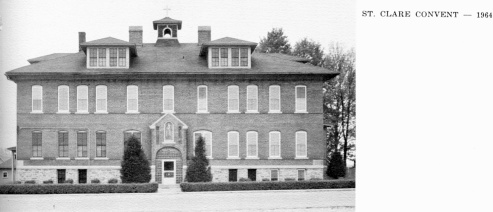
By this time, Saint Claire Convent was becoming too small for the growing Community; besides, it proved inadequate from the standpoint of location. As new schools were being opened in the East, a change of some kind was imperative, and a more centrally-placed site for the Motherhouse and novitiate was sought.
In 1880, a location was finally selected in Detroit on what is today Aubin and Canfield Avenues.
With some difficulty Mother Mary Monica secured permission from Bishop Krautbauer for the transference of the Mother House to another diocese. It was only after he had learned that Saint Claire Convent would be converted into an institute for homeless boys, and that the sisters would not abandon their schools in his diocese that Bishop Krautbauer permitted the transfer and sent the official recommendation of the Congregation to Bishop Borgess of Detroit.
After the transfer was officially sanctioned, Mother Mary Monica and
Sister Cajetan at once began making plans for the new building in spite
of the most discouraging financial outlook. They lost no time in
communicating with the Generalate in Cracow for necessary permission to
buy land and enter into negotiations for the erection of a new convent.
In 1882 the Felician Sisters’ mother-house was moved from Polonia to Detroit, Michigan, and their old convent in Polonia was converted into an orphanage for boys conducted by the sisters.
The sisters discontinued the orphanage in the ‘20’s making it a home for their own aged Sisters.
Rev. Dabrowski Leaves Polonia
Father Dabrowski left Polonia and followed the Felician Sisters to Detroit where he became their chaplain, and, at the same time, undertook the building of the Polish Seminary there to provide priests for the Polish emigrants in America.
The vacancy was filled by Father Ladislaus Grabowski who came from Brazil, South America. He stayed from October 1, 1882 to April 16, 1888. He made many interior improvements in the church.
For the next three years the Franciscan Fathers from Pulaski, Wisconsin, took charge of the parish.
In 1891 Father Thomas Grenbowski was appointed pastor. His greatest undertaking was the building of a new brick church.
The old stone church had no basement and there was no provision for air space under the floor, which later resulted in the rotting of the beams. Besides, it was too small to accommodate all the people. Much of the labor was done by the parishioners themselves. All the brick was hauled from Ringle, Wisconsin, a distance of more than 30 miles, by wagon. They had to travel day and night to make the round trip. It had been estimated that the church cost, at that time, approximately $80,000. The church was dedicated July 26, 1902, on St. Ann’s Day.
Yesterday & Today
In 1895 the congregation of the Sacred Heart numbered 4,000 souls, making it one of the most important organizations in the Diocese of Green Bay. The parochial school at Polonia was in a flourishing stage having an enrollment of 300 scholars. Catholic societies were the Rosary Society with 425 members, Sodality of the Blessed Virgin Mary for young women with 350 members, and the Society of the Guardian Angel for boys. There also, had been established two subordinate schools on the parish limits, which were for the use of children living at a considerable distance. A mission station at Alban, Portage County, was quite regularly attended by Father Grenbowski.
Gradually the parish had diminished in size as new churches were being established; St. Mary’s of Mount Carmel at Fancher, St. Ladislaus’ at Bevent, St. Adalbert’s at Alban, St. Mary’s at Torun, and St. Stanislaus’ in Stevens Point.
Sacred Heart Parish is down to 275 families at the present time. Hard-working Father Grenbowski, after having built the church, decided to leave the parish - moving to Pennsylvania. In 1904 the Bishop of Green Bay appointed Father Theophil Malkowski who moved here from St. John’s Parish, Menasha, Wisconsin.
In 1914 the orphanage in Polonia burned to the ground - leaving the orphans and the Felician Sisters shelterless. But, due to the efforts of the sisters and the people, a new orphanage was erected in one year’s time - where once more the orphan boys were happily cared for. The pastor’s living quarters were very poor. The old rectory was again destroyed by fire, forcing the priest to live in a small temporary house for a number of years. In 1914 a new two-story solid brick rectory was built. In 1916 Father Malkowski was transferred to St. Hyacinth’s Parish at Antigo - being succeeded by the Very Rev. L. J. Pescinski, who came here from St. Mary’s Parish, Fancher.
During Father Pescinski’s time, the big church was beautifully decorated and a magnificent new main altar installed, toward which a friend of Father Pescinski, John Bukolt, owner of the Lullabye Corporation of Stevens Point made a generous contribution.
Father Pescinski worked hard to get electricity into the Polonia community and in 1924 he signed a contract with the Wisconsin Valley Electric Company of Stevens Point in the sum of $2,500 to pay for the erection of an electric line from Jordan to Polonia
The following is taken from Rates and Connection Charges, Polonia Line, issued by the Wisconsin Valley Electric Company, dated May 12, 1924:
For a period of five years from the date of commencement of service only those who have contributed to the cost of constructing the transmission and distribution system will be served. The Priest or a committee of the Church of the Sacred Heart of Jesus will grant permission to the Company to serve customers and a charge of $100 will be collected from each connection and paid to the Church to apply toward the cost of the lines.
After 12 years of hard work and devotion Father Pescinski’s health was gradually failing and on April 2,1928 (at the age of 69), he died in the rectory after a few weeks’ illness.
After Father Pescinski’s death, Father Leon Jankowski, formerly pastor of St. Bartholomew’s Parish, Mill Creek, was appointed pastor.
Father Jankowski undertook the task of paying the debt, which had been in the parish since the building of the church in 1902. Besides, there were needed repairs on the church and other buildings which he had undertaken. The year 1929 and the following 10 years were years of hardships because of the depression. The good people, although never rich, felt the hardship. Many had lost their farms and moved out. When World War II broke out, many young boys were taken into the army, who upon returning married and moved to the cities - thus the circumstances have diminished the parish in size.
On St. Patrick’s Day, March 17, 1934, a new calamity invaded the parish. Lightning struck the church and it was completely destroyed by fire. This was the fifth disastrous fire in the parish in half a century. The amount of $65,000 was collected from the insurance company for the damage.
Since it was during the depression, material and labor was cheap, and the parish was able to undertake the task of building a new church, which was completed by Christmas of 1934 - a new location and with a seating capacity of 1,000. With the expert figuring of Father Jankowski and the help of the people the church was built and furnished without incurring any debt. Three years later it was decorated.
Father Jankowski had done an excellent job in managing the work. On September 27, 1946, Father Jankowski died after a prolonged illness.
Father John B. Gruna was appointed in September of 1946 by the Most Rev. John P. Treacy, Bishop of La Crosse, to succeed Father Jankowski. During the five years of his pastorate, he undertook many tasks of repairing the church, rectory and school. On November 15, 1951, he retired from active duty to private life at Crivitz, whereupon, Bishop Treacy appointed Father Joseph Schulist to succeed him. The parishioners of Sacred Heart Parish were very happy with the appointment as they received their own boy who was born and reared with them - and now works with them for their sanctification and success.
Upon the arrival of Father Schulist in November of 1951, the heating system in the church and old school was modernized by installing a mechanical heating system in both at a cost of $1,500. Installation also took place of a public address system in the church at a cost of $598.
In 1952 the rectory was completely modernized and renovated. All floors were recovered and new furniture was purchased. Extensive repairs were made in the plumbing and radiators in the church all at a cost of $9,500. This same year the School Hot Lunch Program was introduced with 112 pupils attending.
Further improvements were made in 1953 exclusively on the church. Tuck pointing and waterproofing was done to the outside of the church with an expense of $4,000. The ceiling of the church was insulated and the heating pipes were covered; this cost $1300. Kneeling pads were installed in the church at a cost of $1,500. Two new vestment cases were built by the parish men valued at a cost of $1,200. New vestments were purchased and all chalices, candelabra and other altar supplies were regilted or replated by parishioners’ donations and parish society activities at a cost of $3,120. In the same year the Envelope System was introduced in our parish which tripled the income.
Many improvements and purchases were made in the parish property during 1954. The church was plastered on the inside which cost $2,830.69, and the church hall was plastered which cost $1,200. A new well was drilled and septic tanks were installed which resulted in the installation of lavatories in the church at an expense of $7,246.69. Because the basic plumbing was present for 25 years and to use the old lavatories was unsanitary, new lavatories were installed in the old school at a cost of $2,600.37. The increasing enrollment in the school resulted in the purchase of 44 new seats for the classrooms at a cost of $460. The many parish activities prompted the purchase of two new kitchen stoves and two coffee urns for the church hall which was financed by the Rosary Society at a cost of $735.
The interior of the church was completely renovated during the year 1955. Luis Shrovnal, an artist from Kewanee, was engaged to redecorate the church. Gold leaf was applied to the numerous ornamentations on the altars, on the walls in the sanctuary and in the church. The hand paintings on the ceiling were cleaned and retouched, and all statuary, including the stations of the cross and the altars, were repainted in oil colors. The redecorating amounted to $9,289.
In 1956 the construction of the new Pacelli High School in Stevens Point totaling $900,000 placed an assessment of 5% of the total cost on our parish amounting to $45,000 plus interest and operating cost. A meeting was held by the men of the parish on July 29, in regard to the construction of a concession and storage shed. An agreement was reached that all labor was to be free and material at cost. Parishioners turned out in large numbers and worked like beavers; in three weeks’ time it was completed and was in operation September 1 for the Annual Picnic. The materials for this project reached a sum of $1,305.17. Due to the increasing attendance at the Annual Picnic, the need arose for new dining room tables; consequently, 18 tables were purchased by the Rosary Society at a cost $1,072. In the same year the parish celebrated a centennial of the coming of the Polish People to this area. More than 60 adults and 30 young people participated in the dramatization of singing and dancing, the demonstrating of old techniques such as spinning wool and grinding flour. Over 700 people attended the show and exhibit. The parish also purchased new sanctuary furniture which cost $700.
A fourth classroom was added in the old school in 1957 which necessitated the addition of 126 new seats for the classroom; the cost was $1,408.60. Also in 1957 a new porch, breezway, and garage were added and sidewalks were laid at a cost of $5,314.21. A complete set of dishes and silverware and a slicer was purchased by the Rosary Society for $1,065.09. On August 1,1957, by order of Mother General of Rome, the Sisters could no longer be engaged as organists.
In 1958 a controversy over boundary lines led to the surveying of the parish grounds which cost $663.60. As a result of this, more land was acquired for the cemetery which required bulldozing; this cost $2,000. The parishioners then donated their time and effort to the landscaping of the church grounds and cemetery. Because of the increasing number of school children participating in the hot lunch program, an institutional size cooler was installed in the kitchen. It was financed by the Rosary Society for $900. In the same year three new statues were acquired. A statue of St. Isidore was purchased by the St. Isidore Society; a statue of Our Lady of Fatima was purchased by the Rosary Society; and a statue of St. Ann was purchased by the generous donations of the parishioners. The price of the three statues amounted to $975. They are placed in three shrines.
The construction of a new cathedral, St. Joseph the Workman, in 1959 placed an assessment of $18,000 on our parish. This obligation has been fulfilled. A mission was held in this same year with services held every morning and evening. Tiling of the church floor cost $2,236.60.
Rev. Joseph Schulist celebrated his Silver Jubilee in 1960. The parish sponsored a banquet in his honor with 1,000 people attending. The old school was becoming incapable of accommodating the rapid enrollment of school children and so in 1960 plans were drawn up for a new school. In place of the annual picnic, a "silent picnic" was introduced whereby donations were made to begin a fund for the new school. A floor buffer and bread mixer was also ‘purchased by the Rosary Society for $741.90.
Construction of the new school commenced in June of 1961 and was completed by December 15 of the same year. It opened January 3, 1962, with 196 pupils attending. The total cost of the new school with all equipment was $94,327.53. We, as parishioners, are very proud of our new school.
The dedication of our new school took place April 29, 1962, by the Most Rev. John P. Treacy, Bishop of La Crosse at 4 p.m. Twenty priests were present for the ceremony, and all were greatly impressed by the modern school that was built. A dinner was served by the parish ladies to the visiting clergy. In the same year during the summer months, the schoolyard and street was blacktopped for a sum of $700.32.
The project undertook in 1963 was the rewiring, painting, and the laying of tile for the church hall. The ladies of the parish did the painting themselves. The total cost of this project was $4,094.40 and the Rosary Society paid $3,300 of this amount.
The tentative projects for 1964 include the renovating of the Communion rail and the landscaping of St. Ann’s Grotto.
Sacred Heart parish of Polonia with a membership of 262 families embraces the Townships of Sharon, Hull, New Hope, Amherst, Stockton and Bevent in Marathon County, a distance of 22 miles in length and 21 miles in width.
The district is hilly in eastern and northern sections and level in central, southern and western portions. Though not a heavy soil, it is a rich loam suitable for farming.
The climate is more or less uniform without sudden changes which cause such disasters in so many ways. Cold can be endured with little discomfort because of the dryness of the atmosphere.
This brings the history of Sacred Heart Parish up to the present date. (Webmaster's note: this was written in 1964)
We have tried our best and hope that we have avoided errors and omissions in this book. However, we know that we are not infallible and that there may be some errors. We assure you that this was not our intention, but it may have occurred simply through oversight.
Our thanks go to all those who have helped us in the compilation of this book. We are grateful to those who furnished us with photographs, facts, and history and especially to Sister Mary Theophania Kalinowski, C. S. S. F. We are thankful to our advertisers, who, through their contributions for space on the advertising pages, and to benefactors, sponsors, and friends have materially helped to defray the expense of publishing this book.
Return to Part 3.