Portage County Historical Society
Family Vignettes Page 8
taken from the May 19, 1992 Stevens Point Journal
The Konkol Family
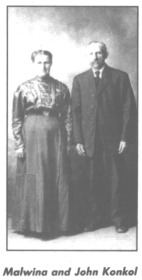
John and Malwina Konkol and their two children, John (in. Mary Jach) and Martha (m. Felix Jastrembski), arrived in the port of New York in May, 1883. They had lived in the Kartuzy district of the Kaszubian area just to the west of Gdansk. That area had been part of the German Empire since its unification in 1871. Prior to that, it had been West Prussia, a state formed as a result of the first partition of Poland in 1772, by Austria, Russia and Prussia.
A son, Joseph, was born that August, shortly after their arrival in Portage County. His birth record indicates his place of birth as the town of Hull. According to a granddaughter, Phyliss Delton, the family spent the winter of 1883-84 in the Hull area. They were invited to share a one-room cabin with another family, probably Vincent and Frances (Gostomska) Migel, who had preceded them to Portage County.
The next year, John purchased a farm in the town of Stockton. The farm was located at what is now the intersection of Hwy. C and Hwy. B. The religious shrine, which he had constructed, located at the corner of the farm, marks what has long been known as Konkol's Corners. Their parish church, St. Mary of Mount Cannel, is further along Hwy K, at Fancher. Such shrines are very common along Polish roadsides and usually at a crossroad. This writer traveled in the Kaszubian area in which the Konkols had lived and discovered an almost identical shrine in one of the villages.
Malwina’s parents, Peter and Julianna Gostomski, and their other children, also came to Portage County. In addition to Frances, mentioned above, Pauline (m. August Literski), Elizabeth (Sister M. Hipolita) and Anton (m. Marlanna Lasinska). All but Sister M. Hipolita remained Portage County residents. Their farms were located in the rural Amherst area.
John’s brother, Joseph, and his family, including Martha (m. August Karczynski) and Malwina (m. John Palash) came to Portage County the next year. His first wife, Julianna, died a few years later. He then married Frances Piotrowska. His farm was located near Lake Thomas, a short distance from the Fancher church.
Malwina was a midwife and delivered many of the babies born in the Fancher area for years. Usually, someone would arrive at their home and ask her to come with them. These unexpected and frequent absences by his wife resulted in John becoming a rather good cook.
John and Malwina had seven children in addition to John, Martha, and Joseph mentioned earlier. Alex, Leo, Anton, Elizabeth, Johanna, Peter and the older children were all lifetime county residents. The youngest, Ben, lived in Black River Falls and later in Wausau.
Submitted by
Adeline M. Sopa
Green Bay, Wis.
The Kussman Family
John and Eve (Kussmann Heimann) Steinke left Pomerania, Prussia, in 1858 in a sailing ship from Hamburg, Germany. The trip took six weeks and two days. Oppressive taxes and poor harvests from drought were reasons for their leaving. With them came her three Heimann children and their two Steinke children. The youngest died soon after arriving in Montello, where they had friends. On the ship was Gottlieb Kussmann, a relative of Eve. By June 1857, they were in Stevens Point where Henrietta Heimann and Gottlieb were married by Justice Jackson, the only person in the area authorized to perform marriages.
In Stevens Point, John Steinke and the boys found work with the section crew on the railroad. Stepson Fred worked in the woods and as a cook in the lumber camps. During some seasons, Sam Steinke ran the river taking logs to Portage and returning by stagecoach.
In 1856, Gottileb Kussmann struck his first job in Wisconsin on the Green Lake Prairie. For six weeks’ work he received $15 in gold. During the winters, he worked at his trade as a tailor. En route to Stevens Point in 1857, he saw Indians, and on the Public Square stood pine trees. After marriage that year, be secured work with a farmer. During the summer of 1858, he ran the river with his brother, Chris, making four trips to Galena and Alton, Ill., and Dubuque, Iowa. They had several narrow escapes from drowning.
In 1870, after previously renting, he bought on credit 120 acres in Stockton Township, two miles north of Arnott. It was destitute of buildings and only 10 acres broken. Later he added 120 acres. He erected buildings. Son Fred remembered that their house had single boards, at least upstairs, so that in winter snow sifted in through cracks and onto the bed covers. Gottlieb kept 75 bee hives south of the house.
In 1878, John and Sam Steinke purchased a farm in Stockton Township just north of Arnott. Sam was married to Mary Hoffman in 1868 by a justice of the peace. A feature of the Steinke home was a large, beautiful, hardwood kitchen floor. Sam and son Wililam played the violin while daughters, Cora and Mae, played the organ when cousins and friends came to enjoy singing and dancing.
The story is told that one day Mary Steinke realized they were short of flour. The men being very busy in the fields, she took a sack of wheat and walked to Amherst to have it ground.
Eve Steinke and her son, John Heimann, died in November 1869 in an epidemic. His widow, Wilhelmina, brought up her four small children by washing clothes for railroad workers and with help from good neighbors.
Steinke descendants in Portage County are Lawrence, Carl, Robert, Leon, Kenneth and Douglas Steinke, Lyndred Newby, Marvin Lutz, Roger and Ronald Sonnenberg, Ruth Hamon, Kathleen Embertson and Cathleen Clark and families.
Kussmanns are Loretta and Paul Kussman, Fern Reinke, Irene Peterson, Kenneth and Wendell Krogwold, Charlotte Roberts, Roberta Honl, Fred Persike and families.
Submitted by
Harriet Kussman
P.O. Box 63
Amherst Junction
The Loberg Family
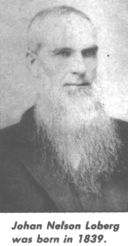
On my father’s side, Keith Borgen, our Portage County history goes as far back as 1858. My grandmother’s, Alma Anderson Borgen, grandfather, Johan Nelson Loberg, purchased 120 acres in Amherst, Portage County. He cleared a small area and erected a small cabin.
In 1859, he brought his family to take possession of his land. He came from Gjerpen, Norway, with his parents and family. They settled in Ashippun, Dodge County.
There were a dozen children in the family. All but the parents and one son moved to Portage County, settling is Amherst and New Hope townships.
Johan was a farmer and accumulated quite a bit of land. He was married to Anna Marie Skowen in 1859. They had 10 children, one of whom was my grandmother’s mother.
Johan was very active in the community. He assisted in organizing the Old New Hope Church. For many years, he was a supervisor in the Amherst Township. He helped to organize and was on the first board of directors of the Nelsonville creamery.
Anna Skowen’s family came to Portage County in 1850. Johan enlisted in Company B of the 47th Infantry from Amherst Township to serve in the Civil War. Because of his exact marksmanship, he was kept at Camp Randall, Madison, where he served as an instructor at the rifle range. He was also in charge of care and operation of the guns. He was honorably discharged with a pension of $32 a month for life. He later received a land grant of 40 acres, the document being signed by President U.S. Grant.
This is taken from Amherst Press No.35 1897, “Johan N. Loberg used to be the Daniel Boone of this section in years gone by, and he can today surprise some of the crack shots of the younger generation. He is perhaps to a great extent responsible for the scarcity of bear in these parts, for it is said when ever Johan got after a bear the animal was doomed.” His biggest catch for one fall was 15 bear.
When Johan and Anna Marie came to Portage County in 1859, this section of the state was much a wilderness. The land on which they settled was called Indian Land. There were no roads or horses in those early days. Supplies were packed on the back or hauled on hand sleds during the winter. Roving bands of Indians were frequently encountered, and while these Indians were friendly, the sight of them would usually strike terror in the breasts of women and children.
Grandma Loberg would often tell about the Indians, especially one occasion at the time when Johan was away during the war. She was left at home in the midst of the wilderness with several small children when a band of Indians came to the house, bedecked in beads and feathers. One of the Indians entered the cabin where she was, and while she was unable to converse with him in language, she surmised that he wanted food, and set before him everything she had in the cabin.
To her surprise, there were hundreds of Indians moving along a trail northward. She had never seen so many Indians before and did not know why they were there. She was terrified. There was no place to go for help, and when the Indian she fed came out of the cabin, she sat down and cried.
The Indian came to her and when he saw she was crying pointed to his knife that he had in his belt and then to himself and shook his head. He was trying to reassure her he meant her no harm. He went and joined the others.
The wood also had its terrors while Johan was in the army. Many wild animals such as bear, wolf, lynx and fox abounded. Their water supply was located in a hollow on the east end of their land. It was necessary to carry the water several hundred yards from the well to the cabin.
Johan and Anna Marie were strong and hard-working pioneers and the farm they settled on in Amherst is owned by Dale Emery, who is a great-great-grandson of Johan. Dale and his wife Laura proudly display wonderful old portraits of Johan and Anna in the same parlor they hung in many years before. The Loberg homestead has been in the family for 129 years.
Submitted by
Donna Borgen Sowka
725 Michigan Ave.
The Mayer Family
John C. Mayer was born in Schorndorf, Germany, in 1845. His father was a wine gardener. Most people made their living farming and the future was uncertain. At the time of his marriage in 1871 to Katherine Schnur, Germany had just become a united country. After the birth of seven children, John decided to come to the U.S. One reason was that all young men were required to serve in the army and jobs were scarce when they left the service.
On June 1, 1881, the family sailed from Bremen, Germany. He was 38 years old and had five living children - one was left behind to take care of his elderly parents. It was the year in America that President Garfield was assassinated and Arthur succeeded him. They went first to the Amana Colonies in Iowa, where they had a relative. He was paid $8 a month and became dissatisfied with the life there and worried about the future of his sons. He read literature of a land in Wisconsin, near Medford, which promised a better life for their family. But when his pregnant wife became ill on the train, they stopped off at the Hotel Voyer in Junction City. During the five weeks they were there, John looked around for a farm for the family. He found 40 acres with a log cabin and a few log barns and he bought it from Mr. Junghans for $300.
He had no cattle and very little experience in farming. He hired himself out to Mr. Borkenhagen to help clear land and in turn his employer plowed a few acres for him. The children were still small, the oldest son only 10, and a new baby was added nearly every year. Later when some of the older children were asked what life was like when they first settled, they wouldn’t talk about it - said it was so bad they wanted to forget it. John grew a little wheat, from which flour was milled and potatoes were also a staple - very little milk. My grandmother became a good gardener and supplied the family with garden food.
The land needed to be cleared - it was cut-over land, no trees left on it, only rampikes, remnants of burned trees. He brought 4-foot lengths of pine to Mr. Jake Skibba, manager of the General Store in Junction City, for 90 cents a cord in cash or $1 in trade for groceries or supplies.
Later when they prospered a little, houses were built. One in 1900 to 1910 - a log house with big rooms to accommodate the large family of 10 boys and two girls. The upstairs was roughly finished and in the winter when it would snow, snow covered the quilts on the bed and the log rafters would snap.
In 1909-1910, a three thickness of brick house was built for a cost of around $1,000. It was two full stories and a large attic. The bricklayers and plasterers received $3 a day. All bricks and mortar had to be carried manually up the steps. Bricks were $7 a thousand for hard ones and $5 for the soft ones. The house still stands on the original farm in the town of Eau Pleine now owned by great-grandson Leif Erickson and family.
All the children were expected to get the best education they could - usually to fifth or sixth grade. They walked to the Junction City school. My dad said the teachers were very strict but also usually well liked. Once when he was caught whispering with his best friend, he was put in the woodbox; it was considered a very humiliating experience.
Submitted by
Marit Erickson
1117 Main St.
Junction City