Portage County Historical Society
Family Vignettes Page 1
taken from the May 19, 1992 Stevens Point Journal
The Abbott Family
George Abbott emigrated from Yorkshire, England, about 1640, and was one of the first settlers in Andover, Mass. He was one of the proprietors of the town.
John Abbott, son of George, lived with his father in the garrison house in Andover, Mass. He was much employed in town business, and upon the organization of the church in Andover, in 1711, he was chosen deacon.
Ephraim, John’s son, settled in Amherst, N.H. His son Ephraim married Hannah Kneeland. There were three generations named Kneeland Abbott.
The Abbotts left New Hampshire, went through New York State, settled in Indiana, where Kendallville is today. Our great-grandfather, Kneeland III, went West, while his brother John went into Michigan. Kneeland Abbott family traveled to southern Wisconsin. There was much “fever and ague” there, so they traveled north, settling in southern Portage County, later called Spiritland on account of spiritualists living in that vicinity. All this traveling was done with oxen. Our mother used to curry the oxen in the barn.
Kneeland bought a section of land from the government. Two of the deeds were signed by President Franklin Pierce in December 1855, and one deed in 1857 was signed by James Buchanan. He divided this land into farms for his sons.
Kneeland and his wife Delilah’s children were Ephraim, Asa, George, Dr. Selah, May, Emma and Eugene. Our grandfather, Asa A. Abbott, lived on the original farm and helped his father build the frame house, which was insured for $500. The Abbotts operated a stone quarry on Mosquito Bluff. The mason work in the basement, foundation and stone steps came from this quarry.
A. A. Abbott and his wife, Gertrude Beggs Abbott, had six children, Isel Abbott Petersen, John H., Alzaide, Rosa, Kathryne and Gladys. Isel and two of her children, Lillian and Alfred, bought the Abbott farm from the heirs. The present owners are Alfred and sister Lillian. It has been in the Abbott lineage since it was bought from the government.
The house has been of interest as to its architectural distinction. It is the first house pictured in the little book, “Our Past and Present.” Many things have happened in this “old house.” There were spiritualistic experiences. Once a year, a cobbler set up shop in the corner of the dining room, making shoes for all the family for the year. Wooden forms were used in making the shoes. Those who died were embalmed here and lay for viewing in the living room. There were weddings, also much fun and laughter.
The wives planted gardens, canned produce, churned butter churn and dasher, washed clothes by hand using boiler on kitchen wood stove, using soap made by hand, or Fels Naphtha soap.
A. A. Abbott was a progressive farmer. He operated threshing, clover hauling equipment, even to taking his “old Stevens” engine and equipment by train on a flat car to Mississippi to saw pine lumber felled by a hurricane.
One daughter of Asa and Gertrude Abbott, Kathryne Abbott Beggs, is living. She was 99 on Feb. 13, 1992. She is very alert and interested in people and happenings.
Submitted by
Lillian Petersen
Route 1 Plainfield
The Behrendt Family
My maternal grandparents, both natives of Germany, settled in Portage County in 1886. August Friederich Behrendt was born in Germany on Aug. 2,1863, and came to the United States with his parents about a year later. The family settled on a farm near Elmwood in Pierce County, Wisconsin, where August grew to young manhood.
His future wife, Louise Emilie Strache, was born on Jan. 22,1867, in the village of Zechin, near Frankfurt-an-der-Oder in the German province of Brandenburg, which is located in what was then known as the Kingdom of Prussia. She immigrated to the United States with her parent, sister Augusta and brother Otto in the spring of 1882, landing at the port of New York in early April. From there, the Strache family settled, first at Woodland in Dodge County, Wisconsin, and two years later moved to a farm near Spencer in Marathon County.
About this time, Louise hired out as a domestic to a family which lived near the Behrendt farm. There she became acquainted with and was befriended by an English family by the name of Allen. The Allens introduced her to young August Behrendt and the two hit it off very well. August’s father, however, did not approve of Louise because she was a skinny little thing who “can’t work good on the farm.” With the help of the Allen family, the couple eloped down to Stevens Point where Louise’s sister Augusta and husband William Langenberg were operating a brick manufacturing concern about two miles north of the Public Square, in the town of Hull.
Here, in the Langenberg home (a sturdy brick structure which stands to this day and is still doing good service) the couple was married by Civil Magistrate John Stumpf on Nov. 4, 1886. In the evening, a dance was held at McCulloch’s Hall located on Main Street, and Louise later recalled that, following the festivities, as they were leaving the hall in the still of early morning, the first snow of the season, "Weisse Traeume von Himmel” (white dreams from heaven) was softly falling.
The newlyweds continued to live in the Langenberg home on the brick yard and occupied themselves with various chores connected with the manufacturing of brick. Louise recalled performing a task known as cornering brick. This was a procedure in which the corners were cut off one side of a brick, before it was fired, leaving one pointed end which was used on the decorative facades of brick buildings. It was also here that their first child, a son named Allen in honor of the family that had befriended them, was born on Aug. 21, 1887.
August, however, had a dream of owning his own grocery store; so, in 1888, he and his little family moved into Stevens Point, which was then a bustling community of six and a half thousand; a community of board sidewalks and dirt streets which turned to a sea of mud with the first spring thaw. Horses, straining to pull wagons, hub deep in mud, and ladies cautiously lifting their bebustled skirts to clear the mud oozing up through the cracks in the plank sidewalks, were not uncommon sights. Here August obtained work with the Lutz Brewery and on May 16, 1889, their second child, a daughter named Elsie, who would later become my mother, was born.
August never lost the dream of owning his own grocery store and, finally, in 1893, he purchased a frame upright and L dwelling located on the northeast corner of Center Street and Michigan Avenue, to which he added a store wing and the Behrendt grocery was born.
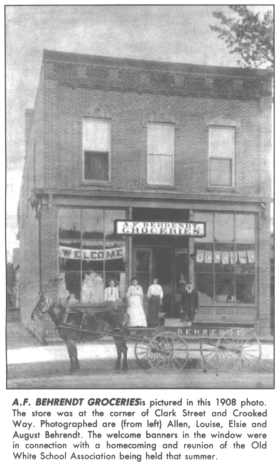
In 1903, he purchased the two-story brick building located on the corner of Clark Street and Crooked Way (Ellis Street), just east of where the telephone company building now stands. With the family occupying a flat on the second floor, he continued to operate his grocery business until the time of his death on March 28, 1918. His wife and their daughter Elsie continued the business for about a year; finally closing it in 1919.
The many stories my grandmother told me of life in those years served, early on, to instill in me an intense and lifelong interest in Stevens Point’s colorful history.
Submitted by
Allen C. Fowlie
Madison
The Bliss Family
The first white girl born in Portage County was Geraldine Bliss, daughter of Nathaniel F. and Mandana Hale Bliss. They came to Stevens Point in 1847 and had nine children. In addition to Geraldine, they were Adelbert, Samuel, Mason, Josephine, Harvey, Charles, Anna, Franklin and Susan.
Geraldine Bliss was married to John P. Clark. They had nine children, including Ray Clark. Their children were Jim Clark of Stevens Point, Virgina Larson, Oconomowoc, Estele Roseth, Stevens Point, Donald Clark, Lodi, and late Geraldine Shannon.
Geraldine Bliss’ daughter, Anna, had three daughters, including Marjorie Smith, who recently celebrated her 101st birthday at the River Pines Nursing and Rehabilitation Center.
Mandana Hale Bliss was a pioneer schoolteacher in Portage County. She taught for two terms at a private school, thus became the first teacher in Portage County.
Brilowski Family
Soon after central Wisconsin’s last great white pine lay blocked and readied for the sawyer’s blade, Immigrant Polish farmers heard of the vast acres of virgin farmland located east of Stevens Point. Family legend tells of table-top stumps throughout a corridor south of Jordan Pond along present day Brilowski Road.
In 1865, “Polanders” Lorenz and Anna (nee Jarzewski) Meyer of Berlin purchased a tract of land adjacent the “Big” Plover River and along the thoroughfare that now carries their future family’s name. In the first three years, while Anna took care of the children at their Green Lake County home, Lorenz cleared the pinery’s wreckage to open fields for farming. He would raise a rotation of crops including snap beans, potatoes, corn, oats, rye, and pasture for a growing dairy herd. He built a house, barn and granary on the site where his great-grandson Leonard Brilowski farms today.
Lorenz was ready to expand the farm when Anna finally joined her husband in the spring of 1868. Brazened by his experience pulling the enormous stumps from the first fields and now armed with the recent discovery of dynamite, Lorenz decided to buy and clear 40 additional acres of raw land off what is presently Rainbow Drive. Today, his great-great-grandson, David, farms near this parcel.
Baby Pauline may have been part of the reason Anna had to stay in Berlin. Anna was pregnant with her daughter the year Lorenz moved to the town of Hull. Then, the Meyers may have decided establishing the new farm was too risky for a newborn baby.
Nearly 20 years later, the Meyer’s family circle became complete when Pauline and her future husband joined league with her older brother Leon and his wife to build a home for their aging parents. The house - no longer standing - was built on land across the road from the first homestead.
When a young Berlin man known as George Brill answered the call to come work for Lorenz, he already knew Polly Meyer as the daughter of a family friend. For at least three years George worked for Lorenz clearing 40 more acres where the new Meyer’s home would stand. It was probably a warm breezy late June day when Polly and George fell in love. Then, George may have been collecting the marsh hay on the south forty when Polly would bring him lunch.
George married Polly about the year 1886. Stephen, their first of seven children, was born in 1887. He was followed by Frank, Mary, John, Veronica, Joseph and Anna. With a large family and a common alias himself, George had created a legacy of different family names.
Following his death in 1899, George’s sons, who also knew their father by the name of Stanley Brillowski, could pick the surname of their choice. Frank and Stephen took the name Brillowski, whereas John remained a Brill. The youngest son, Joseph went a different route, dropping an “L” to be named Brilowski.
Joe remained on the farm and on June 25, 1923, he married Josephine Jurgella. Together they had eight children, Robert, Isabelle, Chester, Joseph, Donald, Leonard, Myron and Norbert.
In 1933, Joseph and Josephine began the J. T. Brilowski and Sons Dairy, a retail milk route for the Stevens Point area until the early 1960s. Joe delivered milk, cream, butter and related dairy products door to door until his sons were old enough to take on the route.
Business operating hours began at 4 a.m. when milk was pasteurized and bottled on Lorenz’s original farm site. The Brilowski brothers divided the work by age. Older boys did the delivering, while the younger sons were responsible for the milking and bottle washing.
Although the work never seems to end, the brothers found plenty of time for sport. Often orchestrating the area’s first indoor basketball games - inside the hay barn. It was cold, but the floor was hard and free of snow. In the summer, the brothers recruited a few cousins to play softball. Under the team moniker “The Brilowski Dairy” they played some of the best ball in the area.
Today Brilowski Farms is incorporated. It is operated by Len and his wife Justine, their son, Stephen, and daughter, Rebecca, and Len’s brother Robert and his son Dave with his wife Rose and family.
Len and Justine’s other children include Karen and Jane.
The corporation farms 715 acres with 520 geared toward the production of potatoes, alfalfa, oats, corn, rye and 120 head of Grade “A” Holstein cattle. The rest remains forested - mostly great white pines.
Submitted by
Steve Brilowski
1282 N. Brilowski Road
Stevens Point
The Borgen Family
My name is Donna Borgen Sowka, and both sides of my father’s family came to Portage County when it was first being settled. His father’s grandfather Torbjorn Gunderson Borgen came in the spring of 1854. He settled in the township of Amherst. He came from Setesdal, Norway, in the company of his brother Thomas, on a wooden sailing vessel, the Inga.
After eight weeks of sailing, they reached Quebec, Canada, and came in through the Great Lakes. It was on this ship the brothers met their future wives, whom were also sisters, Anna and Ingeborg Benson.
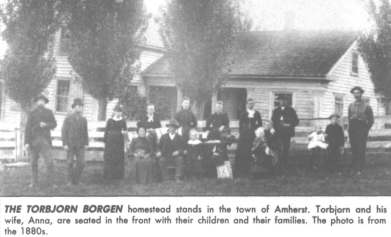
The brothers worked for a short time in the lumber woods near Stevens Point before coming to Amherst. Thomas located on a farm about four miles into Waupaca County. Torbjorn purchased 40 acres of land from the government and began what is now the fifth generation of Borgen dairy farmers. He cleared land and built his log cabin. He had to walk to Waupaca for his provisions, which he would carry home on his back until he could purchase a yolk of oxen.
He was married in 1855 to Anna Benson. They had six children, the eldest being my father’s grandfather. In 1864, at age 33, he enlisted in Company B, 17th Wisconsin, and joined Sherman’s army in Georgia. He was honorably discharged in June 1865.
The farm was turned over to his son Ole after his retirement. His family worked hard to develop what is now a very successful farming operation. I was told he did some horse trading, and was quite generous with his children. He helped each of them purchase their own farms. His farm stayed in the family until the 1970s, and his house still stands and is well cared for by Wallace Schulfer of Amherst.
Torbjorn and his children were instrumental in building and starting the Hie Corners School, which is presently being restored in the Historical Society’s village in Plover. My grandfather Turben Borgen donated the school building a few years back. Grandpa is now 93 and was one of its first students.
Submitted by
Donna Borgen Sowka
725 Michigan Ave.