Portage County Historical Society
Family Vignettes Page 2
taken from the May 19, 1992 Stevens Point Journal
The Buelow Family
Fredrick Buelow was born in Pommern, Germany, in 1835. He came to the U.S.A. in 1858 and settled in Oshkosh where he met his bride-to-be Albertiene Schultz, who was born in Pommern, Germany, on March 22, 1846. She came to the United States alone in 1868. They were married in 1870 in Oshkosh and lived there for some time before moving to the town of Eau Pleine in 1897. They settled on 80 acres of timberland and lived in a big log house for 34 years.
To this union eight children were born three in the town of Eau Pleine. Daughter Martha, the last of the children, was born June 3, 1880, and died in October 1888 of diphtheria. She was the first to be buried in the Buelow Cemetery.
Mrs. Buelow’s brother, Mr. Schultz, lived one mile up on Oak Road and Uncle Karl Kohlmeir lived across Oak Road, near them. So, to make a living, the family logged, had a sawmill, sawed lumber for other people and sold lumber and stove wood on the Square in Stevens Point. They also had two steam engines and two thrashing machines to thrash grain for the farmers in the fall. They also made maple syrup to sell and milked cows and sold milk to the cheese factory and cream to the creamery to make butter. They also grew many potatoes to sell.
The woods were full of wild animals. They told many stories such as when Fred Buelow Jr. was 10 years old and got chased by a big black bear. Lucky he had his gun aimed and killed the bear.
After 35 years, they built a big brick house which still stands on the farm. They sure had many hard times and misfortunes of deaths. Albertiene’s mother, Caroline Schultz, lived with them for many years. She died in 1905 at the age of 85. Daughter Ida Sack’s husband, who was pastor of a Lutheran church at Tigerton, died of a heart attack as a young man. She came home to her mother to raise her five children. Their youngest son, Otto, died in 1900 when he was 18 years old. Fred Jr.’s wife died in childbirth and he brought his baby girl and three other children home to mother to raise in 1906. Then Karl Buelow was kicked by a horse and died in 1907. Then Dad Fredrick Sr. died in 1908.
The older children had to walk three miles to school in Junction City. The Lutheran Church wasn’t that far - one mile - at the corner of Highway 34 and Oak Road, for church and catechism.
Albertiene Buelow died at age 89 in 1935. Of 33 grandchildren, 16 are still living. I am the oldest child of the youngest son, August Buelow. I am 82 years old.
Submitted by
Irma (Buelow) Bulgrin
2787 Victory Road
Junction City
The Bulgrin Family
Gustav Bulgrin was born in New Lisbon on May 14, 1868, to Mr. and Mrs. John Bulgrin, who came from Germany. On April 30, 1893, he was married to Anna Papp in Monroe County. She was born in Cleveland, Ohio, on Oct. 18, 1874, to Mr. and Mrs. Fredric Papp, who came from Germany. After marriage they settled in Nekoosa and owned and operated the River View Hotel. They also owned a team of horses and operated a dray service from Nekoosa to Wisconsin Rapids for 12 years.
Six children were born to this union. Then in 1907, they traded the hotel for 160 acres of wild land to make a farm on the west end of Portage County, east of the county trunk line in the town of Carson, near Milladore. Two sons were born on this farm. They endured many hardships trying to clear the land to start farming. Then in 1918, a cyclone went through and blew all their buildings down and all personal belongings away, so they had to start over again. And no insurance in those days.
Then they had a lot of sickness in the family. Their oldest son died of an appendix operation; only married three months. When Gustav died on July 23, 1941, son John took over and farmed. Then when John Sr. died on Aug. 7, 1971, his son John Jr. kept on farming. So it has increased in size to date and is quite a farm. It has been in the Bulgrin name for quite some time.
I am a daughter-in-law of the former Gustav Bulgrin.
Submitted by
Mrs. Leonard (Irma) Bulgrin
2787 Victory Road
Junction City
The Copa/Sopa Family
John and Elizabeth Copa moved to their town h5f Buena Vista farm in March of 1893, after living in Winona, Minn.
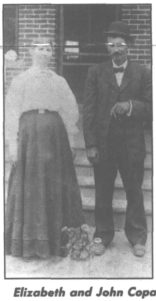
Both had immigrated to Winona from their home villages in what was then part of the German Empire and is now northern Poland. Present day maps identify the area as “Pojezierze Kaszubskie or the Kaszubian Lakelands located just to the west of Gdansk. This area borders the Baltic Sea on the north and extends southward to the area of Chojnice.
John had lived in the tiny village of Kobyle gory in the Chojnice district of the Bydgoszcz province, where his family had a small farm. He was nearly 21 years old and was facing four years of compulsory military service. Chancellor Von Bismarck's harsh Germanization policies had made life as a Pole in a German state less tolerable. There was always a tone of resentment when John talked about the Kaiser or the owner of the estate on which they lived. As a result, in the fall of 1881, John and his parents, Stephan and Magdalena (Lemanczyk) Copa, and his two sisters and two brothers decided to leave for America. They left the port of Hamburg on a ship bound for England in October. They then went on to the port of Liverpool, where they boarded their next ship, bound for New York. This ship began to sink shortly after leaving the port. John often told how the passengers were transferred from one ship to another while still at sea. Despite stormy weather, the SS England arrived safely in the New York harbor in early November.
Elizabeth’s home was in the tiny village of Sluza, also in the Chojnice district, just to the east of her future husband’s village. She was 19 years old when she and her brother, Bert, traveled to America with their uncle and aunt, Teofil and Anna (Bielawa) Prondzinski in the spring of 1884. Their route took them to Glasgow in Scotland, and then on to New York.
Her father, John Trzebiatowski, came the next year in June, and her mother, Victoria nee Bielawa, and the rest of the family arrived that December. Victoria’s brother, Paul (m. Anna Rozek) and their uncle, Peter Bielawa (m. Josephina Gorecka), had lived in Portage County since 1866.
All of Elizabeth’s family except for her half-sister, Catherine (m. Frank Literski), settled in Portage County. Frank, Andrew, Ignatz (Nick), Joseph, Onufry (Charles), Mary (m. Peter Glodowski) and Jacob all married and lived on farms in the rural Amherst area. Their parents’ farm was near Lime Lake and most lived a short distance away.
John and Elizabeth had married on January 18, 1888, in Winona. John was a mason and the seasonal nature of his work as well as the presence of Elizabeth’s family drew them to Portage County.
Their daughter, Sister N. Hermina, soon to be 95 years old, tells of her father’s hard work and patience while clearing some newly acquired fields of the stumps left by the lumbering crew. Despite the difficult task, he sang as he worked. In addition to farming, he continued to work as a mason, usually for John Lubetski. The foundations of many of the new buildings in that area were constructed by them. Because he often worked away from the farm, her mother and the children usually milked the cows. She also tells how her mother made all the clothes for her family. She kept a spinning wheel busy, as well as her knitting needles. As soon as they were able, all of the children joined in the daily farm duties.
John and Elizabeth had a large family with 11 reaching adulthood. Two of their daughters became nuns, Mary, mentioned above, and Susan (Sister M. Luella). Their daughter, Helen, lived in the Medford area, but Martha, Lucy, Frances, Joseph, Florian, Charles, Anna and Louis all married and lived on farms in Portage County.
Submitted by
Adeline M. Sopa
Green Bay, Wis.
The Cyra Family
In September 1871, Peter Cyra, his wife Mary Lana Cyra, two sons, Stanislaus and Alexander, arrived in New York from Gdansk, Poland, by way of Bremen, Germany.
They lived in Michigan for a few years, before arriving in Stevens Point in 1876. Two more children were born Laura and John. Mary Cyra died giving birth to John in December 1878. Peter married Michaline Ligman Cyra in February 1879, becoming an immediate and loving mother of his four children. Ten more children were born, two dying as infants during a diphtheria epidemic. Daughter Helen married Roman Bucholz -- Bukolt Park.
The Cyra family bought land taught themselves and their children English. Half of the original family farm on Highway E has been in the family until this past year, and the other half across the road was owned by the second son, Alexander Cyra. The two-story home he built of bricks and one of the barns can still be seen from the road. Alex kept the original home as a granary, separating the rooms with wooden half walls. During an electric storm, the barn was struck and started to burn. Friends and strangers came and formed a bucket brigade from the river to the barn. Most of the animals were saved but not the barn. It was also the day of the wedding reception of John Cyra, the son of Alex and Mary Cyra. The reception went on as planned.
I remember the spear fishing from boats with smudge pots that did not keep the mosquitoes away, fish cleaned and pickled in large crocks. Soap, butter, gloves cut from cured deerskin using a hand for a pattern. Bread made in the giant wood stove, ironing done with up to four irons placed on the stove and replaced as they cooled. The summer kitchen not remembered happily, but the canning then took place there, especially the beef and chicken in two-quart jars. A taste not found today.
The thrashing parties, and they were parties, hard work, wonderful food, and so many people, and the laughing and talking. The three-day weddings, and all could dance no matter the age, and the older dancers were the best.
During a diphtheria epidemic, Michalina Cyra made large pots of soup, enough to fill up two milk cans. Her son Alex would fill kettles with the hot soup and leave it at the back door, then feed the animals and milk the cows for the neighbors who were too ill to leave the house.
Dogs, chickens with glass eggs in their nests, cats wailing for milking time, hoping to have milk squirted at them, the huge bull controlled with a ring in the nose and a baseball bat in the hand. The pigs and the really good smell of the pig soup (slop), the baby calves sucking on your fingers, taking the cows out to the field and back again. The geese that alternately protected and attacked, and the wonderful goose down pillows and comforters.
The last day my grandfather Alex Cyra walked on his farm after it was sold, he took his granddaughters hand, mine, and we walked and we sat on the riverbank, He handed me a shaft of wheat (I still have it), told me to look across the river, close my eyes, listen to every sound, make a picture and I would always have it. I can still close my eves when I hear a fly buzzing, hear the breeze through tall grass, see the river and feel Grandpa's hand around mine.
I feel great pride and love for my Cyra ancestors. Their love of the land, animals and family is an inheritance I value. Though I live in California, Wisconsin is my home.
Submitted by
Jeanne V. Tanghe
Livermore, Calif.