Portage County Historical Society
Family Vignettes Page 11
taken from the May 19, 1992 Stevens Point Journal
The Steffanus Family
The Steffanus family history begins in Alsace-Lorraine, France. Joseph Paupun came to America in 1838 in a sailing ship which took a month to cross the Atlantic. He had been a soldier under Napoleon I.
William Steffanus was born in Etting, France, where his forefathers are traced to 1670. Alter serving seven years as a horseman in the French Army he came to New York in 1850. William and Melanie Paupun were married in Buffalo and moved with the Paupun family to Eden, N.Y., in the vineyard country, where Joseph died.
In 1855 they moved to Portage County with two infants, Rosalie and Charles. Six hundred forty acres of land were acquired in Sharon township; 320 acres by homesteading, the rest for 25 cents an acre.
William was a man of great strength, enterprise and ability. To reach his land he had to cut a road thru heavy woods. First a shack was built, but shortly after, it burned down. He was not a wealthy man. With only $100 left, a log house was built. In 1876 the log house was replaced by a substantial building of stone which was quarried from his own farm. It was built by the Lauer Brothers of Stevens Point and William often called it his “chateau.” Stone walls were erected to protect the vineyard from wild animals and thieves.
He was a loyal churchman and helped establish St. Martin Catholic Church, Ellis, in 1866. He served Mass, copied music for the choir and put up quarry stone markers in the cemetery. Three more children were born in Wisconsin. The first language they learned was French.
Rosalie married Henri Lauer and the construction business was moved to St. Paul, Minn. She arranged for her 34-year-old brother, Charles, to meet and eventually marry a beautiful immigrant, Elizabeth Eiden from Trier, Germany. Despite country schooling only long enough to master the 3 R’s, Charles was fluent in four languages. Of the seven children born to the marriage, the two eldest sons died in early childhood in the 1890s, as did Charles’ father and both brothers.
The marriage lasted 19 years when Charles died of typhoid fever, leaving 14-year-old Martin the “man" of the family. Charles’ obituary read: “He was one of nature’s noblemen and his death an irreparable loss to family and neighbors.” A mile-long procession was formed at his funeral.
Martin’s marriage to Ellen Simonis in 1920 united two of the earliest pioneer families in the county. During his ownership much of the land was cultivated, a purebred Guernsey herd was developed, the quarry was operated and Steffanus stone was used for buildings throughout the state. Stonehurst was chosen as the name of the farm.
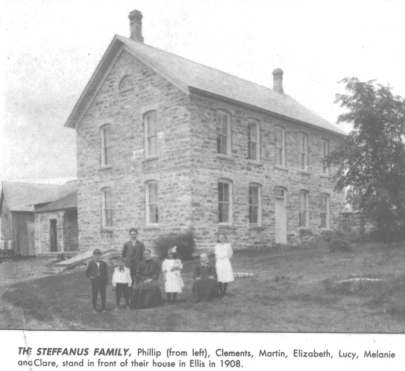
Martin’s son, Wilfred and Agnes Steffanus were the fourth owner of Stonehurst until 1985. Martin’s daughter Avis, Mrs. Louis Wysocki, is the present owner of the 137-year-old family farmland. Her son, James Wysocki, and his wife Sharon own the century old landmark house on County K. Their daughters, Katherine, Christine and Allison are 6th generation descendants of the original settlers. The family continues the tradition of hospitality to the many descendants of William and Melanie Steffanus who come to Stonehurst for a glimpse of their roots.
Submitted by
Sharon Wysocki
Custer
The Stoltz Family
According to his intent to naturalize, August and Magdalena Stolz arrived in New York in August of 1869. They had lived in the Kartuzy district in the Kaszubian area just to the west of Gdansk, at that time, West Prussia.
Their grandson, Casimir Sikorski, inventor and writer of many articles on a variety of subjects wrote that they traveled by rail to Berlin, Wisconsin, and then walked the rest of the way, 40 to 50 miles, to their destination of Polonia in Portage County.
Their arrival in Portage Countv had been preceded by that of many families, including neighbors, from that Kaszubian area in the north of present day Poland. Sikorski writes that the only English word they knew when they arrived was, “Veesconssen.”
They purchased a farm in the town of Sharon, to the north of Polonia. It was cutover land covered with stumps, very hilly and filled with stones. Very affordable land for a recent immigrant who was more than willing to work hard. Probably a part of the terminal ridge of the Green Bay lobe of the Wisconsin Ice Sheet which covered most of Portage County about 10,000 years ago. Today, the Ice Age Trail passes through this area.
About 1875, Magdalena was surprised by a visitor who was her brother, John. He was about 11 years old when she and August had left for America, and was now about 23. John lived with his sister’s family until his marriage to Anna Jach/Yach. Their farm was also located in the town of Sharon.
In 1895, August lost his life in an attempt to bury a particularly large rock, described as being several hundred pounds in an article about the accident. Another report noted that he and a hired man, Frank Zoromski, were digging a hole in which to bury the rock. They had reached a depth of four or five feet when the ground began to give way and the rock rolled down on them. Zoromski was slightly injured, but August had been crushed by the rock and died almost instantly. One report of his death noted his success as a farmer in that area.
He was survived by Magdalena and their eight children. The youngest, Augustina, who was 12 years old, had responded to the calls for help by Zoromski. The others were Marianna, Catharina, Joseph, Rosalia, Frances, Josephine and Anna. All but Rosalla and Frances were life-time county residents.
Submitted by
Adeline Sopa
Green Bay
The Trzebiatowski Family
Andrew Trzebiatowski was one of nine children of John (Von Zmuda) Trzebiatowski and Victoria Bielawski Trzebiatowski.
He was born Nov. 28, 1872, in the town of Konierzyny, about 40 miles southwest of Gdansk, Poland, county of Chojnice.
He was about 12 years of age when he came to America along with his mother and seven siblings. His dad John and sister Elizabeth (Sopa) came to America before them in order to escape the pressure of the German land policies under the Iron Chancellor - Bismarck.
He farmed with his parents on the land his Dad settled in the southeast corner of Amherst township, until his marriage to Rose Glodowski at Sacred Heart Church in Polonia on Jan. 23, 1894.
They then bought a farm of their own that joined his Dad’s land. This farm was later settled by their son Max, who passed it on to his son Myron (Arlene Ebel). It is located at 5274 Lime Lake Road.
After Max settled the homestead, Andrew and Rose bought a smaller farm located presently at 8899 Fountain Grove Road. When they were ready to retire, they sold the farm to their younger son Nick. Don Shulfer (Hazel) owns the property now.
They retired to a small parcel of land next to St. Mary of Mount Carmel parochial school in 1938. He was a well-known merchant on the Public Square from 1938 until the time of his sudden death, due to lockjaw.
Andrew and Rose had 14 children. Two died in infancy, Regina and Robert. The 12 surviving were Agatha (Anton Konkol), Martha (Alex Patoka), Agnes (Joseph Patoka), Dorothy (Peter Konkol), Max (Rose Wierzba), Clara (Frank Patoka), Henry (Suzie Wierzba), Nick (Eleanore Shulfer), Mary (Peter Printz), Susie (Alvin Jastromski, Gertrude (John Stuczynski), and Esther (Ed Kliczko).
Most of the children settled near their parents’ farm married and had children of their own, except for Henry and Esther who settled in Chicago.
From this family there are 842 direct descendants (last count in 1989) when a huge family reunion was held at Lake Pacawa.
Andrew died Aug. 14, 1948, and Rose died on May 22, 1952, of cancer. They are both buried in the cemetery of St. Mary of Mount Carmel Church in Fancher.
John (Von Zmuda) Trzebiatowski (his full German name) was born about the year of 1839. The last name originated from a town called Trzebiatow (Treptow in German). It is located 25 miles east of the German-Polish border on the shore of the Baltic Sea.
His family moved to an area about 40 miles southwest of Gdansk. It is in the county of Chojnice in the village of Konierzny. Among other things, they owned a feed and flourmill run by waterpower.
John came to America to Winona, Minn., to join a daughter Elizabeth (John Sopa) who came before him. He did this to escape the pressure of the German land policies under their Iron Chancellor - Bismarck.
After their youngest son Jacob was born, John’s wife, the former Victoria Bielawski also came to America with the rest of their children. They had nine children who were all born in Poland. They are Frank (Martha Glodowski) Elizabeth (John Sopa), Bartholomew, (Olbrantz), Ignatius (Frances Knitter), Joseph (Frances Domazek), Mary (Peter Glodowski), Onufry (Johanna Buzza), Jacob (Rose Milanowski) and Andrew (Rose Glodowski).
About 1885, John bought a farm in the southeast corner of the Amherst Township. This might have been arranged through a promotion of the Green Bay and Western Railroad. The site of the land is now owned by Charles Trzebiatowski, son of Tony, grandson of Onufry. Later he expanded his property to include the land that is now owned by Richard Trzebiatowski, son of Jack, grandson of Jacob.
All their children, settled around their parents where they grew up, married and had children of their own. John died on Jan. 29, 1913, at the age of 74. His wife, Victoria, died May 17, 1910. They are both buried at the cemetery of St. Mary of Mount Carmel Church in Fancher.
Submitted by
Sharon Wysocki
Custer
The Tufte Family
Ole Tufte came to the United States from Sundalen, Norway, in 1879. He was born in 1856 and worked on a farm until he was 23 when he decided to leave his native land, hoping for a better life in the new country. Many of the young men of Norway were fishermen and it was a dangerous profession in the cold, stormy North Sea.
When he arrived in Stevens Point, he had a trunk with his name on it and a pair of home-made skis. Nearly everyone was able to ski in Norway.
He found work shortly in a lumber camp and worked at SherriMills, west of Junction City. Later, while living in Stevens Point, he met and married Marit Rogield, who had come from the same town as he had - although they hadn’t known each other in the “old country.” Her father had come to America many years earlier to earn money to send for his family, but he was killed or died of pneumonia while working in a lumber camp. He is buried in a Stevens Point cemetery.
My grandfather, Ole, became acquainted with Mr. Weeks and became a millwright in his mill. He also did saw filing at home, employed by the Lullabye Furniture Co. He always walked to his work over the bridge to the mill, just west of the bridge. My mother said many times when he just got home around 7 o’clock and was eating supper, Mr. Weeks would come peddling on his bike and call my grandfather back to file saws or repair some machinery.
Ole and Marit were the parents of 10 children, two who died in infancy. After the third child was born, he decided to build their own home. It still stands at 1557 W. River Drive and the youngest son and last survivor still lives there.
Many early settlers from Norway moved to the west side of Point. They had a few cows and it was the children’s jobs to drive them to and from the pasture. Many times it was left to the girls to do this, as the boys had other things to do.
Most people had boardwalks in front of their houses, and I can still remember the sound when we used to run on them.
My grandfather was ahead of his time because he believed in education for his daughters - four who attended college and three became teachers.
A few other things come to mind when I think of him. My mother said he was health-conscious, when not much was known about germs. All fruit and food that had to be handled must first be washed good as well as hands. This was easily understandable because so many in their little settlement had tuberculosis and usually it was fatal.
Submitted by
Marit Erickson
1117 Main St.
Junction City