Portage County Historical Society
Family Vignettes Page 12
taken from the May 19, 1992 Stevens Point Journal
The John Wysocki Family
John Wysocki immigrated from Pound in 1878 leaving his parents and siblings behind. Many Poles came to Portage County in that era and many of them settled in Ellis, Wisconsin, which was known at that time as “Poles corner.” John married Justyna Lukasavage. Her family had moved to Ellis in 1863. Her father, Casmir Lukasavage, operated a grocery and tavern business in Ellis.
In the early years, John operated a retail business on Clark Street in the downtown section of Stevens Point. By 1886 John and Justyna would build their home in Ellis from local virgin timber. The home was copied from the Frank Kirwin home that stood on Main Street in Stevens Point until 1951 (currently the SE corner of the Shopko mall parking lot) when it was razed and the National Tea Store built, later called Bob’s Food King.
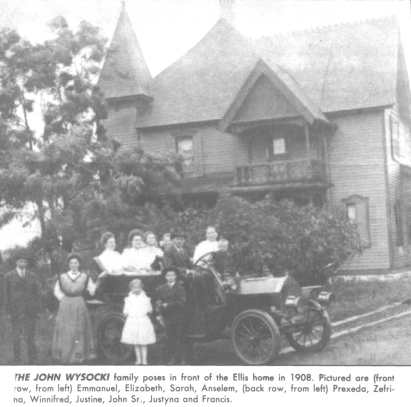
In Ellis, John operated an International Harvestor dealership and General Merchandise Store as well as farmed. He was also town of Sharon’s treasurer for more than 30 years. John “guaranteed passage” for many Polish immigrants including one of his half brother, so that they could come to the U.S. He would pay their way to America and once here they would work and pay him back for the loan.
John and Justyna raised 10 children, many well known in their community for involvement in education and government, also for their longevity (many lived into their late 90s.) John Jr. operated a grain elevator in South Dakota. Later he would travel to California and run a nursing home. Anselem served in WWI and returned to become a teacher and later high school principal.
The six daughters, Elizabeth, Prexeda, Zefrina, Winnifred, Justine and Sarah became school teachers. Later some would leave teaching to marry. In those days you weren’t allowed to teach and be married.
Winnifred taught at many local schools and was an active member of St. Martin Catholic Church, Ellis. She wrote the history of St. Martin’s for their Diamond Jubilee in 1932, was choir director, sacristan and coordinated many church picnics, several of which where held at the Wysocki home.
Emmanuel moved north to Winchester in the early 1900s when logging camps around the Minocqua area were clearing the land of its timber. He was a carpenter “well-known for his log homes,” operated a logging camp and later farmed his land well into the 80s, living to be 101.
John and Justyna’s youngest son, Francis Sr., stayed in Ellis to farm. He married Clara Grenier in 1926 and together they had nine children. After the “repeal of Prohibition,” Francis opened the “Buckhorn Tavern” which he operated until 1953 when he sold it to his daughter, Jeannette and her husband, Mike Orlikowski; they ran the business until 1969.
Like his father, Francis Sr. was town of Sharon treasurer for approximately 30 years. This tradition still goes on today with Francis Jr. as town treasurer since 1971. In 1953 Francis Sr. began to farm more intensely with his sons, Louis and Francis Jr., as his partners. Gregory became part of the corporation in 1964, known as “Wysocki Farms Inc.” Today there are 18 active family members working together producing 4,200 acres of irrigated vegetables.
Paragon Potato Farms Inc., a large potato processing facility, and Russet Potato Exchange, a marketing firm headquarters, are located across Hwy 66 from where John built his home. The house was razed in 1990 after the death of Winnifred who had resided there her entire 96 years. Francis and Clara’s other daughter, Justine, is married to Leonard Brilowski who runs a sizeable dairy and vegetable farm in the town of Hull.
Their son John works for the Social Security Administration and lives in Madison, and Lawrence owns a computer business in Milwaukee.
Submitted by
Sharon Wysocki
Custer
The Frank Wysocki Family
Frank Wysocki and his wife, Mary Szmaglik, were born in Lesno parish, Bydgoszcz, Poland.
They had their first two children, John and Josephine, while still living in Poland. They came to America between 1865 and 1868 and apparently lived in New York for a short time and then in Chicago where their son, Joseph, was born. They moved to Portage County between 1870 and 1875.
The family farmed in the town of Stockton. The children of this couple were John F. (Johanna Fierkus), Josephine, Joseph (Mary Bluma), Charles (Edith), Antonia (John Polly), Frank John (Anastasia “Stella" Rinka) and Monica who died shortly after birth.
Mary Szmaglik Wysocki died soon after the birth of her last child. Frank Wysocki then married Elizabeth Jakubowski who was born at Suleczyno in Poland. They had three children, Anton (Antonia Cieminski), Helen (Anton Mroczynski) and Frances (Michael Karcz).
Frank Wysocki farmed all his life and lived in the town of Stockton until he died.
The descendants of his son Frank John and “Stella" Rinka will have a reunion at Lake Emily on July 11, 1992.
Submitted by
Diane Wysocky Anderson
Poulsbo, Wash
The Whipple Family
The Whipple family put down roots in the town of Lanark, Portage County, with the arrival of Ira Whipple (my grandfather) with his wife Adelia, daughters Annette and Emmarette and son Frank. They came from Buffalo, N.Y., to make a farm in the Winnebago County wilderness. In 1862 they traded this for a farm eight miles west of Waupaca in the Badger community. Ira, who loved good horses, worked hard to improve his new farm as he built a frame house and barn which are still standing.
Ira was stopped in his work by the seriousness of the Civil War. Even though he was 44 years old he volunteered for the Union Army in March 1864 and was discharged in July 1865. Ira’s wife and children ran the farm, sowed wheat and harvested it and chopped their own firewood while he was at war.
Adelia died in 1872. Soon after her mother’s death, Emmarette went as a missionary to the Dakota Indians. Her early experience was at the Badger Church teaching Sunday School. After two years, she became sick with typhoid fever and died in 1877. She and her mother are buried in the Badger Cemetery with “She did what she could” carved on their tombstone.
Ira Whipple did not wait long after the death of his wife until he married Hattie Porter, (my grandmother) who was working at the Phelps Wayside Inn, a few miles west of Badger. Ira’s first wife was much older than he, but Hattie was 29 years younger. They had eight children. They continued to farm, raising hops as a cash crop. The hop house stood along-side the road for many years and was an object of interest, for family members often told of the hop harvest and the dances for the hop pickers.
Ira was active in civic affairs as he was one of the first chairmen of the town of Lanark and served as a member of the first Portage County Board of Supervisors. But Ira did not live to bring up his family. He died of pneumonia in 1888 when the youngest child, Harry, (my father) was only six months old.
His wife, Hattie, was of sturdy pioneer stock and the death of her husband did not defeat her. She continued to run the farm with the help of a brother for a short time. The older children soon learned to do whatever task had to be done. Planting and harvesting were done on time. Myra was said to be the best corn husker of all. I expect the neighbors “changed help” too. Some of the land was rented out for a share of the crop, which was sold. Firewood was obtained the same way. On the farm was plenty of wood to be cut on “halves.” A few cows, pigs and sheep along with a big garden and apple orchard produced food and cash for the family. Living was meager, but no one ever went hungry.
With all the work of making a living, Hattie did not neglect the education of her children. They all finished the eighth grade at the Badger School. Two of the girls became teachers in Portage County rural schools. Ada and Sarah studied to be dressmakers in Waupaca. Gertrude became a registered nurse. Harry worked several years as a male nurse in mental hospitals, and later became a carpenter. Theron, the oldest son, stayed home and became a farmer. Amy, a teacher, married a town of Lanark farmer, Charles Swenson. Hattie married another farmer, Frank Onan, whose sons and grandsons are present day town of Amherst farmers.
Education in the Whipple household included a daily paper which was passed around. Plenty of books were available from the free lending library in Madison. A big wooden box of books was obtained each winter and was kept at the Whipple home for the use of the whole neighborhood. This meant a trip to Waupaca with the team as the books were shipped as freight.
Among her many tasks, Hattie was Postmistress for Badger, Wisconsin Post Office in her home. She was present for many births and “laid out” the corpse in many deaths. She was called upon in sickness and neighborhood emergencies. Church attendance was a must for her family as she tried to “bring up her children in the way of the Lord.”
Along with her many interests, this grand old lady kept up with local and national politics. When women were first given the right to vote, she was one of the first women to vote at the Lanark Town Hall and never missed a presidential election thereafter. She was a staunch Republican.
Ira and Hattie Whipple have made their mark on their descendants, many of whom have been lifelong residents of Portage County. I like to think that their ambitions, attitudes and beliefs and their example have influenced others to become good solid citizens.
Submitted by
Agnes Staples
Town of Grant
Portage County