Portage County Historical Society
Family Vignettes Page 10
taken from the May 19, 1992 Stevens Point Journal
The Rinka Family
Christian Rinka was born in 1847 at Kaszuba, Lesno parish, Bydgoszcz, Poland. He probably attended school as he could read and write in Polish and German. He served in the Prussian Army during the Franco-Prussian War of 1870-1871. Family tradition says Chris’ brother also served in the Prussian Army.
After the military, Chris Rinka emigrated from Poland to America. He settled in the Chicago area as he had a sister already living there. He went to work on the Wisconsin Central Railroad doing heavy beam construction building the railway to central Wisconsin.
At Stevens Point, he quit the railroad and married Anna Dudzik at Polonia in 1877. After their marriage, the young couple lived in the town of Sharon with her parents, Paul and Anna (Cyrhowska) Dudzik, for several years before buying their own farm of 40 acres near Jordan School in the town of Hull. Chris did iron work and made many of his own tools. He also was a gifted woodworker and made violins.
The family farmed in the town of Hull and eventually purchased more land to increase the size of their farm.
The children of Christian Rinka and Anna Dudzik Rinka were Peter (Frances Retchey), Leo (Lucy Kulas), Anton, Paul (Polly), Rose, Anastasia Elizabeth (Frank Wysocki), Tillie (Alex Payette), Agnes (John Hintz), John J., Frances (Ben Konkol), Adolph (Jennie Blomdahl), Barney and Edmund (Mae Davis). Some of the families remained in Portage County but some scattered to Rhinelander, Milwaukee and Black River Falls.
Submitted by
Diane Wysocky Anderson
Poulsbo, Wash.
The Rogers Family
Publius V. M. and Charlotte Lamphier Rogers came to Wisconsin from Rome, N.Y., in 1850, settling first in Ripon and then moving to Stevens Point in 1856. Pubilus Rogers operated a meat market here.
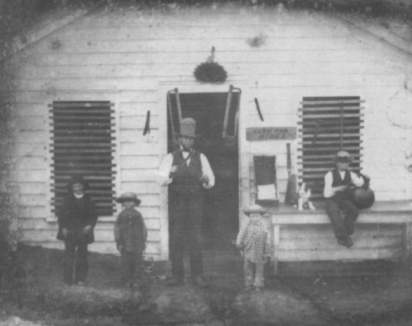
Publius V. M. Rogers sharpens a knife in front of his meat market in Stevens Point. Also in the photo, from left, are his three sons, David, George, and Maro, and on an unidentified boy. The picture was probably taken just before the Civil War.
The couple had three sons. One of them, George L., was a raftsman when the principal means of moving lumber was assembling boards into huge rafts and floating them down the Wisconsin and Mississippi Rivers to market. It was a dangerous occupation, which claimed 40 lives on the Wisconsin River in 1872 alone.
Later George Rogers was an owner of a veneer mill at Glidden. He served as mayor of Stevens Point in the 1890s and was city comptroller for many years. Through him, Pubilus and Charlotte Rogers have numerous descendants here.
Submitted by
George Rogers
Stevens Point
The Schultz Family
On Thursday, June 24, 1886, at 8:10 p.m., Johannis Ferdinand Karl (John) Schultz was born in the town of Stevens Point to August Ludwig Ferdinand Schultz and the former Christina Louise Henrietta Manthey. The information on his birth certificate was given by his older half brother, Karl August Schultz (Charley), who stated that there were “no doctors or road available, had to travel with oxen.”
Their father, August Schultz, was born in Germany in 1840. August and his wife, along with his stepmother, Karoline, 47, sister, Johanna, 22, half-sister, Albertina, 19, and half brothers, Johan, 14, and Ferdinand, 10, all came to the United States about 1866-67, settling in Cook County, Ill.
Johanna met and married Karl Kohlmeyer in the Sag bridge area of Illinois in 1869. Ferdinand moved to Oshkosh where he worked as a tailor and met and married Sara Petersen. John also moved to Oshkosh, working as a machinist, and married Hulda Barsch in 1877.
August’s wife, Augusta, died in 1872, having borne him six children. August was confirmed into the Lutheran church at Sag bridge in 1870, where he apparently met Christina Louise Henrietta Manthey, who had come from Germany in 1864 and was confirmed the same year. She became his second wife at St. Matthew’s Evangelical Lutheran Church in Lemont, Ill., on July 10, 1879, when she was 25 years of age.
August was one of about 2,000 stone quarry workers in the Lemont area. That area had much dolomite, known commercially as “Athens Marble.” Other products of the quarrying operations were lime and limestone. The carbon dioxide given off when lime was made was used for carbonated beverages and dry ice.
In the spring of 1885, the quarry owners lowered the wage from $1.75 per day to $1.50 per day and the workers went on strike. The situation became heated, with the governor of Illinois calling in the militia. Many men were wounded and two were killed. The incident is referred to as the “Lemont Massacre” in the history of the area. The Schultz family moved to Portage County that year.
Albertina, who had married Friedrich Johan Buelow (Fred) in Oshkosh, in 1867 and her mother joined them in Portage County. They are buried in the Buelow Cemetery, which was once called the Lutheran Cemetery at Junction City.
August’s daughter, Ida, married Otto Ludwig Dimke (Dimka) in 1893 and daughter, Hulda, became the wife of Art Zorn in 1902. His son, Leo, served as an army veterinarian stationed in France during World War I and his son, Albert, served as a navy electrician during World War I. Leo died in 1960 and is buried in the Wisconsin Veterans Memorial Cemetery at King, Wisconsin, never having married. Albert, who died at the Grand Army Home for Veterans at King in 1981, was brought home and buried in the Buelow Cemetery.
August died in 1916 and Louisa in 1918, having spent their remaining years farming in the town of Eau Pleine. They were both buried in the Buelow Cemetery. Buelow, Dimka, Schultz and Zorn descendants continue to live in Portage County.
Submitted by
Susan M. Schultz Hopfensperger
Nahotah, Wis.
The Shaurette Family
In the year of 1846, two French Canadian brothers ventured from Quebec, Canada, and ended up settling in what is now Portage County. Their last name was Shaurette, but spelled “Shauret” at that time and pronounced Shau-ray. Compare this to the American automobile called Chevrolet. You do not pronounce it Chev-ro-let, but Chev-ro-lay. In French, a single “t” is silent and the letter “e” takes on the sound of “a” at the end of the name. I was told the added “te” was put on our name by my great-grandfather to bring out the “t” sound and Americanize the name to Shaurette. This took place before the turn of the century.
In 1846, the Shaurette brothers opened up a trading post located approximately one mile up the Wisconsin River from where the bridge is now located. (This was two years before George Stevens opened his trading post.)
After a few years went by and more settlers moved into the area, the brothers thought they would also start farming and produce food for not only themselves but the growing population. From what I was told, this covered an area across the river south of their trading post running down to about where the Mead Park is located.
Both of the Shaurette brothers married in the 1850s and the start of the Shaurette clan of Wisconsin began. There was not very much mentioned to me covering the period from the 1850s until the late 1880s.
One of the brother’s male children, who would be my great-grandfather, became active in local politics in the late 1800s and early 1900s. I think he had something to do with naming “Shaurette Street” near the south side of Stevens Point.
My grandfather, Fred Shaurette, was quite active in business ventures. He started and operated a moving van lines for some 10 years and then went into the tavern and restaurant business. The restaurant and tavern was located on the south side, and after he sold out became known as The Modernistic. The building burned down in 1962 and was replaced by another building and tavern now known as Archie’s.
It should be noted that on my mother’s side of the relation, the names of Bunde and Meek are related and my Grandmother Shaurette was a Harder girl.
Submitted by
Jerold H. Shaurette
2516 Simonis St.