Portage County Historical Society
The Northern Institute
Appeared in the Nov. 7, 1972 issue of The Pinery
Edith (Mrs. Win) Rothman, honorary member of thc Portage County Historical Society Board, has a personal link with Portage County’s earliest decade of community life that is most valuable. The story of her great aunt, Clarissa Emmons Northrop, and an adventure in finishing school education in the rough pioneer days in Stevens Point is a significant picture of the cultural scene. We are fortunate to have this history given to us in Mrs. Rothman’ s own narrative in the following pages.
The Northern Institute by Edith Rothman
A little more than one hundred and twenty years ago a new village was burgeoning on the banks of the Wisconsin. It marked the gateway to the Pineries, then peopled by the, sturdy pioneers from the New England states, and New York and Ohio who were schooled in the democratic processes of town meetings, churches and schools. Many who came to the little village, already known as Stevens Point, were well educated, some with college backgrounds and anxious for their children to have the best training the times and circumstances could afford. Mandana Hale had taught the first school in the village in the late 1840’s. Then came the first public school with its problem of inadequate teachers or none at all until the arrival of John Charles Fremont Maloney in the late fifties (1850’s).
At sometime in the early fifties a pioneer by the name of Newton Emmons arrived on the scene, invited by the business opportunities the new area offered. Born in Connecticut, growing to young manhood in New York State, of Quaker background in a family of teachers, the community desire for better educational facilities pointed to the establishment of a school offering such cultural advantages, especially for young women. What better opening could there be for his two sisters, both experienced teachers, than to join him and conduct just such a school? Correspondence followed, at the slow pace of those primitive days. The two sisters, Mrs. Clarissa Emmons Northrop and Anna Emmons, had previously joined two brothers in Dane County sometime in 1854 or 1855, and secured teaching positions there, but the possibilities in Newton’s plan appealed to them. They agreed to come to Stevens Point with the purpose in mind of establishing a boarding school for young ladies, as well as making a home for their brother. Going first to Berlin, they took passage in the stagecoach for Stevens Point. Meeting the stage coming from Stevens Point, the drivers asked for news from each direction. To their consternation, the Stevens Point driver reported the death of Newton Emmons, unaware that two passengers in the other coach were his sisters. (The Wisconcin Pinery for April 28, 1856, carries the following brief notice: DIED: In this Village on Sunday, the 27th of April, Newton Emmons (formerly of Madison) aged 40 years.)
They decided to continue to Stevens Point, and send for their brother-in-law, Benjamin Burr, then in business in Rochester, N.Y., to help them decide their future plans.
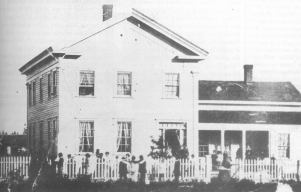
Benjamin Burr arrived toward the end of May 1856, and apparently was impressed with the hustle and bustle of the little village as well as with the need for a young ladies seminary. Plans to build the seminary on the property Newton Emmons had purchased (now the half block between Oak and Center Streets facing Division) were completed. The Pinery of July 10, 1856 reported “A Young Ladies Seminary to be opened up in the course of the ensuing autumn,” and on October 16,1856 added: “The Seminary Buildings are going up rapidly in Crosby’s addition. They will be a valuable institution in Stevens Point. That part of town is going ahead rapidly.” Clarissa Emmons Northrop had excellent qualifications for serving as the head of the new Seminary. A graduate of Macedon Academy, she had been teacher and principal in one of the Rochester, NY, schools for many years. The following comment from the Rochester Advertiser appeared in the Wisconsin Pinery March 5, 1857: “ROCHESTER TEACHERS AT THE WEST. Our city has furnished quite a number of school teachers to the west within the past few years. Among those who have more recently gone there, and with whom those in our city who feel an interest in our schools, part with reluctantly, is Mrs. Clarissa Northrop, who has located at Stevens Point, Wis., and erected a fine Seminary for young ladies. Mrs. Northrop was connected with District School No.11 in this city for a number of years, and was esteemed by both patrons and scholars. She is a most accomplished teacher and will no doubt make herself as popular in her new home as she has been in our city. An experience of twenty years in teaching eminently fits her for the Head of a Seminary. Her assistant, and we believe partner in the institution is Miss Anna C. Emmons, a young lady who has been connected with School No.13 in this city for the past two or three years. Although with less experience than her senior in the Seminary, she is a ripe scholar and a most excellent teacher, and will win her way to popular favor anywhere. We understand that the Seminary, which is a large one, will be in readiness for the reception of scholars next month and that already there are nearly applications sufficient to fill it. We congratulate the enterprising owners of the institution on the prospects before them.”
The Pinery (March 5, 1857) goes on to add: “We can cheerfully endorse all that is said by The Advertiser (Rochester) of this seminary and the excellent ladies who are at its head. The institution, as we are informed, will be opened on the 2d Monday in April next.”
On April 2, 1857, appeared the first advertisement in the Pinery of “The Northern Institute” as it was officially called. A copy of its initial prospectus is given here.
One can realize that it was a truly ambitious program, but Clarissa Northrop was an unusual woman. She apparently was one generation and possibly two ahead of her tine. I am quite sure that had she been living during the tine of the suffrage march on Washington or in some of the women’s lib activities which are so prevalent today she would have been taking an active part
The Gazette of March 28, 1906 carried quite an article on Clarissa Northrop (she was visiting in Stevens Point at the time) under the title “Pioneer Lady Teacher.” Besides speaking about her at the present tine it goes on to say that in spite of her more than four-score years, Mrs. Northrop takes an active interest in the affairs of the day and converses instructively upon all the leading topics. With one side of her body completely paralyzed, yet this ambitious little woman declines the service of maid or friend whenever she can possibly do without them. When in Rochester she became intimately acquainted with the late Susan B. Anthony, who was a teacher in the same school. Mrs. Northrop at that time received 250 dollars per year, the maximum salary for a woman, and she was the first woman in the country to openly protest against the injustice done women teachers in the matter of remuneration. At the First State Institute for teachers in New York, Mrs. Northrop drew up resolutions for the betterment of salaries, which were passed at that conference, and which had the hearty support of Miss Anthony and five other women who were bold enough to vote for the innovation. Mrs. Northrop is a great friend of Miss Mary Anthony, a sister of the suffragist, and a few days ago wrote her a letter of condolence following the death of Miss Anthony. Mrs. Northrop said, no woman ever completed such a great life work as did Susan B. Anthony.”
During all of her years as a teacher, Mrs. Northrop was apparently influenced by her early bringing up in a devout Quaker household. The teachings which she absorbed at that time she endeavored to put into active use in all of her contact with young people.
The first session of The Northern Institute, or as it was more commonly called, the Stevens Point Female Seminary, was commenced in April, 1857. According to The Pinery of July 30, 1857, we find the following: “The first session of the Northern Institute, located at Stevens Point under the charge of Mrs. Northrop, closed on the 16th inst. with a highly creditable examination exhibition of the progress the pupils, about 60 in number. We cannot refrain from bearing public testimony of the complete satisfaction manifested by all... The seminary is a fixed fact and an honor to our county. The enterprising principal has placed in our midst facilities for obtaining a thorough education, equal to that of any other place. It speaks for itself.”
In spite of all the encouraging words the life of the Northern Institute was destined to be short. With the growth of the public schools and the improvement in the teaching facilities which were available, as well as with the advent of the Civil War, the means for carrying on the Northern Institute as a private school became very much of a problem. In 1860 Mrs. Northrop and her sister, Anna Emmons, felt it advisable to close the school.
Following their arrival in the summer of 1857, and after the closing of the school and also from the time of the marriage of Anna Emmons to Samuel R. Merrill, the home was occupied by Benjamin Burr and family. Benjamin Burr’s wife was Eliza Emmons, the sister of Clara Northrop and Anna Enimons.
The original property which Newton Emmons had purchased and which the two sisters took over at first in their project as far as the seminary was concerned occupied the half block between Oak St. and Center Ave., facing Division St. It is now the 1900 block on Division. The abstract of the property shows that the land was originally patented from the U.S. government to James S. Alban. James S. Alban has become so prominent in the history of Portage County, and especially in the town of Plover where he was an early-day attorney, that it probably is of interest to mention that it was originally patented to him. It became the property of Clarissa Northrop and Anna C. Emmons in 1856, and in 1857 it was taken over by Benjamin Burr. For many years it was known as the Burr home and recognized in that way in Stevens Point. In the early 1900’s it passed to a great-nephew of Clarissa Northrop and Eliza Emmons, Charles E. Emmons. Since that time it has been platted into lots, many of which have been sold, but part of the original property which was patented from the United States in 1854 still belongs in the Charles Emmons family.
Clarissa Northrop was my great-aunt. Just prior to her entering the Protestant Home for the Aged in Milwaukee, where she passed away in 1909, she lived in our family for quite a period of time. I remember her as a small, rather frail woman, at that time severely paralyzed on the left side, but attempting to overcome the difficulty in every way that she could. She walked with difficulty and she used the left arm with difficulty, but never the less was courageous about it and tried not to let it be too much of a handicap. I am only sorry I didn’t realize at the time how much interesting information she could have given me; I think of all the things I could have learned from her - it would have been of great usefulness and much pleasure during all of these years in which I have been interested in the local history of Stevens Point.