Portage County Historical Society
University of Wisconsin - Stevens Point
Frank S. Hyer
1930 - 1938
The Depression Years
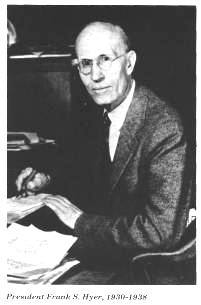
Frank S. Hyer, then president at Whitewater State Teachers College, was named to succeed Dr. Baldwin. Mr. Hyer was no stranger to Stevens Point, for he had served on the faculty there from 1904 to 1919, the last ten years as principal of the Training School.
Mr. Hyer was a graduate of Ripon College with some graduate work at the University of Wisconsin.
At Whitewater, Mr. Hyer had been involved in a controversy, which had boiled beyond the confines of the campus into state newspapers. One of his professors, Joseph Cotton, charged that he had been discriminated against in salary matters because of his political beliefs.
The Board of Regents made a comparison study of Professor Cotton’s salary with others who had similar qualifications and experience and decided that no such discrimination existed, clearing President Hyer.
Mr. Hyer emerged from the fray with a reputation as a conservative, while Professor Cotton’s public image was that of a radical.
It had been a nasty affair, one which split the Whitewater campus and community into pro and con camps, and it may have had something to do with Hyer’s decision to return to Stevens Point.
The sixty one year old Hyer had behind him a long and successful career in Wisconsin education, and Stevens Point was happy to have him back.
He was not only familiar with the duties of his office, but he had extensive knowledge of the college and the territory it served. He was respected in the business community and had been active in civic affairs during his previous residence when he had given freely of his leadership abilities.
The decade of the thirties was not to be a time for starting many new programs at "Central State". These were indeed the quiet years when it would require much effort not to lose ground.
The Depression had diminished state income and many legislators regarded higher education as a dispensable luxury, at least one to be stripped of any frills. Budgets were drastically cut. Mr. Hyer discontinued small classes where it was possible to do so as one economy measure.
Students were often needy. The National Youth Authority (NYA) provided money and students earned it at 30 cents an hour, with a monthly maximum generally at $15. It was not unusual for a student to stretch that $15 to cover all his monthly expenses.
During those years the heads of Wisconsin schools stressed practicality in the education of teachers hired to staff their schools. School administrators respected the accomplishments of Central State Teachers College:
"The Stevens Point College is doing a very fine and common sense piece of work," . . . the people President Hyer has around him, are people who are practical minded. It seems to me the chief aim here is to produce teachers who can actually go out into the field and do a creditable piece of work," Supt. R. F. Lewis, Marsh field, told a group of fellow administrators.
The Wisconsin Rapids Supt. of Schools found that "Work in Central State Teachers College is carried out in an excellent manner. The school has an unusually alert and earnest working faculty. The teaching staff is not given to extreme fads, but copes with our age and modern times. I am deeply impressed with the school . .
As the Depression deepened enrollment at Central State boomed. The rapid increase was not expected by the regents or the presidents in the state system. In 1932 Central State was second in size to Milwaukee State Teachers College in a city 44 times the size of Stevens Point.
"Many students have returned because there is nothing else to do and they intend to use this slack time in continuing their education. The University of Wis. reports its freshman enrollment will be smaller - it seems logical that many students are choosing the institutions nearest their homes. It seems that students think the teaching profession overcrowded as it is, offers a better opportunity for the job seeker than any other," said E. G. Doudna, Secretary of the Board of Regents.
The 1931-32 school year at Stevens Point was one of new record high enrollments, with the largest incoming class in the school’s history. There were 302 freshmen for a total of 592 students. The faculty numbered 39 with a salary budget of $122,000.
College athletics were in their heyday and inter-varsity sports got a great lift when Stevens Point brought in Eddie Kotal to coach at the Teachers College. Kotal had been a Green Bay Packer football star and an All American Pro. The Teachers College competition was keen in those years and getting Kotal was considered a great coup.
Kotal brought Central State athletics to a state of phenomenal success in short order. One of his greatest feats came in basketball, when what was billed as an exhibition game for the University of Wisconsin turned into defeat for the Madison varsity before 5000 astonished spectators in the Wisconsin Rapids field house. It was Eddie and his Pointers who gave the demonstration.
But all was not joyous in outcome under Kotal despite repeated conference championships. He also succeeded in getting the Central State football team booted right out of the conference when he staged. a pre-season exhibition against the Packers. With Kotal right in there playing against his own squad.
There wasn’t even the satisfaction of a victory, for the Packers whipped the Pointers, and it was a no-conference season for a disciplined Stevens Point.
It was exciting while it lasted and the old grads still talk of those years with Kotal.
In the Normal school days speech activities were as important as athletics, and well into the 30s Oratory was considered by many as more important.
Under Coach Leland M. Burroughs, Pointer orators made a habit of bringing home top honors.
President Hyer brought Peter J. Michelsen to Stevens Point. Norwegian born "Peter J" was one of the state’s outstanding band men. He is remembered by many not only for his traditional Christmas concerts in the college auditorium, but for the atmosphere he created there with brightly lighted banked Christmas trees, trees he and his students brought in from the woods. Edna Carlsten and her art classes set the stage for the Nativity scene and Mr. Burroughs lent the measured cadence of his tones as he spoke an appropriate selection.
Elementary education was a major interest of President Hyer and he put much emphasis on that phase of the curriculum. He brought Susan M. Colman from Whitewater to head the Primary education department.
A radio studio installed in the college was one major innovation during this period. This function was to gain in importance during the 1940s, but it had its start in the 30s.
Norman E. Knutzen formed the Men’s Glee club in 1933 with 26 members. The popular singing group quickly became an active one, earning the name of "Good Will Ambassadors" as they traveled far and wide during the years "Norm" directed them.
Miss Mary Neuberger became resident nurse and Dean of Women. George Martens, a local attorney, was appointed to succeed Regent Atwell by Governor Phillip LaFollette. Professor Joseph Mott was a familiar figure on his daily walks.
As the decade waned President Hyer wanted to retire. He tried three times before the Board of Regents finally allowed him to hand over the reins to a younger man as he requested. He was persuaded to remain until July 1938. The senior class that year expressed the desire to graduate with the tall, grey haired President Hyer.