Portage County Historical Society
University of Wisconsin - Stevens Point
Lee Sherman Dreyfus
1967 - 1977
The University Looks to the 21st Century
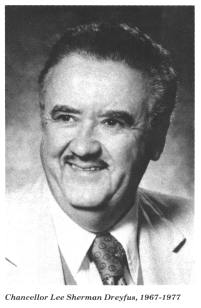
Dr. Lee Sherman Dreyfus, a renowned professor of Speech and Television at the University of Wisconsin-Madison became ninth president in October, 1967.
Until he took office, acting president was Dr. Gordon Haferbecker, Vice President for Academic Affairs.
The waiting University knew that Dr. Dreyfus was a colorful, dynamic personality with a brilliant scholastic record and an unorthodox approach to his new appointment even before the man in the red vest arrived on campus; for his candid appraisal of and approach to his new position, recorded in newspaper interviews, preceded him to Stevens Point.
One of his initial actions was to tour the local beer bars seeking out students so he might meet and talk with them informally before becoming, in their eyes, a member of the Establishment.
The president took to his new challenge with characteristic ebullient enjoyment. He arrived with a well-formulated philosophy for the University, which he has repeated clearly and often.
He believes the purpose of an education today is to help youth find national purpose in our democratic society and to learn ways to make leisure time meaningful. He sees the University as an instrument of change, with its prime role first class undergraduate education.
He has said he thinks universities should do more than provide vocational training and should return to the old liberal arts concept of educating the whole person.
His prediction is that the University will become the dominant educational and cultural influence in Central Wisconsin.
The Ruroplex concept of regional planning for Central Wisconsin devised by Dr. Dreyfus has attracted wide notice as a means for attaining urban advantages while maintaining those of the rural environment through development and sharing of such things as specializations, improved communications and transportation facilities.
His immediate aim was to abandon 19th century processes in 20th century buildings in order to teach those who will be citizens of the 21st century. To this end he encourages utilization of the latest in electronic methods for teacher-student communication. Television is being used more and more extensively throughout the University’s academic operation.
Dr. Dreyfus is "energetic, outspoken and quotable." These are qualities, which in ordinary circumstances might involve any man in controversies.
And no university president today finds himself in ordinary circumstances as those words were understood in the quieter "groves of acadame" a few short years ago.
For across the land, across the world, a spirit of social protest is rampant. The ivy has been ripped from the walls and at times it seems the very walls are coming down.
There is more activism at WSU than ever before. This is due partly to University growth and partly to conditioning, President Dreyfus believes. But involvement is considered preferable to apathy by most in the academic environment. Concerned leaders in many campus groups work consciously to keep communication lines open and in constant use, especially where objectives may seem at variance or unacceptable. The University community has been proud of the spirit of responsibility on the campus.
WSU-Stevens Point has had its share of issues in the last several years. These included the banning of the Students for a Democratic Society and the adoption of a Student Conduct Code by the Board of Regents.
Unresolved as of this writing is another controversy having to do with language used in an underground newspaper edited by some young faculty members. The president raised the issue and asked for a faculty opinion through a relevant committee.
In reference to perhaps just this kind of situation President Dreyfus said in his inaugural,
"These become personal judgments by scholars and professionals who make their judgments we hope on scholarly and professional grounds."
Perhaps it is the asking and seeking for operational answers to just such questions that nourishes the kind of intellectual vitality that seems to permeate Wisconsin State University at Stevens Point today.
An evaluation of this era must await the perspective that the passage of time allows, but facts indicate that the University is fast coming into focus as an important institution of higher, learning. It and its sister Universities now form the fifth largest university system in the country, in full time students, a development that has been termed phenomenal.
In 1968-69, there were 6,830 students enrolled at Stevens Point, with 6,317 of them Wisconsin residents. The College of Letters and Science attracted 3,442 of these; the College of Applied Arts and Sciences, 1,622; the College of Education, 1,267 and the growing infant College of Fine Arts, 329.
Dr. Raymond E. Gotham, Director of Placement, now helps more graduates find positions each year than the entire college enrolled a few years back.
Recent major appointments have included Dr. John Blaise Ellery, Assistant to the president; Dr.
William J. Hanford, Dean of the College of Fine Arts; Dr. Winthrop C. Dif ford, Dean of Graduate Studies and Frederic D. Frederick, first full-time Alumni Director.
The Graduate program is growing fast, though emphasis at WSU will continue to be essentially undergraduate in nature. It is now expected that an enrollment ceiling will be set, perhaps at 11,000. Registrar Gilbert W. Faust’s analysis has the student population peaking at 10,830 in 1979.
The University has offerings in more than 30 subject fields, with others in the planning or approval stage.
Speech Pathology and Audiology became a full-fledged department in 1967.
A major in Forestry in the Department of Natural Resources is new, with the first degree scheduled to be awarded this year.
A Reserve Officers Training Corps unit was established on campus in 1968, with some 300 students enrolled.
A Department of Peace is being explored as possible addition to the curriculum.
Approval has been given for a branch campus ii En gland to be opened next year. Dr. Pauline Isaacson is working out the innovative program detail with the Board of Regents staff. There is much interest in this opportunity.
The Vietnam educational program has continued and expanded. Top Vietnamese educators visited this country for a study in which they were aided by key personnel of the University.
At the request of Vietnamese officials, William B. Vickerstaff, the President’s Special assistant went to South Vietnam in 1968 to help put in operation educational plans for administration, budget, charters and goals for the universities there.
There is in process of formulation a new programs to aid the economically and culturally disadvantaged. This has been named Pride, (Program for Recognizing Individual Determination Through Education.)
The American Indians in northern Wisconsin will be the first to benefit from the program, for the University has already been working with this group in a limited tutorial and Head Start program, taking special interest and responsibility for these people within its region of immediate influence.
Pride will be directed by Robert Powless, an Oneida Indian. His staff plans to expand the program to assist poor rural white children, migrant Mexicans and Negroes. Any Negroes currently enrolled may take advantage of the tutorial or other forms of assistance.
The annual Youth Leadership Workshop sponsored by former Congressman Melvin R. Laird brought to the campus such notables as John Gardner, Esther Peterson and Major General Richard Stilwell.
An expanded Arts and Lecture series under Director Jack Cohan sponsored 25 outstanding artists this school year.
Authorities in many fields of learning were guest lecturers under the sponsorship of various departments and campus organizations.
Underway is a $12.5 million construction program, the largest in any biennium, including two outstanding buildings, which should be ready for use in 1970.
A Fine Arts Building, includes a 350 seat concert hall and a 400 seat theatre for use in the expanding music, art, drama, and dance programs. This building, one of exciting architecture, is shown here on page 24. The $3.9 million structure will include spacious studios and practice rooms, an open sculpture court and an art gallery. The gallery will be named in honor of Edna Carlsten, long time chairman of the art department, now retired. The concert hall will honor the late Peter J. Michelsen, who for many years was the entire music department.
The Learning Resources Center, a $3.4 million facility, will house a book collection of 600,000 volumes and the latest in audio visual and self-instruction materials. The six-story building will have several hundred private study booths, small group study rooms, lounge reading and study areas, a centralized catalogue and open stacks. Here also will be located studios where television programs will be produced for on-campus and area viewing.
Other expansion includes a $1.5 million addition to the present physical education building, a new residence hall to be named for the late Regent John C. Thomson and a second classroom building for the growing programs in home economics and speech pathology.
This is far too brief a summary and far too skeletal a presentation to do justice to the faculty and students who with these nine presidents have made the history of the Wisconsin State University at Stevens Point truly 75 dynamic years.
The University looks now to the future, for which the past has been prologue. Wisconsin State University prepares for the 21st century.