Portage County Historical Society
University of Wisconsin - Stevens Point
James H. Albertson
1962 - 1967
Progress and Tragedy
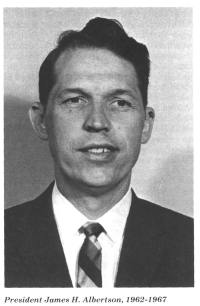
After long, involved screening of 122 applicants, Dr. James H. Albertson was chosen eighth president of WSC.
Dr. Albertson had been executive assistant to the president at Ball State Teachers College at Muncie, Indiana where he played a significant part in that school’s rapid expansion.
This experience was valuable as he assumed the presidency at Stevens Point, July 1, 1962, when a comparable expansion was imminent.
James Albertson, at 36, was the youngest of the 10 WSC presidents. He held B.A. and M.A. degrees from Colorado State College, and the Ed.D. from Stanford University.
This quiet friendly man who stood 6’4" was soon very much at home in the college and the community where his ability as a competent administrator was quickly recognized.
President Albertson had firmly in mind what higher education should do and the part that Wisconsin State College at Stevens Point should play.
"Higher education is unique in that its primary objective is the preservation, the transmission and the advancement of knowledge. True, there are resemblances to economic enterprise, just as there are to religion, government and welfare interests in the operation of our institutions of higher learning. However, higher education is different and unique. In pursuing the objective . . ., higher education is committed to helping individuals develop their talents and competencies in the service of others," he said at his first convocation.
He did not consider students the product of higher education. That product, he thought, was an "environment of learning."
He was interested in improving all that went into that environment and he wanted the college to demand excellence in all areas. The level of that demand or expectancy, he said, rested with the faculty.
He admonished the students to expect excellence.
Very early in his administration he insisted that the faculty define the goals of the educational program, and in his inaugural address called for a reappraisal of the curriculum. He thought the question of what to teach and what to learn was the basic problem facing the college.
A Faculty Long Range Goals committee concentrated on definition of specific goats, which could develop the student as an individual as well as a breadwinner.
As others of the faculty worked at various relevant committee assignments the new president was busy restructuring the faculty and administrative organization, preparing the college for the ever-increasing demands to be made upon it as more and more students entered.
These were stress years. WSU had under 2,500 students when Dr. Albertson came in 1962. During his five year tenure the enrollment passed 5,000, marking a greater growth than in all previous 68 years.
A new Science building and a Classroom center were opened. There were more residence halls, the May M. Roach and the Ernest T. Smith halls, the Bessie May Allen Food center, the Elizabeth Pfiffner DeBot Residence center, and a large addition to the University center. By 1967, architects were working on plans for a Fine Arts building and a Learning Resources center.
With this rapid growth there came problems. Opposition was the price the college had to pay for a unified campus.
There was a great battle over the proposed development of a shopping center in an area where it was felt it would disrupt campus expansion plans.
On the whole, President Albertson was successful in guiding campus expansion.
The role of the Campus School had changed from a facility for practice teaching to one for observation, experimentation and research. Campus schools had been under frequent attack by several governors who called for evaluation of their worth. College officials felt that the new role justified continuance in the Education program.
The School of Fine Arts was created in 1963, separating the departments of art, music, speech and drama from the College of Letters and Science. Dr. Robert Cantrick was its first Dean.
Dr. Gordon Haferbecker was named Vice President for Academic Affairs and Dean of Faculties the same year, a post created "in recognition of Dr. Haferbeckers’s contribution to the college and the state." He had been Dean of Instruction.
The office of Vice President for Business Affairs was created with Milton Sorenson the first to hold that post. Upon his resignation Col. Leon Bell was appointed. Dr. John Yuthas was first Vice President for Student Affairs prior to Dr. William Stielstra. Dr. Frederich Kremple was made Dean of Learning Resources, Orland Radhe, Director of Extended Services, Dr. William Clements, Director of Research and Development and Ray Specht, Director of Campus Planning.
The president held an administrative council breakfast each Tuesday at 7 a.m. for a lively exchange of views. His questions could be sharp and penetrating, and though quiet spoken he could be firm. He expected first rate production from everyone on his staff.
"Gone were the gentle days of six class periods when nobody had a class after 3 p.m. Classes started at 7:45 and ran for ten periods a day with evening sessions." The campus was aswarm with students, and they were beginning to demand a more active voice in policy formation.
In 1963, Congressman Melvin R. Laird (now U.S. Secretary of Defense) came to the campus to meet with some 60 state college presidents, deans and administrators to better acquaint the smaller colleges with federal money programs available for education and research as well as for construction and equipment.
This was the start of a relationship with the Stevens Point campus which culminated in the assignment of a projected multi-million dollar federal water pollution research center to be affiliated with the University at Stevens Point.
On July 1 in 1964, the college became Wisconsin State University-Stevens Point. This was later to be Wisconsin State University at Stevens Point, to emphasize the fact that the school is one in the State University system.
WSU began to think about setting up a Foundation, originally with the thought of borrowing funds to build faculty housing, a project which never developed as that need was met by private builders.
The WSU Foundation had its first meeting in September. Its first directors were Robert S. Lewis, faculty chairman; Warren Kostroski, student body president; Mrs. Elizabeth Pfiffner DeBot, Alumni representative; John C. Thomson, Joseph R. Hartz, Samuel G. Kingston, Hiram D. Anderson, Jr., Carl N. Jacobs, members of the community and President Albertson.
The Foundation’s purpose was to do things for the University that the state could not, to provide "the margin of difference." It has since proved a strong and effective arm for the University under its Executive Secretary William B. Vickerstaff who was also named Assistant to the President.
Governor Warren Knowles named Mrs. Robert R. Williams, a Stevens Point citizen, in August, 1965, to succeed Regent Thomson who declined reappointment because of ill-health.
President Albertson went to the Far East for the first time in 1964 on a study for the American Association of Colleges for Teacher Education and the U.S. State Department’s Agency of International Development (AID). That trip took him to the Philippines.
WSU was looking outward with a sense of worldwide responsibility. President Albertson was chosen to head a team for the first critical study ever made of Vietnamese public higher education, an assignment of import, but also of great tragedy for the University.
On Good Friday, March 24, came the terrible news that President Albertson and his colleagues had been killed in a plane crash on a lonely rain-swept mountain north of Saigon.
The editor of the Stevens Point Daily Journal expressed it so well:
"His death was a tragedy of shocking magnitude. His contributions in the circles in which he moved in his brief span of years already were so tremendous that it staggers the imagination to con template how much more he would have added in the future were he not so suddenly taken from us."
Twice before the college and community had joined to mourn the passing of a president, but this time they gathered in stunned disbelief for a memorial to 41 year old James Albertson who had left them in youthful vigor, his promise unfulfilled. Dean Haferbecker said at the service in the Field-house, "He gave his life for his country." He fought for ideas, with books instead of bullets.
Wisconsin State University and the WSU Foundation were determined that President Albertson’s work should be completed. So Dr. Burdette W. Eagon, Dean of the School of Education, flew to Vietnam to complete the study report. He had been selected previously by President Albertson to head another study in elementary and secondary education. He completed both assignments for AID through a WSU Foundation contract.