Portage County Historical Society
Green Bay & Western Caboose 617
GBW CABOOSE #117 (Originally #617)
By
Don Kottke July 2006
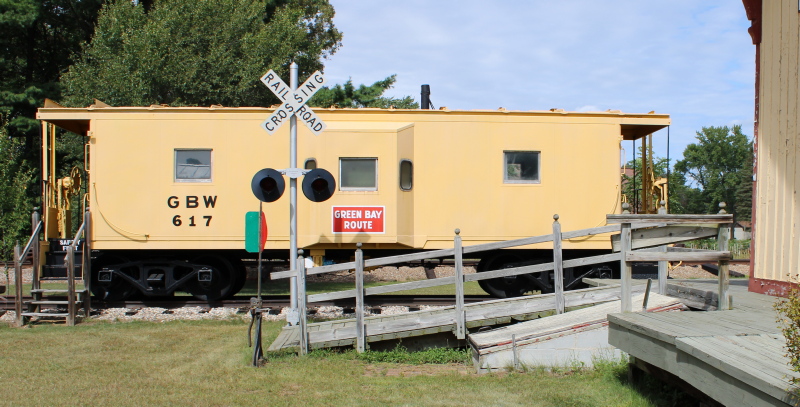
In November of 2001 Ray Konkol was watching trains switching at the WC Yard. Observing from the Copps Warehouse Lot, he spotted the GBW Caboose. The unit was quite dirty and appeared to be on the verge of destruction. It was the GBW Caboose #117. He was entertaining the thought of purchasing it for himself and putting it on his own land. His son, Dale, began calling around to see if this was possible and found it would be "next to impossible". He then contacted Don Kottke to see if the Central Wisconsin Model Railroad Club would be interested in obtaining this caboose.
Don indicated that this could be a strong possibility if it were to be a joint venture with the Portage Count Historical Society. Ray took some pictures and presented them to the CWMR, through Don Kottke, and the Portage County Historical Society’s Board Member, Anton Anday.
In doing some investigative work, Dale Konkol became aware of the fact that two other organizations were also trying to acquire the caboose. The Gopher State Railroad Museum of New Prague, MN wanted it to go with the Green Bay & Western R53 #305 at their site. The Rhinelander Logging Museum also wanted the caboose that would be used to trade for another piece of equipment with the Gopher State Museum.
Apparently, neither the Wisconsin Central nor Canadian National were anxious for either of the two museums to get the caboose; as there had been too much vandalism around Rhinelander when the caboose had been stored until the end of 2001. The Gopher State Museum had no way to get the caboose to their museum.
They were trying to come up with $60,000 to install a turnout so they would have access to a mainline. Dale started his inquiry at Stevens Point’s Customer Service Office. He was eventually directed to Fond du Lac where he contacted Terry Corson. Terry was pleased with the idea of the caboose staying in Central Wisconsin, close to the original GBW mainline in Plover. He instructed Dale to send, directly to him, a Letter of Proposal to acquire the caboose, using Portage County Historical Society Letterhead.
As information was gathered through many phone calls and contacts, the acquisition was awarded to the Portage County Historical Society for placement in Plover’s Heritage Park.
After being notified that the Portage Count Historical Society had been given a Green Bay & Western Bay Window Caboose, everything went "nuts" at the same time.
The Canadian National Railroad was in the process of purchasing the Wisconsin Central at the time. Our ties with the WC were vague, and we needed to know how the caboose would be moved and who would do it.
The following describes how the events evolved.
First, Gordon Trafton, head of the railroad, announced that the PCHS would be the owners of the caboose. The caboose showed up at the Stevens Point Rail Yard. The caboose was to be placed on a track in front of the Depot. Since rail and ties were originally requested from The Central Wisconsin Railroad over a year before the caboose was acquired, it was essential that the CWMR follow up with the WC to obtain these rail and ties.
Don Kottke was not having any success after approaching WC’s, Jim Holzer or Mr. Guthrie at the Wisconsin Central, Engineering Division, in Stevens Point. A letter from Gordon Trafton didn’t seem to budge anyone.
Since WC no longer owned the caboose, Terry Corson notified the Point Yard to get the caboose out of the yard. I believe his contact was probably Jim Holzer.
Don returned to the WC Engineering Office and talked to Jerry Sernau. Mr. Sernau remembered the earlier promise for WC providing rail and ties, however, the railroad was now owned by the CN. Don left a copy of the CWMR communication from Gordon Trafton with Jerry but left feeling there wasn’t much hope that the PCHS would ever see any rail or ties. Of course, without rail and ties, we would not have a place to permanently set the caboose, so timing was of the essence.
The very next day, Carl Whittaker spotted a WC truck loaded with rail and ties headed towards Plover. He and Don Kottke decided to head to the Depot. A pleasant surprise awaited them as everything needed had been delivered. Not only rail and ties were now on site, but tie plates, spikes, rail connectors and bolts. It was evident that Jerry Sernau worked a miracle for us.
We were then told that the caboose would have to be moved in two weeks. A specific date was set - June 7, 2002.
The onus now fell on volunteers to get the rail down. Larry Misiewicz, Fred Haase, Don Kottke and Ross Rossier went to work. Larry used the Village of Plover’s front-end loader to grade the roadbed. The ties were then positioned and leveled. The tie plates were position to accept the rail. Ross obtained a clamp rail gauge and spike hammers. Larry used the front-end loader to lift the heavy rail on to the ties plates. The members began the arduous task of hand-spiking the rail. A few nights later, the rail was laid.
Once Anton Anday had the ballast delivered, the above-mentioned volunteers ballasted the rail. Finally we had a home for the caboose.
The PCHS and Phil Gjevre made the arrangements with Peters Construction and the railroad’s Jim Holzer, to have the caboose moved to the new site.
It was agreed that the caboose would be set out on the spur heading towards Del Monte on Friday evening. It was to be moved before Saturday noon to clear the spur for switching.
Somehow everything came together on Saturday morning. The move began with the help of Peters Construction, Canadian National RR, and Larry, Fred and Don.
Only a few hitches prevented the caboose from being moved quickly. First, the caboose weighed slightly more than expected. Therefore, Peters Construction had to re-rig with heavier cables to accept the 22-ton plus caboose. In order to lift the caboose in its entirety, with one crane, the trucks had to be chained to the body of the caboose. This procedure worked out fine but the trucks could not be set on the rail accurately. Don Kottke began sweating it out, thinking they had laid the rail gauge incorrectly. With the help of the rail crew from the CN, it was determined the chains were holding the trucks slightly askew. It was rectified and the caboose was set in place.
Don Kottke wanted to be able to board the caboose from the existing platform without blocking the view of the depot. Again, the CN crew came to the rescue, and with the winch on their truck they moved and secured the caboose to the desired position.
During the summer of 2003 volunteer work began on cleaning out the caboose interior. Larry Misiewicz ground off four metal plates that had been welded to cover the four side end windows. Don Kottke removed the ten side windows. All had been vandalized. All the glass was smashed. He removed the glass and spent hours buffing the frames.
The process of removing the leather seats, stove, sink, brackets for restoration was completed. The volunteers then began scrubbing and sanding the ceiling, walls, and lockers. Damaged spots were repaired and re-sanded.
By the end of summer 2003 the ceiling was done, sidewalls primed, window frames were ready for glass, and the caboose rewired for 110 lighting and power. The wiring changes were minor thus all the original electrical equipment stayed in tact. It was noted that the generator was missing from the Caboose.
In 2004 the interior painting on the walls and lockers was completed with the help of Jerry Rohlinger and Ray Konkol. Larry Misiewicz sandblasted and repainted the seating hardware, water tank, and various brackets. Don Kottke restored the armrests for the seats. Jerry Rohlinger had the cushions completely reupholstered by Ernie Zywicki.
2005 turned out to be a lot busier than anticipated. The scheduled work was to be entirely on the interior. The floor was redone, and the lockers were repainted with a rust inhibitor. Fred Haase, Phil Gjevre and Don Kottke tore out the old linoleum, put in new floor under-layment. New 12" tile was installed. Jerry and Don Anderson upgraded the painting on the lockers. The lockers turned out a lot better. At this point we thought we had accomplished our goals. The interior of the caboose was to be put on hold until the windows were installed.
Enter - Mr. Anday and Todd Rice of the Paint Company. A system of painting some of the structures in the park was being set up. The caboose was to become the first project.
Problem #1. The Paint Company did not want anything to do with grinding or sandblasting the caboose. However, they would provide the PCHS their power washer for the cleaning.
Problem #2. The volunteers were to help on the inside of the caboose; the PCHS was to take care of the exterior. Don Kottke approached Larry Misiewicz and Fred Haase on their thoughts on preparing the caboose exterior for painting. Duh! You can guess their answer. Work began almost immediately, grinding off rust spots and old welds.
Then the power washing began. The roof went well. We were all looking forward to start cleaning the sides. Since the roof went so well, it was felt the caboose sides would, too. Wrong!
Problem #3. The 3300-psi washer was taking everything off but the grime. With a stroke of really good luck, Chet Biadasz from Beaver Cleaners drove by and stopped. He took one look and to quote him said, "I can help you boys, just have some beer on site Wednesday at 3 p.m."
On Wednesday at 4 p.m., Chet arrived. Larry got the pressure washer; Chet brought what he called the "extra strength laundry detergent". Even with this cleaner it still took two applications with the pressure washer to clear the grime away. The results were great.
The caboose was ready for priming. The Paint Company applied a primary coat of clear Sherwin Williams Macropoxy 920 primer. This was followed up with a second primer, Sherwin Williams Macropoxy 646 using a spray application. The final paint coat was a Safety Yellow #B65Y337 Sherwin Williams High Solids Polyurethane High Gloss.
- The exterior grinding was done June 1-9, 2005
- First wash - June 10-11, 2005
- Second wash June 15, 2005
- Start priming - Jun 17, 2005
- Paint - June 20-25, 2005
At the beginning of July 2005, with the caboose painted, it was ready to have the windows installed.
Problem #4. The original company who agreed to repair the windows for a cost of "materials-only" two years ago had not even started working on them. As of July 12, 2005 the windows are now at Esser Glass.
As for the caboose numbering and reporting marks, the Paint Company recommended we wait least a month for proper curing of the paint. It was hoped that the letter stenciling would be done by the end of 2005.
Before winter, Don Kottke installed the twelve windows. This completed the sealing of the Caboose and made it safe from the elements.
2006 turned out to be a very productive, gratifying year. Since the Portage County Historical Society wanted to dedicate the Caboose on June 10,2006, the only problem would be the "time" element. Since the volunteers usually didn’t begin working until May 15, it only allowed them a limited number of days to complete the task of replacing all the interior paraphernalia.
Since there was this deadline, Larry began immediately, restoring the stove. At the same time Don mounted the seats, brackets, radio and water tank. Fred and Don installed the sink and safety railings. Don installed the stove, with Fred and Larry putting on the final touch, installing stove pipe and door kick plates. The interior was completed by the end of May 2006.
All that was left was the lettering and the Herald. With the remaining time before the dedication, the volunteers were able to fabricate exterior stairs on one end of the caboose. This allows pedestrian traffic to enter on the platform-end and exit via the opposite end of the Caboose.
Modern Signs then appeared with their computer generated letters and Heralds. Bev Clayton, owner of Modem Signs, completed the lettering on June 6,2006, completing this wonderful project
I would like to thank everyone for their valuable time and sometimes-arduous work in completing this great piece of railroad history.
A very special thanks to Larry Misiewicz, Fred Haase, and Anton Anday.
Return to Heritage Park Caboose 617