Portage County Historical Society
St Paul Lutheran Church
A Brief History of
St Paul Lutheran Church
Stevens Point Wi
1872 – 1972
Pastors M. L. Dake and Jerome Wagoner
St. Paul Lutheran Church dates back to October 2, 1872, when 12 families in and around Stevens Point formally organized the church and at their first meeting decided to build a house of Worship. They purchased a site on the corner of Elk and Shaurette Streets.
Their new church was dedicated on July 26, 1874, the same date on which Rev. W. C. Schilling, their first pastor, was ordained. Pastor Schilling was resident pastor from 1874 to 1887, also serving the new congregations at Almond and Amherst during this same period.
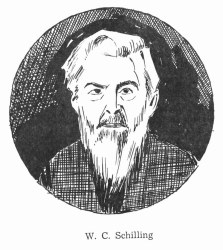
Pastor Schilling also established preaching stations between Stevens Point and Ashland, along the old Wisconsin Central Railway and St. Paul Church may rightly be called the mother church of a number of Lutheran churches in central Wisconsin.
Pastor Schilling passed away in 1927 and is buried in the Forest Cemetery at Stevens Point, following funeral services at St. Paul Church.
Rev. E. Roller was pastor from 1887 to 1895. Under his leadership the church was blessed with continued growth, necessitating enlargement of both the church building and the parsonage.
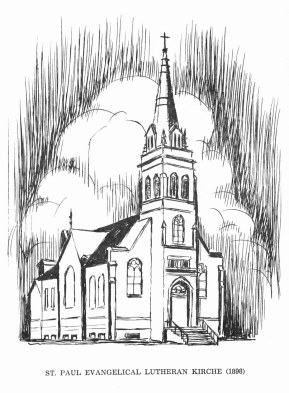
Rev. Carl Schmidt was pastor from 1895 to 1909. Membership increased and in 1897 two lots were purchased for $600 on the corner of Center Avenue (nov Wyatt) and Center Streets. In October of that year, when the congregation celebrated its 25th anniversary, the vital statistics were – 444 souls 260 communicants 52 voting members and the new church was dedicated on the first Sunday in Advent, 1898.
The Rev. B. O. Richter was resident pastor from 1909 to 1915 and the new parsonage, next to the church, was built in 1911.
Many innovations were made by Pastor Richter, such as the introduction of English worship (once a month) in addition to the regular German services; also the installation of our first pipe organ, in the balcony.
The absolute necessity for services in the English language was because some of the young people could not read German, although most of them could speak it, and as a result, they were not attending worship services.
The Rev. E. H. Bertermann served the parish from 1915 to 1919 and in spite of the fact that these were World War I years, the congregation paid off the balance of its indebtedness and became self-supporting.
Of course, costs were considerably less also - the annual report for 1919 carries a number of interesting items, including:
Janitor’s salary -- Fred Foerster Sr $15.00
Wood $108.00
Paid for sawing 2¼ cords of wood $2.25
Organist $47.50
Telephone bill $16.50
Postage $1.00
Received by church dues $696.30
Sunday collections $193.37
The Rev. Rufus Hudtloff was pastor from 1920 to 1931, and came to Stevens Point following service as chaplain of the 127th U.S. Infantry, 32nd Division.
We observed our 50th birthday in 1922 and during Pastor Hudtloff’s regime, many physical improvements were made in the church and parsonage. Pastor Hudtloff was killed when struck by a train on August 20, 1932, having resigned some time previous to that time because of ill health. The funeral service, held at St. Paul Church, included both an English and German sermon. He is buried at Wausau.
Our budget for 1921 was $1,687.00 and the average annual contribution was about $10.00 or $11.00 with one or two exceptions where the (male) member contributed $25.00 for the year.
Some interesting highlights were obtained from Marguerite Schmidt Clausen (now Mrs. Ray Clausen, Wisconsin Rapids) covering the years she was organist at St. Paul, from 1924 to 1932.
The regular organist became ill, and because there was no one to replace her, the job was literally wished onto Marguerite, who was then a freshman in high school. For a while she only used the keys for all her organ playing, but after a year or so, she gradually learned to use the foot pedals, too.
The job was further complicated by the fact that the only German word Marguerite knew was "Amen" but still was required to play for German services. Pastor Hudtloff was fully aware of the fact that if he ever deviated from the book while conducting worship services that his organist would literally be "lost."
Another interesting item was the fact that the organ was hand pumped by the boys in the congregation, who were paid 10 cents per hymn. At times the boys were not too alert - and the organist could not start playing until there was action from the pumpers.
The salary for the organist was $1.00 per service, but for weddings and funerals, very often the organist would receive double her usual pay.
The Rev. W. F. Ludwig was resident pastor from 1931 to 1950. Our 60th anniversary was observed in 1932 and for this occasion, the church had been completely redecorated and a new pipe organ installed.
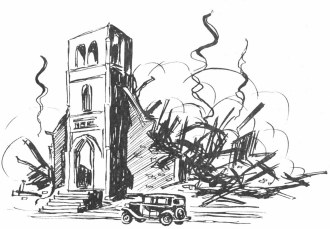
On August 18, 1934, the church was struck by lightning, and totally destroyed. At a congregational meeting held a week later, it was unanimously agreed that we would rebuild on the same site. During the period of construction, church services were conducted in the Lyric Theater, the present location of the Woolworth store.
Dedication of the new church was held on December 15, 1935, about 16 months after the fire.
Many of the windows are memorial gifts from various members of the congregation, as well as altar fixtures, furniture, light fixtures, organ chimes arid the bell. The offering plates were a gift of the confirmation class of 1935.
Some still familiar faces were included in the church officers, finance and building committees for that year—William Henning Jr., Eugene McMiller, Albert Lange and Glen Persike.
Special services were held during August, 1947 honoring Pastor Ludwig who celebrated his 25th anniversary in the ministry.
Pastors M. L. Dake and Jerome Wagoner
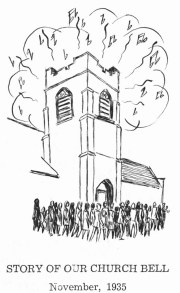
STORY OF OUR CHURCH BELL
November, 1935
I am a 2,000-pound bell made of zinc and bronze and feel I am at least a hundred years old.
I first served in St. Paul’s Lutheran Kirche, Chicago, which I believe was the first Missouri Synod Church in Chicago. The building was near the now-downtown area, and as the city of Chicago grew, this site was desirable for development and expansion, and the property was purchased by the city.
The congregation then bought and moved into what was a former Jewish Temple at 1301 N. LaSalle Street. As there was no belfry they had no further use for me. My condition wasn’t too good, either, the toll hammer was lost and the rope pulley was broken. I was stored in a hallway—there was even talk I was to be sold to a junk man.
Then in 1934, St. Paul Lutheran Church at Stevens Point burned down. A member of that congregation, Mr. A. J. Lange, visited several churches in Chicago, observing various styles of architecture, and saw me idle in the hallway. About a year later, when the Stevens Point church was nearing completion, Mr. Lange came back and bought me. I was transported by train to Stevens Point. Here a new rope pulley and toll hammer were made for me by the Fox Blacksmith and Woodwork Shop. My tone was tested by Pastor Ludwig and given his OK. I was then accepted by the St. Paul Lutheran Congregation as a gift from Mr. and Mrs. Lange.
The building contractor, with the aid of a few church members hoisted me over the top of the tower into the belfry.
Here I am again, happy to serve St. Paul’s - this time at Stevens Point, instead of Chicago. Embossed on my side are the words "St. Paul’s Lutheran Kirche".
The Rev. Herbert P. Wunderlich was pastor from April 1951 to Februarv 1958 and it was while he was our spiritual leader at St. Paul Church that our Christian Day School was organized and built.
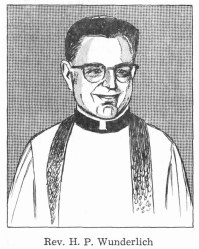
Pastor Wunderlich conducted the services for the laying of the cornet stone of our new school but did not live to see completion of the building. Following heart surgery at Madison, he passed away at University Hospital on February 4, 1958.
"Something new" was introduced in 1955 when our Easter sunrise service at the outdoor theater was held. Five hundred people attended.
Our school was established in the fall of 1955 consisting of grades 1, 2 and 3 with Mr. John M. Roth as teacher, and housed temporally in the church basement.
Following are the names of the 16 charter students:
1st grade - Andy Barge, Larry Behling, Donald Kulesza, Linda Marquard, Thomas Reinke, Danny Ritter, Ronald Sonnenberg, Elizabeth Wunderlich
2nd grade - Richard Gast, John Payne, James Persike, Ted Reinke
3rd grade - Lois Behling, Lawana Marquard, Janis Pavlik, Lynda Ritter.
Ground was broken for the new school in September 1957 and in addressing the members in attendance, Pastor Wunderlich told us that ground breaking "gives a sense of accomplishment and perhaps a little bit of pride. We have worked hard and our work has been blessed."
Dedication services were held May 4, 1958 and that September our school progressed from 4 grades to 8 grades with an enrollment of 90 pupils. Mr. John M. Roth was principal and taught grades 5 through 8, and Miss Joyce Juers taught grades 1 through 4. Mrs. Erv Hanson assisted on a part time basis, teaching reading to the pupils.
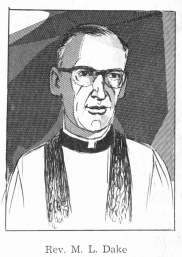
Pastor M. L. Dake has been our pastor since December 1958 which included 9 years as Gamma Delta pastor for WSU-Stevens Point. During June 1969 we were happy to participate in observing his 25th anniversary in the ministry and his 10th year at Stevens Point. Climaxing the festivities, members of the congregation presented Pastor Dake with a new automobile. The 25th wedding anniversary of the Dakes was observed a year later.
"90 Years of Grace" was the theme for our celebration in 1962 and a thanks offering from the members permitted many projects to be completed for the beautifying and improving of the interior of the church including cleaning and painting the walls, new light fixtures, carpeting and a new public address system.
At the time of our 90th Anniversary, we numbered 994 souls.
After many years of acknowledging the need for a new parsonage, we finally built it and moved Pastor Dake and his family into it on November 17, 1968.
Rev. Jerome Wagoner, our associate pastor, joined St. Paul Church during August, 1971, bringing our professional staff to 2 pastors and 4 teachers. A large portion of Pastor Wagoner’s time has been devoted to working with our young people.
1972 also brought an important change in the constitution, reading:
VOTING MEMBERSHIP SHALL BE GRANTED TO ALL
MALE AND FEMALE COMMUNICANT MEMBERS
WHO HAVE REACHED THE AGE OF 18 YEARS.
It is not enough merely to inherit a fortune. In the case of members of St. Paul Church, we have indeed inherited greatly. Through the century, God’s Word has been lovingly passed from one generation to the next. We have inherited the benefits of past members’ labor and planning as far as our church and school are concerned.
Now it is up to us to go on "Sharing Christ" in the next century, and if it be God’s Will, throughout the universe.