Portage County Historical Society
IN THE PROCESS OF TIME
by Malcolm Rosholt
‘And in the process of time it came to pass’ (Genesis 4:3) that a new church was to be dedicated at Rosholt, Wisconsin on Sunday, the Twenty-Seventh Day of August in the Year of Our Lord One Thousand and Nine Hundred and Seventy-Two.
And on the appointed day the congregation of Faith Lutheran Church was gathered to consecrate this house of worship to the glory of God. It was a time for rejoicing and a time of prayer, and an occasion for wonderment at what had been accomplished.
In the process of time this sense of wonderment will fade and even the memory of this dedication service will pass away. Only the purpose will remain unchanged as man continues his eternal quest for peace with God.
The first tangible step looking toward the consummation of this dedication day occurred on Sunday July 5, 1970 when, at the conclusion of worship services held in the one-time Concordia church, members of the congregation and their pastor drove up to the slope of a hill overlooking south Main Street for the ground-breaking ceremonies. It was not altogether necessary to go through the ritual of digging up a spade-full of earth, but it is a symbol and in this instance it seemed to bring closer a dream long cherished in the Lutheran community that one day there would be a new church here. It was also fitting that Pastor Paul O. Monson should have the honor of turning over the first spade-full of earth, since he served as pastor through the difficult period of readjustment to change.
For, like all things of beauty, it was not easy to create, even this new church of God. There were differences; there were doubts and often confusion, but nothing really serious, since this is the fabric of American life which weaves and bends but does not break because men and women in this lovely, lovely land are free to choose, to change their minds, to advocate, yet ultimately to accept the will of the majority. It is the cornerstone of democracy, probably a touchstone of God.
The first hurdle to overcome in the realization of this dream for a new church was the organization of a new congregation which would consolidate three older congregations, namely Concordia at Rosholt, the Norwegian-Danish Evangelical Lutheran at Alban (one mile east of Rosholt), and Christ Lutheran at Galloway in Marathon county. With the strong support of Pastor Vern H. Holtan who came here in 1959, the amalgamation was achieved and the new incorporation legalized April 1, 1961. The name chosen for the new body was "Faith Lutheran." Serving on the first Church Council were Walter Oestreich, President, Eugene Olstad, Vice-President, Vernon Rosholt, Secretary, A.P. Dobbe, Treasurer, Luell Dobbe, Harold P. Anderson and Pastor Holtan.
By now a majority of members of the new congregation were convinced that if they were to continue to attract new members and develop a strong spiritual and economic base, a modern building was imperative. A new building does not guarantee spirituality, but an old one can deaden it, and there is something in the process of time, which requires that man shall change outwardly while preserving inwardly his timeless relation to God.
At a special meeting held June 2, 1968 in Alban church, the congregation discussed the location of a new church and after a spirited meeting, the members agreed on a three-acre site located on the hillside overlooking south Main Street in the Village of Rosholt. This property, owned by A.T. Wolding, was valued at $3,000. After the vote was taken to accept this site, Mr. Wolding announced that he would donate the property to the congregation. With this dramatic announcement, the audience broke into spontaneous applause and in that very applause there was also the assurance of a building.
A building committee was later organized consisting of Harold P. Anderson, Ralph Colrud, Art Doede, Vernon Paulson, and Vernon Rosholt, and at a meeting of the congregation held October 27, Colrud, President of the committee, made a motion, seconded by Doede, that the congregation authorize the building committee to select and engage an architect. Several months later Hofman & Associates of West De Pere showed preliminary plans of a building which would cost $15 per square foot or about $152,000. The vote in favor of this plan was 33 ‘yes’ and 26 ‘no’ with one abstention. The substantial ‘no’ vote reflected perhaps not a disinclination to build, but probably a reticence about going too deeply into debt.
The building committee then considered it advisable to scale down the original cost by eliminating some of the features proposed by the architect, and this reduced the figure to about $132,000. Since that time the cost of interior decorating, furnishings, carpeting, pews, not to mention blacktopping and landscaping have been added to bring the total cost to around $155,000. Faith Lutheran Church Women raised more than $8,400 of this amount towards furnishing the kitchen in addition to clothes racks, window drapes in the dining room and tables and chairs.
The general building fund by 1970 had swelled to nearly $60,000. This amount, together with money borrowed from the State Bank of Rosholt ($30,000) and money loaned by private persons to the congregation ($30,000), brought immediate funds available for building to $120,000. New contributions to the building fund are being added from month to month and it seems possible that the total debt will be liquidated in the next decade or so.
Faith Lutheran has been served in the past decade by four pastors, namely Vern H. Holtan who came in the latter part of 1959 and remained until early 1962 when he resigned to accept the pastorship at Trinity Lutheran in Stevens Point. Pastor Alden Lerhol came in the fall of 1962 and remained until September 1965 when he moved to California. He was followed by Paul O. Monson who remained until the end of December 1970 when he removed to Faribault, Minnesota.
On the recommendation of District President Theodore A. Ohlrogge, the congregation in March 1971 called Emil Docktor, then serving in Bloomer, Wisconsin. He was graduated from Wartburg Seminary, is a navy veteran of World War II, and is married and has four sons.
AN ARCHITECT’S EXPLANATION
The Faith Lutheran Church building accommodates the needs for administrative space and parish meeting rooms, accompanied by suitable changes in room finish and lighting. The narthex provides the primary transition between the outside and administrative offices, parish activity rooms and the church itself. Upon entering the nave, one finds that the congregation envelops the chancel and sacristy. The community rooms are immediately adjacent to the church, can be joined to the church, and are accessible from any part of the building. Finally, the design and materials were chosen for their honest expression of structure and function.
Hofman & Associates
Members of the Church Council elected to serve in 1972 are Bennie Colrud, President, Eugene Olstad, Treasurer and Luell Dobbe, Secretary, in addition to Harlin Jorgensen, Mrs. Vernon Paulson, George Stahl and Pastor Docktor. Mrs. Paulson was President of the Council in 1971, the first woman to serve in this capacity in the first decade of the new congregation and, in fact, the first woman to be elected to an office dominated since pioneer times by men.
Nearly a hundred years of church history in this community antedates the new building of Faith Lutheran. Most of the pioneers who settled the eastern half of the township came here from Norway and Denmark, and a few were second generation Scandinavian-Americans born in Scandinavia and Iola Townships of Waupaca County. Unlike the rolling prairies found in the Fox River valley and in southern Wisconsin, Alban Township of Portage County was heavily forested and as a result it was much more difficult to wrest a living from in the first years. A small clearing was made and a few acres of vegetables planted between the stumps. The main cash crop, however, was not from the land but from nearby lumber camps where the men found work in the woods in winter and in the river drives and sawmills in spring.
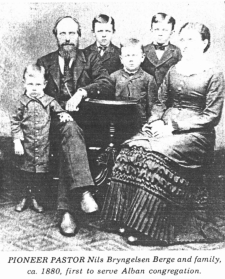
In this formative period of settlement the pioneers of Alban in the 1870s held services in each other’s homes; they sang familiar hymns and read from Martin Luther’s book of sermons or went on foot or by team to New Hope Church to listen to Pastor Nils Bryngelsen Berge. On occasion, Berge drove up to "Town 25" as Alban was referred to before incorporation in 1878, and conducted services in Alban School. On one occasion, at least, he preached in the home of John Furuvold, a pioneer to what was then called the "Tomorrow River Settlement" in the Township of Sharon.
And in the process of time it was decided by the Alban pioneers to organize their own congregation and build a house of God. The date of this decision was April 30, 1878, and since the people were mostly from Norway and Denmark, the new congregation took the name of the Norwegian-Danish Evangelical Lutheran Church, and affiliated with the Norwegian Synod, a synod organized in 1853 in southern Wisconsin.
Later in 1878 work got under way on a church to be located on the southwest corner of the intersection of present Highway 66 and County Trunk A, with a cemetery lot to be located directly back, or west, of the church. Pastor Berge who was to serve Alban as well as New Hope, was paid $5 for an architectural plan, but what he probably provided were the measurements of New Hope Church since the two churches at Alban and New Hope were very similar in design and size.
Up to 1883 Alban congregation was divided into two districts for collection of church dues, and each year a man was appointed to make collections, one for each district. But in 1884 this was expanded to three districts which suggests that the congregation had grown since incorporation in 1878. Subscribing to operating expenses of the church in District No. 1 for 1884 were Andrew Brekke, Ole A. Brekke, Martin N. Bestul, Rasmus A. Brekke, Knut Halverson, John Dobbe, John Larson, Thomas Listul, Ole P. Quisla, Jorgen Olson (Kroken), and Margit Ostenson.
Subscribing to operating expenses in District No. 2 in 1884 were Charles C. Gilbert, Peter O. Dobbe, Jens Ramussen, Hans J. Frederickson, Knut J. Lien, Ole J. Oas, Jens P. Hansen Jr., Hans P. Anderson, Jacob Jensen and Paul Anderson. Free will offerings, mostly a $1 to $4, from this district were made by Bende Rasmussen, Carl V. Rasmussen, Rasmus Jorgenson. Hans Anderson, Charley C. Peterson, A. M. Nelson and Rasmus Jensen.
Subscribing to operating expenses in District No. 3 were Aslak (Ike) Anderson, Olve Ingebretson, Thor Knutson, Ole P. Dobbe, Ole P. Lindland, Knut Erikson, Ingebret Fjelbo, Nils Amundson, Isaac J. Howen, Knut Syvertson, Knut Thorson, Gunder J. Lia and Jens Haroldsen. Free will offerings of a $1 or more came from Ole Halvorson, Mathias Anderson, Hans Hansen, Ole Stenerson, Jorgen Lien, Thor Stenerson, Carl Stenerson, Hans Lien, Ole Lien, Jacob Evenson, John Gilbert and Anton Stenerson.
The Alban congregation affiliated with New Hope as a parish, a parish which later was to include Nelsonville, with the pastor’s residence at New Hope, south of Sunset Lake. The relation of Alban to New Hope continued interrupted until 1920 when circumstances prompted a change and Alban became affiliated with a parish at Rosholt and Galloway.
This leap over the years, however, requires a brief explanation. Ordinarily, there would not have been any need for two Lutheran Churches of the same ethnic background, professing the same tenets of belief, to be built a mile apart, but in the 1880s a split occurred in the Alban congregation, not to mention many other congregations in the Norwegian Synod, over the question of predestination and certain other passages of Scripture. In New Hope and Alban the basic question appeared to be: "Who can pray in a manner pleasing to God?" meaning, of course, who has the correct interpretation of the means to salvation?
Pastor K. O. Eidahl was the resident pastor at New Hope at the time this division arose. He came to the parish in 1883 after Berge resigned on the grounds of ill health. At the time Eidahl took over at New Hope, the congregation was probably the second largest in the entire Norwegian Synod stretching across Wisconsin, Minnesota and Iowa. Thus, any decision made in New Hope was bound to have a strong influence on Alban, and when the majority in New Hope congregation decided to withdraw from the Synod in 1887, it was almost a foregone conclusion that Alban would follow suit, particularly since it was served by the same outspoken pastor.
There was no open confrontation between members of the Alban congregation and its pastor such as occurred in New Hope. The Alban people heard Eidahl’s views on who was teaching the "pure truth" and the majority agreed with him and voted to withdraw from the old Synod, but not from the church building. A minority in the Alban congregation did not agree with Eidahl and voted to remain in the Synod, but were forced, by the logic of numbers, to withdraw from the use of the church building, which they had helped to build.
As a result of this split, the minority party in Alban built a smaller church of their own a few miles to the northeast of the township in Section 15, actually on the hill overlooking Bradley Creek on the east side of present Highway 49. The organizational meeting for the new congregation was held at the home of Andrew Brekke in Section 10 on June 29, 1889 "for those who would hold fast to the old Lutheran teachings ... " The new congregation, calling itself Concordia - which means harmony - was served by O. K. Ramberg, a Synod pastor who served three other Synod churches at Iola, Scandinavia and South New Hope. The parsonage was in Iola.
Meanwhile, a small community was developing in the central part of Alban Township around a sawmill built by John Gilbert Rosholt. On March 2, 1893 the U.S. Post Office Department authorized the opening of a post office to be called "Rosholt." But it was not until a railroad spur was built south from Elderon to Rosholt in the summer of 1903 that the community began to grow much and then it mushroomed overnight.
Since Rosholt, or "J. G." as he was usually called, platted the first addition in the village, he wanted to do all he could to enhance the value of his lots and one of the first steps he took was to encourage the removal of a creamery from Alban corners to Rosholt and Concordia church from Section 15. "J. G." offered to help rebuild the church if the members of the congregation agreed to its removal. Since the church in the country was in need of repairs, and the inducements offered by Rosholt substantial, the members agreed to the removal. The old church in Section 15 was then demolished, some of the joists and studdings were utilized in the new building, and the pulpit and bell brought in. This new church in town, also calling itself Concordia, was ready for worship services by the fall of 1905.
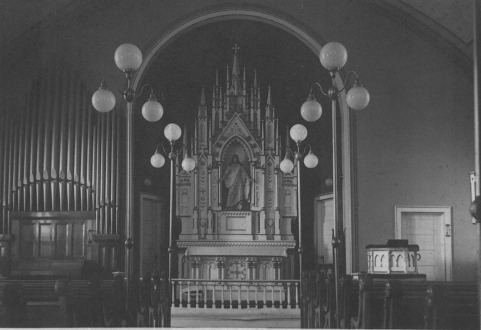
Thus on a Sunday morning it was possible for a person to hear two church bells calling its communicants to worship, both Lutheran bells, but ringing in dissonance. In the process of time the matter was resolved not by the older men in the church who were still intent on their own interpretation of "truth," but by a new generation of Americans of Scandinavian descent who sought to soft-pedal the legalistic interpretation of Scripture and to work for the unification of the old churches. And out of this movement for union developed the Norwegian Evangelical Lutheran Church Synod in 1917 which after more mergers became the American Lutheran Church (ALC) of today.
Between 1887 and 1890 both Alban and New Hope were loosely affiliated with a so-called "Brotherhood" in Wisconsin and out of this a new synod developed in 1890 which came to be called the "United Church," or United Lutheran Church of America. This new synod absorbed several splinter groups and the congregations, which had broken away from the old Norwegian Synod in 1887. Thus when the dialogue was resumed between the several church bodies in the early 1900s looking to a merger of all Scandinavian-Lutheran groups, the main effort of conciliation had to be made towards uniting the "United Church" with the old Norwegian Synod.
Alban congregation had a number of interesting visitors through the 1880s and 1890s. On September 5, 1879 Johannes B. Frich, President of the eastern district of the Synod, visited here. His office was in La Crosse and he was probably on a round of visitation, serving as an early-day ombudsman, as it were. It was a practice of the district president to try to visit each parish at least once in three years, to keep in touch and offer advice. The most common complaint he heard from the members of the congregation was the big budget of the general synod, and the most common complaint he heard from the pastors was the low salary they were getting. Nevertheless, the coming of the visitatar (as he was called in Norwegian) was an occasion of solemnity and he was treated as a distinguished guest during the two or three days he spent in the community.
President Frich spent at least one day here, and when he prepared to leave, he made a notation in the pastor’s journal in which he says he attended services, heard a catechism class, held a short business meeting and found that the congregation was more than pleased with its pastor, N. B. Berge. Frich’s handwriting is almost delicate and one might suspect that in his leisure time he wrote poetry. But he never got back to Alban in the next few years and after 1887 it was too late because the congregation had by then withdrawn from the synod he represented.
Another visitation service was held in Alban on May 9, 1892 by Gjermund Hoyme, the first president of the newly formed "United Church" Synod. Hoyme had been pastor of Grace English Lutheran in Eau Claire for a decade before becoming president of the new synod in 1890. A man only 43 years old when elected, he was considered by many of his contemporaries the greatest preacher-orator of his time and exercised almost a hypnotic influence on his audiences. Oddly enough, not a wisp of legend survives his visit to Alban in 1892.
On August 4, 1898 the Alban congregation honored Pastor Eidahl with a special service on his 25th year in the ministry. Attending pastors included A. L. Dahl from Mt. Morris, Ole Nilsen from Scandinavia, George Sovde from Winchester, and Johan P. Bugge from near Oconto Falls. Bugge had married one of Eidahl’s daughters, Clara, the year before. Ole Nilsen was becoming known as an author and had written at least two books which had a wide appeal among Lutherans of Scandinavian descent. One was called Taale Tangen, the story of a youth in Norway raised by a widowed mother. By her sacrifices and Christian care the boy manages to get an education and goes off to a life at sea before turning to the ministry and a life as a missionary. The late Oscar Hellestad of Scandinavia once told me he was inspired by Taale Tangen to become a missionary to China. The other popular book by Nilsen was called Luthers Liv (The Life of Luther), written for children and young adults, published in 1895. Mr. & Mrs. J. J. Westren of Stevens Point, later of Galloway, gave a copy of the book to their infant daughter, Dagny, "her first Christmas present," according to a notation on the flyleaf of a copy recently acquired.
On August 27, 1899 Eidahl attended the dedication of the new orphans home at Wittenberg, one of the institutions founded by Even J. Homme. Every year there were children’s "festivals" at Alban, and every year there were mission "festivals" with outside speakers and picnics and collections taken for one cause or another even when the congregation was paying interest on a loan for its own operating expenses.
It seemed like the end of an era when Pastor Eidahl handed in his resignation to Alban congregation in the spring of 1904, even as he had already done in New Hope. At a special meeting held April 25 to consider whether to accept his resignation, the first ballot was 16 to 16. A recess was taken over the noon hour and in the meantime some new developments had taken place because when the next ballot was taken, the vote was 25 to accept his resignation and 16 against.
In 1907 a new problem arose in Alban. More and more Scandinavian settlers had been moving into Harrison Township in Waupaca County (across the east range line from Alban in Portage County), and in the horse-and-buggy days these people were somewhat isolated from church affairs. In 1907 plans were being made by people farther to the south in Harrison to build a new Lutheran church, and at first it was assumed that it would be located somewhat in the center of the township. Instead, a site was chosen at Northland in the extreme southwest corner. This was a disappointment to people around Norske who though the people to the south had taken a very uncharitable attitude to the settlers farther north or, as the Norwegian entry in the minutes reads: ikkehavde taget broderlyt hensyn til de nysettlere. The people around Norske now turned to Alban congregation to help them build a chapel and to share a pastor with them. The Alban congregation agreed to help build a chapel. The vote was two against building and the others in favor. The main objection, however, came not from the congregation but from Pastor O. C. Farseth who had succeeded Eidahl in 1904.
After hearing him out, the members elected him chairman of the meeting and Martin Johnson Secretary. Farseth then conducted the meeting with no further interruptions. A motion to build was adopted and the building program got under way in 1908 on land once owned by Reier Leer in the southwest corner of the intersection of present County Trunks NN and P where, in fact, the chapel still stands. If the people around Norske had had any idea how fast things were going to change in the next ten years they would never have gone to the trouble of building because it would be only a few more years before the Model-T would be in Norske.
Harrison Chapel has not been used for worship services for many years but now serves as a social center and meeting place for the Sarah Circle of Faith Lutheran Church Women.
The closing service at Alban church was held Sunday, September 26, 1971 and the closing service at Concordia on Sunday, October 24, 1971, both occasions crowded with sentiment and precious memories. Many of the not-so-old-timers remembered the day they were confirmed here and others the day they were married, or how beautifully Glen Lockery Jr. sang the Lord’s Prayer at Mei-fei Rosholt’s marriage to David Elrick. Sacred objects were ceremoniously carried out and an era concluded. On June 10, 1972 Concordia and the contents in both Concordia and Alban were put on the auction block. The proceeds from the sale of fixtures and kitchen utilities in both churches, plus the sale of Concordia, brought in more than $12,000, which was added to the general building fund of the new church. Alban church was not sold and will probably be demolished.
There was no official closing of Galloway’s Christ Lutheran Church. After 1925 it was easy for the pastor to travel from Rosholt to Galloway by car but the 1920s saw the end of the logging and lumbering industry in Franzen Township and a fast change-over to farming amid the stumps and slashings left behind by the big lumber companies. The Lutheran population was moving away and membership in the church at Galloway continued to decline until finally in the early 1950s there were only a handful still attending services. Mrs. Luell Dobbe recalls that about this time the children of Lutheran families were being driven to Concordia for Sunday School and the parents too began to stay for church services. After Pastor Olaf Olson became pastor of the parish in 1956, he suggested that the people in Galloway discontinue services at Christ Lutheran and come to Alban or Rosholt on alternating Sundays.
Although worship services had been conducted for the Scandinavians-Americans in Franzen Township now and then through the years at private homes or in the Franzen town hall, it was not until 1919 that a movement got under way to organize a congregation. The lead was taken by Louis P. Lund and a meeting called at the town hall on January 5. Carl Nottelson was elected chairman and J. J. Westren, Secretary. J. J. Westren and J. K. Lien were named to a committee to negotiate with either Moore & Galloway Lumber Company or Hatton Lumber Company about getting a piece of land on which to build. The site chosen was a lot adjoining the present Galloway elementary school to the south.
The first service for the newly-organized congregation was probably conducted at the town hall on February 16, 1919 when Pastor C. S. B. Hoel officiated. He had replaced O. K. Ramberg at Iola in 1898. It was probably his last service in Galloway as he was shortly to leave for a new assignment in Minneapolis with the home mission board.
Charter members of the Galloway congregation were the families of James Bestul, Halvor Benson, Andrew Hansen, Swan Johnson, Adolph Erickson, Adolph Wogsland, Gunder Dobbe, Alfred Brekke, Adolph Torgerson, Carl Paulson, John Westren, Lewis Lund, Ole Haroldson, Gustave Nelson, Mynert Colrud, Jorgen Lien, Lars Nerdahl, Elmer Hellestad and Alfred Olson and two bachelors, Oscar Klope and Christian Nelson.
It was decided to call the new congregation the "Norwegian Evangelical Lutheran Church," which shortly thereafter became Christ Lutheran. Ole Haroldson was elected president of the trustees, Westren, Secretary and Carl Paulson. Treasurer.
By April 13, 1919 a motion was passed to build a church in the fall of the year and a campaign was launched for funds. Finally, by August 2, it was determined that the building would be 34 x 50 feet with a "suitable steeple," plus a basement eight feet deep, and exterior in brick veneer.
By December 11, 1919 Pastor Gerhard Peterson was preaching in Galloway. He had replaced Hoel, at least in the Rosholt-Alban-Galloway parish, and would also serve a fourth church at Elderon called Our Savior’s. At this meeting the congregation voted $25 toward the annual rental of the parsonage which had now been purchased for the new pastor of Concordia and Alban at Rosholt. At this meeting the congregation also decided to ask the home mission board of the newly-created synod of the Norwegian Evangelical Lutheran Church at Minneapolis for a loan to help in the building program. It was not until a year later, probably August 29, 1920, that the cornerstone was laid, although the building was not completely finished until several years later.
Pastor Peterson resigned in February 1922 but the Galloway congregation begged him to stay. The same feeling prevailed in Rosholt-Alban and as a result he remained for a while longer but by the fall of 1923 begged to be relieved and his resignation was accepted. He removed to Moscow, Idaho.
Christ Lutheran was formally dedicated on June 10, 1928 and Pastor Peterson returned to participate In the proceedings. Several other pastors were in attendance, including "Rev. Preus," who may have been Ove Preus, then president of the eastern district. The Rosholt Concordia choir "rendered several beautiful song selections" and the Ladies Aid served "a nice lunch during the noon intermission."
The depression hit church organizations everywhere, and Galloway was no exception. In 1936 the congregation was two years behind in its share of rental payments to the Rosholt parsonage.
Pastor Wilfred L. Johnson was called by Concordia-Alban after Peterson left and he then became the pastor for Galloway as well, although Galloway still remained independent. He also served the congregation in Elderon for a short time but not long after Elderon affiliated with a church in Wittenberg. On April 5, 1946 the congregation learned that Pastor Johnson’s health "has failed completely and he is compelled to resign." His resignation was accepted and he was replaced by William L. Anderson, although Anderson’s name does not appear in the Galloway records until he attended the annual meeting on January 25, 1948.
The Ladies Aid Society was the main religious and social organization supporting the church at Galloway throughout its brief history. The women furnished the basement parlor, kitchen, paid for painting and whitewashing, and even helped towards reducing the church debt. It raised money by quite old-fashioned but effective methods. At its meeting on March 10, 1927 "It was decided that the ladies should make another quilt. Each one was asked to make one, or if possible, two blocks." Quilts were still being made in Galloway by the members up to 1934, at least. Now this old craft is being revived by a new generation interested in "crazy quilts."
On October 22, 1927 groups I and III of the Aid Society sponsored a pie social and apron sale at the church basement and heard an illustrated lecture by Thorwald M. Rykken, then pastor of the Bethany Indian Mission at Wittenberg. Total receipts from the pie and lecture were $52.45 of which $2.63 went for buns, 50 cent for dried beef, and $5 for the speaker. Frequent contributions in clothes or money, or as memorials, were made by the society to the Bethany Indian Mission.
On September 11, 1930 the Ladies Aid learned that a $600 loan from the general synod made August 4, 1923 had been satisfied. H. O. Shurson, long-time treasurer of the synod, sent the deed and mortgage.
Mrs. J. J. (Andrea) Westren was the first president of the Ladies Aid Society and continued to serve for seventeen more years before she asked to be retired in 1936. She died in 1940, aged 81, keenly missed by a community who well remembered her many acts of kindness and service.
For many years the Galloway church stood empty and finally it was demolished in 1967 and the lot sold to the Township of Franzen for $300, a sale approved by the newly-created Faith Lutheran congregation on June 5, 1968. The church at Galloway had served its people and its time, but today only memories and a bell remain, and soon there will be only a bell.