Portage County Historical Society
‘Old Waubie’--a friend to settlers
How would you like to be living in Waubakanish, WI 54481?
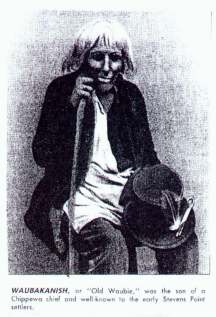
There was a suggestion once that our city be so dubbed in honor of a colorful American Indian "warrior" who became friendly with local residents.
In 1919, when Stevens Point underwent the last of several periodical debates about whether to retain what some called our "backwoods" sounding moniker, an unidentified Pointer wrote to the newspaper suggesting we resurrect the name of our neighbor of yore, Waubakanish, son of a Chippewa chief and grandson of a Potawatomie chief. That’s as far as the idea went.
Since then, "Old Waubie" has faded into history, his name all but forgotten.
A few weeks ago while researching another story, I found the newspaper account recommending use of a "romantic" Indian word to identity our city as opposed to the surname of George Stevens, who only passed through here in his comings and goings to and from an unsuccessful saw mill operation in Wausau.
Waubakanish? I knew the name and remembered my friend Marge Warner’s stories about this man, including her references to his portrait, which used to be displayed in the first public library building downtown.
Old Waubie became well acquainted with the settlers when the native population was rapidly taking flight in deference in new arrivals of more pale-faced folk. That sets him apart in history from many of his contemporaries. In addition, he was surely one of very few members of his generation of Indians in these parts who was photographed.
Nowadays, the portrait, I was pleased to learn, is still in safe keeping almost beneath my nose in the library of the local university. The Portage County Historical Society collection there also includes a precious description of the old Indian by a pioneer who knew Waubie for a quarter century.
The information, giving us a fascinating picture of life as it was once lived here, is included in the diaries of S. A. Sherman, a lumberman who was one of our county’s first white settlers.
Sherman first met Waubakanish in about 1848, when the old warrior claimed to be 120 years old. "He was febble and unable to keep up with the rest of his family in their wanderings through the forests. And as none of the tribes had a permanent location, their home was where night over took them," the diary reports.
In their first meeting, Sherman was making plans to make his first crossing of the Wisconsin River to explore the terrain and natural resources. In checking various sites, he came upon a settlement of several wigwams, which had been set up by the Waubakanish family in the vicinity of the present site of River Pines Living Center.
Waubakanish’s son, Big Papoose was estimated by Sherman to be "between 6 and 7 feet in height, well-built with a large head, black eyes and hair with a feathered band around it." He was hired by Sherman for 25 cents to paddle the lumberman across the river in a birch canoe. The son was reluctant because ice was just breaking up during a spring thaw.
Sherman was probably amazed to encounter Waubie still wandering a decade later, this time near Shantytown. The Anderson and Brown Shingle Mill there attracted the old Indian, who sought warmth, rest and food before a campfire.
Waubie supposedly claimed his family had let him out to die, and was even considering tying him to a tree to hasten the process.
The story infuriated mill operator Anderson, who, in turn, threatened to kill Big Papoose if any harm came to the old man. There was another son and two daughters in the family, as well.
Meanwhile, Waubakanish continued his wanderings for yet another decade. Sherman gives no more information about the family’s support except to report that Big Papoose met a horrible death in Shantytown after drinking kerosene and eating eggs atop a large measure of whiskey. White men were blamed by the diarist for the dastardly trick, and you can bet they never faced criminal prosecution.
It was Waubie’s good fortune to have friends in strategic places. Mr. and Mrs. Robert Maine of Stevens Point were said by the Portage County Gazette to have given him all his clothing and other provisions in later years, and near Shantytown, a settler identified by Sherman as Harm Smith had married a "squaw," and the couple also opened their home to the old Indian.
The last time Waubie was seen alive, according to the diarist, was on July 1, 1871, while returning from the Pike Lake area. On July 7, "two Norwegians found him dead near the big spring and reported it to Dewit Brown, who was camping at the Gilchrist logging shanties on Pike Lake Creek. He (Brown) gave two Potawatomie Indians a quart of Whiskey to bury the body."
Waubakanish was not to rest in peace.
Five years after his death, while Sherman and his son, Eugene, were driving logs over Cedar Rapids on the Plover River, they located a fire pit in a small hallow with a small knoll beside it. After driving stakes and assembling a camp kettle over the fire pit, Eugene sat on the knoll only to discover discomfort from a protruding object.
When he stood up, bones were discovered, some of which were gathered up and tossed in the river. Upon further investigation, Eugene found a coat with buttons still affixed matching the description of what Waubakanish was wearing at the time of his death. The elder Sherman’s response was to split two pieces of cedar and create a grave marker.
It would have been better if no marker ever went up, for news of the find spurred mischief in Stevens Point.
Albert Bentley, identified by Sherman as one of Waubie’s old friends, learned that a Dr. McCulloch in Stevens Point had offered $500 for the Indian’s skull. Knowing others were in pursuit, Bentley reportedly arrived at the grave first, removed the skull and took it to town. Years later, when Bentley tried to reclaim his find for the purpose of sending it to the State Historical Society Museum in Madison, a brother of the doctor, Hugh McCulloch, and business partner congdon, said the skull was stored in the attic of their store on Main Street. However, they refused to give it up. I have been unable to locate any more reference to this macabre dispute or of the disposition of the skull. Could it still be in the store attic?
Some of the Wisconsin Indian history contained in the 1919 Gazette story about changing Stevens Point’s name to Waubakanish is interesting at best, but according to David Wrone of the University of Wisconsin-Stevens Point history faculty, not very accurate.
Reference of Waubie’s incredible age, nonetheless fascinates Dave. While Indians did not measure time in years, he does concede that it was possible Waubakanish lived to very advanced age, which was not uncommon for Indians who had vigorous lifestyles and ate the kinds of natural foods that nurtured good health.
Diarist Sherman referred in his writings to seeing, many scars on Waubakanish’s body when the old man wore little clothing during warm weather. This may confirm some of the references in the Gazette article to the fact this "warrior chief’ had, as a younger man, led some of the Chippewa Indians in the massacre of Fort Dearborn (now Chicago) in 1812.
After this event, the Gazette continued, Waubakanish "became the staunch and trusted friend of the white man and no further depredations were committed upon the earlier settlers." He had apparently lived in these parts from the time of the massacre until his death.
Our local university was recently favored with the arrival of Ben Ramirez Shlwegnnaabi, a Chippewa Indian who is expert in the language of his tribe. What, I asked him, does Waubakanish mean. He first thought it was "someone who is different," for it was thought, according to Marge Warner, that Waubie had a very large head (perhaps one of the reasons for the Stevens Point doctor’s interest in it.) But Ben later decided the real meaning is silver hair. Look at his photo. Was he born with it? An albino?
There’s an epitaph in the Sherman diary. Waubakanish was described as "a harmless person. I never knew or heard of any misdeeds he ever done."
Which brings me to a suggestion. Those of you charged with the responsibility of naming public places, please give thought. That 1919 suggestion still has merit for a street, road, park, or a variety of other facilities except a casino.