Portage County Historical Society
Nobility in Portage County
ARISTOCRATIC CAD OR DASHING NOBLEMAN?
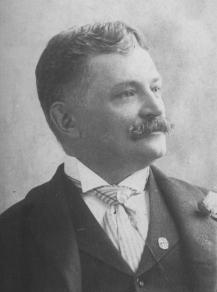
One of the more intriguing but shadowy personalities from the Stevens Point past was a Polish -- born (Poland was then part of the Russian Empire) nobleman by the name of Count Sigismund (Steven) Bielski.
Only the sparsest of details have surfaced about Beilski’s public life. The Count arrived in Stevens Point from Europe (via New York City) in 1876 or 1877. In 1877 he married Anna M. Stenger of Stevens Point. The ceremony was held in Milwaukee. By this time Bielski had stated his intention of becoming a United States citizen. In November 1881 this wish became fact.
Several months before, in April 1881, the Count had traded a business career for politics as he was elected City Marshal of Stevens Point on the Democratic ticket. His majority was 51 votes over his Republican opponent, A. J. Empey.
But all was not well in the Bielski household. In 1882, shortly after his term as City Marshal expired, Bielski summarily departed for Poland without his wife and two children. Ostensibly he left to look after his wealth and property in Poland. Years later, however, in 1896 the Stevens Point Gazette would suggest that the aristocratic Count had tired of his wife and had wearied of his life in Stevens Point. The Count never returned to Point and his wife and children moved to South Dakota to live with Anna’s parents.
What became of Bielski upon his return to Poland remains a mystery. One plausible, but as yet unverified, story is that Bielski was seized by Polish authorities for having deserted the Russian army, tried, and sentenced to Siberia. After serving some time in Siberia he was released when the U.S. government protested such treatment of an American citizen. Bielski then took up residence in New York City. Another story is that the Count was shot and killed while attempting to escape from Siberia.
Although Clio (Clio is pen name of author) has not yet revealed the whole truth about Count Sigismund Bielski he was remembered with fondness by at least some in Stevens Point. To his admirers the Count was “quite a dashing fellow, an ideal foreign nobleman” who “cut quite a swarth while in Stevens Point.”
A photograph of Count Bielski appeared in the Stevens Point Journal (Reach) June 20, 1979.
ROYALTY IN PORTAGE COUNTY
Friederich Emmerich Von Ingwersen was born in Schleswig-Holstein, then a part of Germany. His name was originally, perhaps, “Von Inger”. In 1812, he was apprenticed for seven (7) years to a merchant in Copenhagen, Denmark, where the ‘ sen ‘ was added to his name.
He married Mary Von Belloff (the name may be spelled in various ways such as Belhauf, Bulof, or Bulov). She, reportedly was the daughter of Frederick William III (1770-1840), King of Prussia. Family tradition says she was the “sister of the last King of Prussia” who would have been William I (1797-1888) after which Germany and Prussia become con-federated into the “German Empire”. Supposedly, Mary Von Belloff was disowned because she married “beneath” her position.
The data on F. E. Von Ingwersen came from Clarabel Hunter, (researcher), Haysprings, Nebraska. (Clarabel is an Ingwersen descendant-researcher). Data on Mary Von Belloff Ingwersen comes from Emil Ingwersen’s Civil War Records.
The “Von” on the Ingwersen name seems to have dropped when the family came to America in 1845/47 by sailboat. They left Germany because their oldest son, Frando (or Ferdinant) had already been conscripted into the Prussian-German Army “for the duration of the wars”, which might continue for years.
In crossing the Atlantic Ocean, the voyage took the family five months due to storms. At one time, they were blown off course for nine weeks. One report says the ship which brought them was a “coaler”, having in addition to the crew, 26 passengers.
The elder Ingwersens, apparently, did not wish to have the younger sons conscripted into the army. One can imagine that If Mary had been ”disowned” by her royal family (the Hohenzollerns - they were really something else), feelings in family relationships were not especially warm.
After reaching the U.S., the Ingwersens settled near Scandinavia, Wisconsin. Frederich Emmerich built the first country store at Benson’s Corners. He later sold this and lived out his life on a farm near Arnott. Mary (his wife) died before there were cemeteries in the area; so she was buried in a field under an oak tree. Descendants are currently trying to locate the old farm in hopes that someday a marker may be placed for her.