Portage County Historical Society
Family Vignettes Page 7
taken from the May 19, 1992 Stevens Point Journal
The Johnson Family

Gustave and Augusta (nee Erickson) Johnson came from Sweden around 1880. They were married in Chicago and lived there for two years. Their oldest child, Arthur, was born there. Gustave worked in the steel mills but when his job became insecure, he followed a crew building a railroad. When he reached the Junction City area, he decided it would be a good place to bring his family.
He purchased 40 acres for about $200 with no house on it. So they set to work building a large log house on it, but tragedy struck and their home burned down, so a smaller one had to be built.
Augusta was alone much of the time with the children. Gustave worked in a logging camp, as did most early settlers. They often had Indians for guests. One time a band of Indians came in the early winter and one of the young men was very ill. The Johnson's took care of him and in the spring, when he was well enough to travel, his relatives left an Indian pony for them to repay their kindness and making their son well.
Augusta became a midwife and traveled through the woods and streams helping out when she was needed. She died prematurely from pneumonia, after falling in a creek of cold spring water. She would soon have become a mother again.
After the death of their mother, the children were left in the care of their oldest sister Helma, who herself was but a teenager - her youngest sibling was 3 or 4 years old and six others to look after. Their father was gone much of the time working in the woods to support his family. Much of the responsibility fell on her shoulders to care for the family as best she could. She also worked in the sawmill camp to help support the family as did the older brothers when they were old enough to work.
Seven years later the father died, so the older children had to support the family. Times were very hard, but the family stayed together and became successful farmers and useful citizens. Many of the descendants live around this area and in Minnesota.
The second log house stood for many years on the original farm after the new one was moved in from around the Swamp Inn area. Part of the old foundation can still be found on the farm now owned by a great-grandson, David Erickson, and family in the town of Eau Pleine.
In September 1950, a tornado destroyed all the buildings except the house. Neighbors and friends responded so well that before winter the barn was entirely built.
Submitted by
Marit Erickson
1117 Main St
Junction City
The Kawleski Family
Our grandfather and great-grandfather, Frank Kawlewski/Kawleski, his wife, Frances Surma, and four children, Antone, Michael, William and Pauline, arrived in the United States on June 22, 1881 (111 years ago), leaving family and friends behind in Gulcz, Poland. A half-brother, Mikoloj Gallon, and his family also came to Portage County about that time.
In researching records in Poland, we learned that families suffered many hardships and illnesses (a lot of diphtheria and deaths in childbirth), with no medical supplies, etc. We found the same suffering on the ships coming over also.
The Kawleskis went to Chicago, where Anna and Ella were born. The Stevens Point area was their destination, especially since the land was much like the land in Poland, also along a river. In 1886, the family settled in Junction City, where they farmed and had five more children, Joseph, Peter, Max, Mary and Frank Jr.
Frank and Frances Kawleski acquired two farms, one on River Road and one on Ridge Road in Junction City. The farms are still owned by Kawleski's, namely Louis and Edwin Kawleski. We now have over 1,000 descendants recorded in our genealogy. There are still a lot of descendants living in Portage County, on both sides of the river, and have acquired more property in Portage County, carrying on the Kawleski name.
In the early years, life was simple and a lot of hard word for survival. There was no running water or electricity and money was scarce. Many items were gotten on the barter system. Families worked together and helped each other. Barn raising by family and friends made the job easier. Women made their own soap, churned their own butter, had quilting and husking bees. Mattresses were made from cornhusks or hay, stuffed into ticking or material. Wow, were these noisy! A summer house was a necessity to cook huge amounts of food and for canning and where meat was processed. This kept the main house cooler, where there were no conveniences. When fish were in abundance, the men brought them in for the women to smoke for the winter. Pork was salted in barrels, as this was the only way to preserve the meat. The farmers worked the fields with horses and a lot of work was done by hand in planting and harvesting.
The first automobile accident case was held in Portage County on March 21, 1908, against Dr. Gregory, by Frank Kawleski. The accident occurred on Sunday afternoon, Sept. 1, 1907, when Dr. Gregory’s automobile frightened the Kawleski team and the wagon overturned with Frank, Frances and two daughters and two sons in the wagon, suffering injuries.
For entertainment, we remember barn dances, card parties and the grain threshing was a big event. Weddings were a big family affair.
The children were baptized at St. Casimir’s Church and most were married at the same church. The Kawleski family was instrumental in the construction of St. Casimir’s Church.
The descendants, numbering over 1,000 at present, are planning a family reunion at Iverson Park on July 11, 1992, starting with a family Mass at St. Casimir’s Church.
Submitted by
Agnes Kawleski Galls
Ogdensburg
Jeanne Cyra Tanghe
Livermore, Calif.
The Kluck Family
My childhood was during the 1950s and UC60s. I grew up in the town of Alban, living in the home my grandparents bought in 1916. My parents, Gordon and Joan Larson, three younger sisters, Grandma Halverson who lived with us, and myself spent one afternoon almost every weekend visiting my Grandpa Halverson’s elderly sisters and brothers who lived in the second home my great-grandfather built after immigrating from Norway. My Grandpa Gustav Halverson died Jan. 1, 1953 (11 months before I was born). His family was from Vestre Gausdal, Gudbrandsdalen, Norway. Their home was in one of the most beautiful valleys in Norway, not far from Lillehammer.
Some of my happiest memories as a child are of visiting my great-uncles and aunts in their farm home off highway 49. There, in their living room, I can see my little sisters and myself playing dominoes, viewing the twin scenic cards in the stereopticon and quietly listening to the conversation of the adults that would often lapse into Norwegian. There would be “UFF-TAS” for How Awful!, long drawn out “YAHS” and short “NEIS” for no. My vocabulary consisted of GOD DAG for hello, TUSEN TAKK for many thanks and VEL BEKOMME for you’re welcome. I can still see my Aunts Elise, Emma and Olga standing by the round oak table with claw feet, the surface covered with plates of molasses cookies with white icing, date filled sugar cookies, coffee pot, and jam glasses of milk for the little girls. My aunties would then stretch out their arms to us, smile and say “VAER SA GOD” meaning come and eat. My favorite part of “coffatee” with them was being offered the square sugar lumps and sucking on their sweet-ness as long as possible.
We loved to play at Halversons! We had the run of the tidy farm no longer in use. The red chicken coop, the old gray granary, the summer kitchen later used as a milk house, the barn all became our playhouse. I loved the smell of the granary and would inspect the bottom half, containing the oats fanner, and then climb the steep, open steps to the upper floor, hooting to my siblings out the lone window. We carefully examined Uncle Harold’s skillfully handcrafted carpenter tools but never would have dared play with them. We would run down the small hill to the barn and roam the abandoned interior. First stop was the silo to the right as you entered the barn. We would lean over the cement wall and holler to hear our echoes in that expanse. We would startle the pigeons and they would flutter skyward, leaving their nests at the bottom of the silo. Next we would look for Uncle John’s old two-wheeled handcart and take turns giving rides around the dusty, cobwebbed barn up and down the gutter lanes. We’d play and put our heads through the stanchions, sometimes swinging on them as we got wound up in our fun. We explored the hay mow and climbed over moldering bales of hay to try to catch the wild, stray kittens who hid from these loud strangers. My Dad once counted 21 cats in that barn.
But best of all for me, I liked to hear my aunties talk about the “old country.” From the times I was very young I dreamed of visiting Norway to find these places that were ingrained in old memories. Two large pictures of Vestre Gausdal and the community of Olstad hung on the living room wall of my great-grandparents’ home. I was shown the church which was included on both pictures, where my ancestors were baptized, married and buried. At the age of 14, I began writing the family history down in school notebooks, as I listened to my aunties talk of their birthplace in Scandinavia.
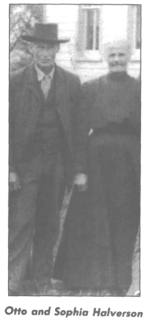
My unmarried Uncles, John and Harold, died before I became a teen-ager so most of my history is from my unmarried Aunts Elise and Emma. My greatest source was historian Aunt Elise who lived to be a happy 103 years old. I learned that her father, Otto Halverson, was born in 1853 (100 years and the exact month later that I would be born in Portage County - the place of his death and burial) to Halvor and Elina. They were poor farmers or cottagers living on a mountainside. Otto was the youngest child and he married Sophia Olstad in 1880 in Gausdal. She was from the neighboring community only a few miles away. Otto lived at the Helleberg farm but as he was Halvor’s son he took the surname of Halverson, while one of his brothers took the name Helleberg. Sophia was Johan and Ingeborg Olsen’s daughter but as they lived at South Olstad farm, she was known as Sophia Johansdatter Olstad. Otto and Sophia had three small children when they decided to emigrate to America in 1887. Sophia’s oldest brother Ole had emigrated to Portage County in 1881, and two of her younger brothers followed in 1882 and 1884. When my great-grandparents left Norway, they took Sophia’s parents and a niece along with their children, Harold, Emma, and infant Elise. I have the sturdy trunk that Otto built for their long journey and lightly carved into the front reads OTTO OLSTAD, AMHERST, PORTAGE CO, WIS., NORTH AMERIKA
Aunt Elise told me that her father used the name Olstad because he was farming at his wife’s place of birth as all her brothers had emigrated to America. My “family” landed at Castle Garden in New York City that summer of 1887 and after arriving in Wisconsin a short time later, took the train to Amherst where Sophia’s cousin Martin Klope (son of the first Norwegian settler in Portage County) met them. He helped them to find land in Alban Township and along with Sophia’s brothers, Ole, Olavus and Guthorm, helped them to adjust to this new world they now lived in.
Otto farmed, and was a well-known carpenter. He built many barns along with son Harold, but he was artistic also and created the curved altar rail at Alban and both New Hope churches. He helped to build Northland Lutheran Church near Iola and churches in Washington State.
Sophia was in the early stages of pregnancy when she left Norway so the long voyage over must have been very uncomfortable for the 32-year-old mother with three children under age 5. She gave birth to three children in the town of Alban between 1888 and 1891, my grandfather Gustav in 1889, named after his mother’s younger brother who conscripted into Norway’s army, died of pneumonia while attending a military school.
The emigrants remained in contact with those left behind. Throughout four generations my family has written to the family of Otto’s older brother, Bernt, who remained in Norway. Bernt disappeared in America after a few letters home.
It was my great joy when in June of 1991 my husband Mark and I traveled to Norway to meet my distant cousins who I had corresponded with for many years. The three weeks we spent traveling throughout southern Norway were very exciting for me as Trond and Nora Kaarfald helped us find several of the farms in Gudbransdal Valley where my ancestors had lived. When we arrived at the church yard that I had viewed on the photographs as a child, I became very choked up with emotion. I was a very strong link past, to the family members who never saw their beloved homeland again.
Testimony to the past lives of Otto and Sophia remain as we sleep in the first bed they bought after arriving in Portage County. When I was 17, my aunts had an auction at the farm and many cherished possessions were scattered at that sad time. The antique dealers and other buyers remained silent when the shy teen-ager hesitatingly bid on the bed frame with 6 foot headboard for $10 as they decided it belonged in the family.
Portage County has been the home of most of my great-grandparents after arrival from Norway and Denmark, including Ole Pederson Daabu and wife Maren (arrival 1870); Jens and Stina Rasmussen (arrival 1868); and Sondre and Mari Olson (arrival 1849). My roots are here now.
Submitted by
Cindy Larson Kluck
1911 North Lane
Custer
The Kollock Family
I am Luella Kollock and I was married to Henry Oswin Kollock on Feb. 25, 1930. Henry’s ancestors fled from France at the time the French Huguenots took over France. The ancestors did not want to live under the Huguenots so fled into Austria and then sailed the ocean and landed in Canada. Some of the Kollocks then went to New Jersey where Shephard Kollock was the first printer there and printed the New Jersey Journal, which was the first New Jersey newspaper. This newspaper contributed significantly to the Patriots’ cause from 1779 to 1783. He also printed the first United States Almanac in the year 1780. Copies of the newspaper were scarce. Any scrap of paper in Revolutionary War time was extremely valuable, as each copy was used and reused to wrap food, to cover cracks in walls and flooring, to stuff cushions and to serve as additional bed covering for soldiers.
During this time, there were two brothers, Simon and Henry, who fought against each other - one for England and the other for George Washington.
After the war, some of the Kollocks then went to Maine, Detroit, Michigan and Waukesha. One of the Kollocks, namely Wellington who came to Buena Vista township to live, died in the tornado of 1863. Then there was George Kollock who was a hotel keeper at Merrill, and a Henry Kollock of Almond township and a Nelson Kollock also of Almond township. These two brothers bought a claim of 320 acres of unsurveyed land. Oxen were used to start breaking this land, which was all wooded.
Henry was married to Permelia Barber, daughter of Chester Barber, on March 20, 1854. Chester Barber was a soldier in the War of 1812. When Henry was married, there were 50 acres of the land under plow and they built a 18-by-24 frame house. They had one son, Shepard. Shepard married Anna Smith and they had two sons, Henry Oswin and Wellington, who died in 1948.
Henry and I lived on the home farm building during the Depression years and times were hard then. We had an egg route in Stevens Point where we delivered eggs, chickens and vegetables each Saturday. We had six children: Kathleen, Alice, Henry James, Patricia, William and Robert.
Relatives on both sides of my family all came from Germany. They heard of America and for religious reasons came to America. They at first settled in Iowa and later came to Almond township. My father’s name was Wittman and my mother’s was Halle. Both families settled on farms in the Almond area. I remember my Grandma Wittman telling me they lived in a log cabin and used wood crates for a table and chairs. My grandfather worked in the Pinery in northern Wisconsin and died from pneumonia when he was very young.
I now have 29 grandchildren and 27 great-grandchildren of which I am so very proud. We all have happy times together and all of us are very happy that our ancestors came to Portage County, Wisconsin.
Submitted by
Luella Kollock
Route 1, Box 108
Bancroft, Wis.