Portage County Historical Society
Family Vignettes Page 6
taken from the May 19, 1992 Stevens Point Journal
The Grothe Family
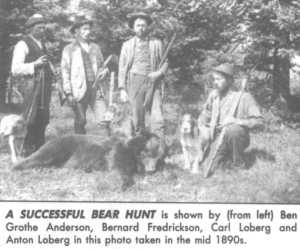
My Grandma Alma’s father’s father also came to Portage County in 1857 to New Hope. This was where her father was born.
Anders Grothe was a blacksmith by trade and supplied a service greatly needed in the community. The farmers came from miles around bringing their plows and other implements to he repaired and their horses to be shod.
He acquired 40 acres from the government and subsequently bought adjoining land until he had 120 acres.
His son Ben took over the farm in 1893. He married my grandma’s mother, Emma Loberg, that year. They had 10 children, one of whom was my Grandma Alma.
This farm is still in the Anderson family as Ben’s granddaughter, Kathleen Theige, and her husband still farm it. This farm has been in the family for 125 years.
Submitted by
Donna Borgen Sowka
725 Michigan Ave.
The Helbach Family
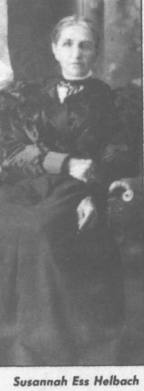
Our family history in Portage County can be traced back seven generations. My father’s family, Helbach, came to this country from Germany in 1847. My great-great-grandfather, Jacob Helbach, came from a small town called Osterspai-am-Rhein. He came to America at the age of 28, settling in Buffalo, N.Y., where he married Susannah Ess. After their marriage in 1847, they made their way to Wisconsin via the Great Lakes, settling in the town of Caledonia in Racine County.
It was about 1857 when they settled in Ellis township and sent for Jacob’s parents and a brother still in Germany. Jacob’s brother Michael remained in Ellis while Jacob and family moved to what was known at the time as “the Buena Vista flats.”
According to Susannah’s obituary in the Portage County Gazette, “when Mr. and Mrs. Helbach came to this county, they were the parents of two little daughters. The trip from Milwaukee was made by ox team and the first winter was spent in a very cold log shanty. Their principal source of livelihood was in making shaved shingles.”
The Helbachs later donated some of their land to St. Martin’s Church in Almond. The church later burned down and was rebuilt across the road. The site of the original church is now the church cemetery where Jacob and Susannah and numerous family members are buried. It is also said that Jacob took his oxen team down to Milwaukee to pick up the altar for the new church.
Jacob and Susannah fanned their homestead along with their 12 children until Susannah’s death in 1913.
My father’s maternal ancestors, Corrigans, came to this country from Ballycastle, County Mayo, Ireland. After arriving in Canada, James Corrigan married Leath Russell and they eventually made their way to Portage County after stops in Michigan, Indiana and Illinois.
James and Leath operated “Corrigan’s Saloon” at the end of Main Street between the years of 1857 and 1871. They moved to Buena Vista and became one of the first parishioners of what is now St. Patrick’s Church in Lanark.
Leath Corrigan’s obituary in 1916 reads that she “was a pioneer in every sense of the word, one to whom the cares of rearing a large family were a sacred obligation. The rigors of life in the new coun-try she met with true Christian firmness and fortitude ... She was the maternal head of one of the largest families in Central Wisconsin"
The Corrigan homestead is located at the corner of Highway 54 and Corrigan Road and has remained in the Corrigan family from 1871 to the present.
My mother’s family, Turzinski, came to Portage County around 1882. Julianna Turzinski Mulin came to America with her two sons, Joseph Turzinski and Alois Mulin. They settled in the Polonia area, apparently coming to this area with the large Polish emigration from Northwestern Poland to the Polonia area. The Turzinskis later settled in Stockton where my grandparents, Paul Turzinski and Helen Kruzicki, became next-door neighbors. Paul and Helen Turzinski eventually settled in Buena Vista where the homestead remains in the Turzinski family.
Because of my family’s strong ties to the Buena Vista/Almond area, the ride on Highway 54 between Plover and Waupaca is a walk down memory lane. I don’t think there is an older building on the way that doesn’t hold some family remembrance; whether it is a family homestead, the home of a great aunt or uncle, or the one room schoolhouse that my parents attended, there is always a history lesson to be learned.
Submitted by
Bonnie H. Helbach
2344A Sims Ave.
The Hickey Family
John E. Hickey was born in Lanark, Wisconsin, the youngest of 10 children, to James and Mary (Hopkins) Hickey, early pioneer farmers. John spent his early life in Lanark. In 1909 he entered the Marine Corps, serving combat in Nicaragua, Central America. His tour of duty included protecting the construction of the Panama Canal. There was no Panamanian Army or Navy, and the defense of the country was, and still is, dependent on the U.S. military based in the Canal Zone. The Panama Canal was completed in 1914. John spent four years in the Marines.
He attended the University of Wisconsin, Madison. There he learned the cheese making business. Returning to Lanark he opened the Lanark Cheese factory. He later built a store and hail adjoining the factory. Neighborhood meetings and social events were held there. In 1926 he sold the factory after 12 years in business, to E. C. Behnke. He then purchased the Custer, Wisconsin, cheese factory from Anton Pejsa, manufacturing cheese there for seven years. The Depression years were very hard on the entire dairy farming industry. He closed the factory when the large cheese corporations competed for the milk products from the local farmers.
In 1934 he became the postmaster of Custer, Wisconsin, succeeding Felix Lukasavage. Florian Banach was the rural mail carrier. John Brunner was the local depot agent for Soo Line Railroad who would pick up and deliver the mail from the train to the post office. At that time the Soo Line did a lot of business in Custer. Next door to the Hickey’s was a row of warehouses and a stockyard. Potatoes, cucumbers and beans were purchased and sold from them. John called Custer the ‘Potato Capital’. He even had the Postal Department make up a cancellation postmark, which was used for one week, commemorating Custer as the Potato Capital. This cancellation was in great demand by stamp collectors everywhere. Needless to say, many had never heard of Custer, Wisconsin.
John and his wife Lillian raised a family of eight children. In 1943 he died of cancer. Lillian succeeded him as the local postmaster, until her untimely death in an automobile accident at the corner of Hwy 10 and County Trunk J, in January of 1962.
Submitted by
Mary Ethel Hickey Liebe 153 Hickory Lane
Coldwater, Mich.
The Jeffers Family
Members of the Jeffers family have been in Wisconsin since they first settled in Racine County in the 1840s. They then moved to the town of Farmington in Waupaca County in 1855.
On Nov. 8, 1858, Truman Jeffers was married to Adeline Severance, daughter of Mr. and Mrs. John Severance. Adeline Severance was the first teacher of what is now known as the Pipe School in the town of Amherst. Truman Jeffers was living on what is now the William Pipe farm in Lanark in 1856. Adeline Severance Jeffers received a wage of $2.00 for a 5½-day week and boarded at home. Eliza Jeffers also taught there for $1.56 per week for four months.
Adolphis Kilby, husband of Ellen Jeffers, a daughter of George Jeffers, had a shoe shop across from the present William Pipe farm.
On Oct. 14, 1881, Julius Jeffers was married to Cordelia Thayer, who was the second teacher at the Pipe School. Family records show a long history of teachers, farmers and lumbermen. The Revolutionary War ancestor of the Jeffers family was a school teacher.
On Nov. 21, 1860, Albert Jeffers was married to Jessie Le Provost in Weyauwega. On Oct. 7, 1861, Albert Jeffers enlisted in Company B, 14th Wisconsin Volunteer Infantry. He participated in battles at Shiloh, Vicksburg, Iuba, Pleasant Hill, Nashville and several other places. He was wounded at Vicksburg. He was discharged at Mobile, Ala., on Oct. 12, 1865. Several of his war letters, pension records and other papers have been kept by the family. After his discharge, he purchased a farm in the townships of Lanark and Amherst, presently owned by Bacon Farms. Albert Jeffers had the first horses in the district in 1870. He also built the first silo in 1903, followed shortly by one built by George N. Jeffers.
Albert and Jessie Jeffers had five children, three girls who taught school. One son, Henry, went into the lumber business, eventually becoming vice president of the Fuller Goodman Lumber Co. Henry married Maine of Stevens Point. George Jeffers, the eldest son, homesteaded in Ontonagon County, Michigan, in 1887. He sold his land claim in 1889 and purchased a farm next to the Albert Jeffers farm.
On April 5, 1894, George Jeffers was married to Margaret Messer. Margaret Messer, according to a Portage County history, was the first grammar teacher at the Amherst High School. George was a breeder of registered Guernsey cattle for many years. They greatly enlarged the home on their farm, making it one of the interesting period homes. George N. Jeffers had the first telephone installed in 1904. The phone is still in the family collection. The George Jeffers were the parents of three children, Agnes, Margaret and George. Margaret continued the family pattern of becoming a teacher for a time.
The current descendant of this family is represented by Charles J. Larson, who grew up on the Jeffers farm and now lives on a neighboring farm in the town of Amherst. Both he and his wife, Aralda Thayer Larson, were teachers. Three of their five children are teachers. Aralda Bell is the elementary librarian in the Tomorrow River Schools, David teaches technology education in Waupaca, Paul teaches agricultural education at Freedom. Their eldest son, Jeffers, is a carpenter and their youngest daughter, Catherine, is a university student majoring in education.
The family traces its roots back to 1634. They came to Massachusetts and shortly thereafter settled in Connecticut. The bulk of the family background had its origins in England - the Jeffers line from Judge Jefferys the “hanging judge of the Tower of London.”
The family history in Portage County spans the time from the early clearing and breaking of the land with horses and oxen to the present. Old notes show the sale of wheat in the 1860's and the depressed prices of the Depression. Our early settlers were a hardy, industrious, patriotic group, who have given us a rich heritage.
Submitted by
Charles Larson
Amherst