Portage County Historical Society
Family Vignettes Page 5
taken from the May 19, 1992 Stevens Point Journal
The Gollon Family
I am Alvine Christensen, grand-daughter of Frank Gollon and Rose Bujarski who were married Nov. 11, 1890, at St. Casmir's Church, town of Hull.
They spent their life here, at 101 DuBay Ave. Both are buried at St. Casmir's cemetery.
Their daughter, my mom, is 90 years old and lives at River Pines Living Center.
My grandfather was a carpenter. He built the house I’m living in and also some around the neighborhood. He also trapped a lot in the winter.
My grandmother was busy with 11 children. Four died in their early years from fever.
I have a copy of their marriage from the church. Only Evelyn Buckel, age 90, and Lucy Moore, 81, California, are alive. All the children were born in this house, even me in 1918, although I lived in Chicago for 27 years, back here for 47 years.
Rose came from Dunkirk, N.Y. I don’t know about Frank or how they met.
They were very poor and had little to eat and not much education for the children, but they all learned to read and write.
Submitted by
Alvine Christensen
101 DuBay Ave.
The Grant Family
William Grant is one of the honored pioneers of Portage County, and the history of life on the frontier is very familiar to him, for he has experienced its hardships and trials, and has borne all the difficulties that come to those who found homes in new and undeveloped regions.
Mr. Grant was born in the parish of Comb St. Nicholas, Somersetshire, England, in 1823, and is the son of William and Margaret (Hayo) Grant, who spent their entire lives in that country, the father following carpentering and also operating his little farm. The subject of this sketch was educated in the schools of his native land. His mother died when he was only 2 years of age, and his father never recovered from her loss. With him William learned the carpenter’s trade, and remained at home until he had attained his majority.
On March 23, 1851, in Somersetshire, at the Comb St. Nicholas Church, Mr. Grant was married to Jane Vickery, who was born Feb. 7,1833, in Bickland, St. Mary’s Parish, Somersetshire.
In April, 1851, Mr. Grant with his bride sailed from Liverpool on the ship “New Brunswick,” which after six weeks and two days reached New York harbor, Rochester, N.Y., being their destination. Through the summer after their arrival, Mr. Grant lay sick with chills and fever, and not until September was he able to do work. His money was almost exhausted and their hardships were many.
At length he engaged in carpentering and painting, and later bought a small tract of land near Rochester, upon which he built a small house. Throughout the week he was obliged to be away from home, and one evening upon his return he said: “I dislike to remain away all week. We will go West where we can get a cheaper home, and I will remain in it.”
Therefore, in the spring of 1854, he left his wife and daughter Emma, now Mrs. C. S. DeVoin of Waupaca, and made his way to Gill’s Landing, Wis., thence to Stevens Point. He afterward went to Portage County and secured work on Fletcher’s tavern, which afterward became Gray’s tavern, and was known far and wide.
Through the summer of 1854, he was there employed, and then worked on Spurr’s Mill in Lanark township of the same county. In October 1854, he was joined by his wife and daughter, and they began housekeeping in a little cabin 12x16 feet, situated on 180 acres of land in Lanark Township, which he had previously pre-empted. He raised a crop of potatoes upon seven acres of ground which he had broken, and in the fall of 1855, he sold this property to Charles Pierce for $1,100, thus laying the foundation for his handsome competence.
In Belmont Township, he secured 160 acres of land, but much of the land had not then come into market, and wild game of all kinds was abundant.
In the early days, Mr. Grant started to the home of his neighbor, who lived two miles away, but lost his way in the forest, and while wandering around almost stepped on a fawn, which shows how plentiful were the deer. He wandered for hours before he found his way out of the woods, and consumed the entire day before reaching his neighbor’s.
On another occasion while they were living in Lanark Township, in a severe rainstorm the roof was blown off their cabin, and Mrs. Grant had to lie in bed, with her child, under an umbrella. Such were the hardships which the pioneers endured.
In August 1870, on a hot sultry day, when Mr. Grant and his son James were in the harvest field, Mrs. Grant started after blueberries, leaving the little ones in the charge of the eldest daughter. While absent, their little son, less than 2 years old, strayed from the house. A search was instituted in which nearly 100 neighbors joined, and after hours of anxious waiting and almost unbearable suspense, the little fellow was found. He had started for the harvest field, but had become lost, and for over a mile he traveled through the thick woods and bushes, but was unhurt, save for a few scratches, and was found on a dry spot just at the edge of a deep creek. The joy of the parents on his recovery can better be imagined than described.
Prompted by patriotic impulses, Mr. Grant responded to the country’s call for troops in February 1864, enlisting at Waupaca in Company D, 42nd Wisconsin Infantry. He went to Madison, thence to Tennessee, where his regiment did guard duty, principally against bushwhackers. He served until September 1865, when he was honorably discharged at Nashville, and then returned to his home in this state. His wife during his absence carried on the farm and provided for her little children.
In his farming operations, Mr. Grant had been quite successful, and had owned much land; also had located several hundred acres for others. He had found in his estimable wife a most faithful companion and helpmate, and to her is due much of their success. While in New York, after working all day at domestic duties, she would sew in the evenings, and frequently made three fine shirts a week, doing all of the sewing by hand.
In 1863, Mr. and Mrs. Grant, with their two children, Emma and James, visited their old home in New York, then sailed on the “Great Eastern” for Liverpool, where they arrived after 12 days spent on the water. They renewed the acquaintances of their childhood, and revisited the scenes in which their youthful days were passed, but were glad to return to their American home. Again they crossed on the “Great Eastern” and this time 13 days were consumed in making the trip. On the 19th of August, 1863, they encountered a terrific gale, a severe and destructive storm which is still mentioned in history.
Mr. and Mrs. Grant were consistent and faithful Christian people, and the Methodist Church in the town of Belmont, near their home, which was built largely through their generosity and instrumentality, is known as Grant’s Church.
Submitted by
Joan Grant Dobbe
Rosholt
The Green Family
Darius E. Green was born Nov. 13, 1835, in Houlton, Maine, according to his family Bible given to him in 1861. Other records show that he was born in New Brunswick. He was the son of James and Mary (Plummer) Green, and was the third child of a family of ten.
At the age of 20 he came to Wisconsin. His first residence was in Dayton Township of Waupaca County where he worked as a farm hand. He later worked as a lumberjack on the river and in the woods. He also worked as an occasional carpenter.
He was married to Effie Garter in 1879. She was the daughter of James Garter and a resident of Portage County. They moved to Belmont Township, Portage County. Seven children were born but only three survived the hardships and diseases of that time. My father, James, his twin sister, Jessie, and one older sister, Ethel, lived and raised families.
Darius died Nov. 8, 1905, when my father was 13 years old. His wife, Effie, continued to farm with hired help. She sold some of the 2,200 acres and purchased a house in Waupaca. Thus my father and his sisters were able to attend Waupaca High School. She later sold and divided the acres between her children. James continued to farm the 200 acres where the original house was built.
My father met my mother when she visited the farm with his sister Jessie. Jessie and my mother, Bertha Darrow, were classmates at Waupaca County Training School for teachers in New London, Wisconsin. To visit her in New London was an extensive trip by horse and buggy.
My parents were married May 25, 1915. My five brothers and one sister and myself were born and raised on the farm in the town of Belmont.
My parents moved off the farm in 1951 and a brother, Laurence, lived on the farm and raised his family. Later he and his family moved to Tucson, Arizona. My mother died in 1960 and my father in 1974.
One brother lives in Waupaca after retiring from farming in Waushara County, one brother lives in Tucson, Ariz., one brother lives in Colorado Springs, Col., one brother is deceased and some of his family live in the Milwaukee area, one brother lives in St. Paul, Minn., my sister lives in Denver, Col., and I live in Stevens Point, Wis.
Submitted by
Ellen (Green) Andrew.
409 Weir Blvd.
Stevens Point
The Groshek Family
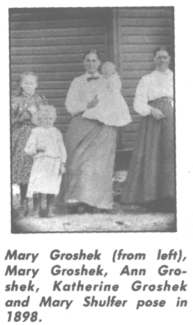
John Groshek was born in Prussian Poland on June 24, 1856. At the age of 9, he came to America with his family. They lived in Buffalo, N.Y., for a year and eventually settled near Princeton, Wisconsin. Here, his parents, Peter Groszczyk (the original Polish spelling of the surname) and Marianna Konek, purchased a 160-acre farm for $600. They both died here in early 1877 from diphtheria.
At 15, John moved to Portage County where he lived the remainder of his life as a farmer.
On Feb. 7,1882, John married Anna Shulfer at Sacred Heart Catholic Church in Polonia. She was the oldest of 11 children born to John Shulfer and Marianna Lorbiecki. Anna was born in the town of Hull on July 10, 1865.
Anna’s father arrived in Baltimore, Md., after leaving his home in Stezyca, Poland, in 1860. Her mother’s family was from Lipusz, Poland, and landed in New York in August 1859. Undoubtedly, they chose to make their home in Portage County because of the availability of land and the hope of a better life. They were among the first of many Polish Immigrants to settle in Portage County due to the similarity in climate to their native land.
After their marriage, John and Anna farmed in the town of Stockton and raised 15 children - 9 sons and 6 daughters. The youngest and only surviving child, Bridget Cieslewicz, 82, now lives in Stevens Point.
On Feb. 9, 1912, Anna died in Stockton. A few years later, John fell from a hay wagon and suffered a head injury. Thereafter, he lived with his daughter in Stockton until his death on August 19, 1942. He was 86. Both he and his wife are buried at St. Mary of Mount Carmel Catholic Church cemetery in Stockton.
John and Anna’s daily life was much the same as most pioneer families whose days were consumed by hard work and the rearing of children. Religion and education were definitely high priorities.
Neither John nor Anna lived to see one of the fruition's of “the American dream.” In 1967, their grandson, Leonard A. Groshek, was elected state representative for Portage County. He served in this position for 12 years.
Submitted by
Raymond L. Groshek and June Groshek Czarnezki
South Milwaukee